
 Ronita Chattopadhyay
I didn’t get to meet B. She was not the protagonist of the story.
This was an assignment on exploring the many lived meanings of reintegration for survivors of trafficking. And I had come to meet a couple – S a trafficking survivor and her husband N who was also B’s husband.
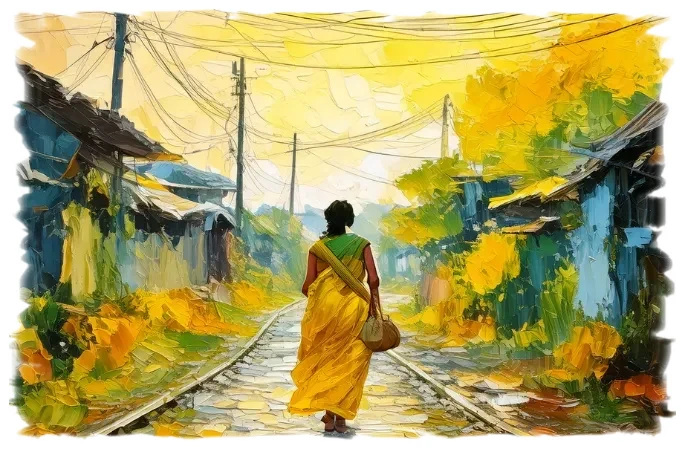
B was not there when I went to their house. I was told that she left early morning every day and returned late at night. She was the main, and often the only, earning member in that family. Her husband had polio as a child. It affected his right leg and restricted his mobility. He also seemed unable to hold on to any kind of work for a long period of time. B, like many other women from her village in South 24 Parganas, travelled to Kolkata daily for paid domestic work.
S and N shared their story. A married older man had fallen in love with a teenage girl and the feelings were reciprocated. S’s family beat her for it. In a sudden fit of anger, she decided to run away from home and that was the beginning of the most harrowing period of her life. She was eventually rescued. She returned to a hostile family and gossiping neighbours. N turned up. S felt that she could not go back to him. N insisted on marrying her. He moved in with her family. Their initial days together were blissful. And then tragedy struck again. They lost their newborn daughter. “She was so fair,” S’s voice trailed off. The two subsequently moved back to N’s house.
“I made a mistake. I was married. But it was love,” N declared. He looked at her and S smiled. Even I could feel it, whatever it was.
I had found myself thinking of B. She would have come home tired and her husband would have informed her about his decision to marry S. Did she have the energy to say something? Did she fight? Did she cry? Had she ever thought of leaving him? What choices did she have?
“He didn’t care what others said about me,” added S admiringly. “It wasn’t easy for you too,” N replied. What about B? I finally asked. “She accepted,” N replied. The community worker also nodded his head.
S and N had a son. S earned her mother-in-law’s blessings. The two sides of the families reconciled fully. Though the demons of the past still haunted her, they no longer controlled her life. She started to step outside the house with more confidence.
How did B feel? She did not have children.
B’s routine remained the same. She continued to make daily trips to Kolkata for work. There was now a child in the family. Expenses were rising.
[Note: This assignment and that visit happened more than a decade ago. But what I saw and thought and felt stayed with me. I remember travelling back that night in an almost empty compartment of a local train with mixed emotions. Life often escapes the neat binaries of black and white and right and wrong. And I thought of courage and the various forms it can take in the messy, incandescent drama of our lives.]