
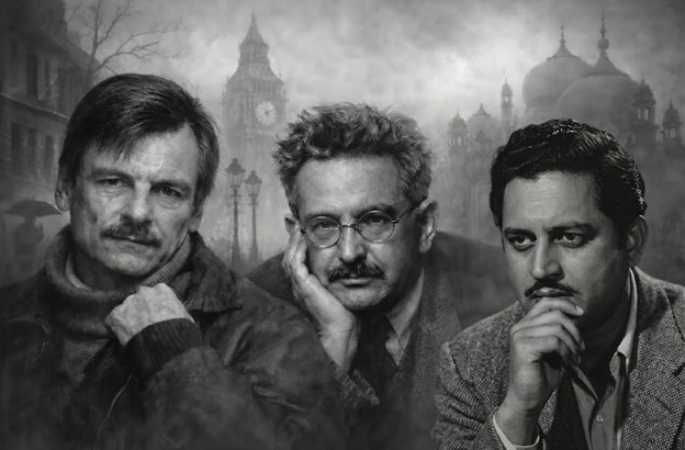
 Swarnavel Eswaran
Shadows of the Saturnine: A Comparative Phenomenology
––Swarnavel Eswaran
Yun toh har shaam ummeedon mein guzar jaati thi,
aaj kuch baat hai jo shaam pe rona aaya.
While every sunset is usually buoyed by hope,
tonight, a certain wordless sorrow makes me mourn the fall of night.
––Lyrics by Shakeel Badayuni (Begum Akhtar’s iconic ghazal; courtesy: Dharampal Agarwal)
Abstract
This essay proposes “cinemelancholy” not as a mood or genre, but as a comparative epistemology of cinematic time. It undertakes an exhaustive examination of “cinemelancholy”—a term deployed here to describe the specific transmutation of the melancholic temperament into a cinematic mode of thinking and perceiving. By tracing the genealogy of melancholy from its Galenic origins through the literary modernism of Charles Baudelaire and the critical theory of Walter Benjamin, this study establishes a theoretical framework for analysing the “black bile” of the moving image. This framework is then applied to the works of distinct yet interconnected cinematic auteurs: Guru Dutt (India), Ritwik Ghatak (India), Andrei Tarkovsky (USSR), and key figures of European Modernism (Antonioni, Angelopoulos, Tarr). Through a comparative analysis of their aesthetic strategies—ranging from the Viraha of Indian poetics to the “Time-Pressure” of Soviet montage theory and the “Temps Mort” of European slow cinema—this essay argues that cinemelancholy is not merely a genre or a mood, but a rigorous epistemological stance. It is a refusal of the “progress” narratives of 20th-century modernity, a deliberate lingering on the ruins of history, and an ethical commitment to the “uncounted” losses of the past.
Introduction: The Architecture of the Shadow
To propose a theory of “cinemelancholy” is to argue for something far more structural than a mere genre of sadness or a prevailing mood of despair. While the term colloquially suggests a cinematic predisposition toward gloom, this study defines cinemelancholy as a rigorous “comparative epistemology of cinematic time”. It is a specific mode of thinking and perceiving that transmutes the ancient, somatic temperament of “black bile” into a modern, mechanical visual strategy. If the defining impulse of 20th-century modernity was the relentless forward march of progress—industrial, political, and narrative—cinemelancholy is the aesthetic technology of refusal. It is the camera’s capacity to linger on the ruins of history, to reject the sanitizing closure of “moving on,” and to construct a temporal space where the ghosts of the past are not exorcised, but granted a permanent, spectral hospitality.
The specificity of this concept lies in its rejection of cinema as a machine of mere movement. While the etymology of cinema (from the Greek kinema) implies motion, cinemelancholy privileges the arrest, the pause, and the decay of movement. It is a “deliberate lingering” that transforms the screen from a window into a mirror of loss. Whether through the “Time-Pressure” of Soviet montage theory, the “Temps Mort” (dead time) of European modernism, or the Viraha (love in separation) of Indian poetics, cinemelancholy functions as a resistance to the commodification of time. It posits that the film strip itself is an archive of durable duration (Doanne, 2002), a physical inscription of the refusal to let the moment pass into oblivion. Unlike the digital stream, which washes away the past in a torrent of the “now,” the melancholic image is an act of preservation.
The film strip serves as an archive of durable duration, a concept that bridges the gap between Henri Bergson’s philosophy of time and the materiality of the cinematic medium. While Bergson (1911/1998) originally critiqued the “cinematographic mechanism” for decomposing the fluid, indivisible flow of durée into a series of static, spatialized snapshots, the physical strip paradoxically becomes the only site where that duration is preserved. By fixing these fragments onto a celluloid substrate, the medium creates what Doane (2002) describes as a mechanical archive of the contingent and the ephemeral. This spatialization of time allows for a “durability” of the past; the film strip does not merely represent a lived moment but physically stores it, permitting the reanimation of a specific, historical duration through the rhythmic motion of the projector.
The Ontology of Refusal: Freud, Benjamin, and the Image
The theoretical provenance of this concept leads us to the wedge between the psychoanalytic definitions of “mourning” and “melancholia.” Following Sigmund Freud’s seminal dichotomy, “mourning” is traditionally viewed as a healthy, economic transaction: the subject tests reality, accepts the loss of the loved object, and withdraws their libido to invest it elsewhere, allowing the ego to become “free and uninhibited again”. Melancholia, conversely, is the pathological refusal to break this attachment. In this state, the subject devours the lost object, allowing, as Freud famously wrote, “the shadow of the object fell upon the ego”.
However, in the context of film theory and the “uncounted” losses of the 20th century, cinemelancholy reclaims this pathology as an ethical strength. It operates on a “melancholic epistemology” which insists that certain losses—the trauma of the Partition of India, the metaphysical void, or the alienating shock of capitalist modernity—should not be “worked through” if that work leads to closure and forgetting. In this framework, the cinematic image becomes the ultimate melancholic object. It is a recording of the very process of life that paradoxically preserves the subject only as a phantom—a play of light and shadow that emphasizes absence even as it simulates presence.
This is in accordance with Walter Benjamin’s diagnosis of the modern condition. If the industrial metropolis bombards the sensorium with “shock” (Choc), disintegrating experience into isolated, lived moments (Erlebnis), cinemelancholy is the attempt to reassemble these fragments into a coherent, if painful, memory. It is a desire to reclaim the “aura”—that unique presence in time and space which Benjamin feared was lost in the age of mechanical reproduction. By lingering on the “fleeting expression of a human face” or the texture of a ruined landscape, the melancholic camera attempts to re-instill a sense of sacred time into the mechanical image. It treats the world not as a resource to be consumed by the narrative, but as a Trauerspiel (Mourning Play), where history is observed as a process of “irresistible decay” rather than eternal life.
The Spectrum of Shadows: A Global Resonance
Cinemelancholy is not a monolith; it is a “spectrum of responses” to the crisis of modernity. As this study will demonstrate, it manifests through distinct “modes” that traverse cultural and geographical boundaries:
- The Romantic Mode: Seen in the works of Guru Dutt, this mode synthesizes Baudelairean spleen with the Indian aesthetic of Viraha. It focuses on the alienation of the individual artist in a commodified society, using high-contrast lighting and “auratic” isolation to depict the poet as an urban outcast.
- The Historical Mode, exemplified by Ritwik Ghatak and Theo Angelopoulos, addresses collective trauma. It uses the “Epic” style and the “sequence shot” to confront the ruins of the nation-state (post-Partition India, post-war Greece). Here, the camera acts as the “Angel of History,” gazing at the pile of debris left by the storm of progress.
- The Ontological Mode: Found in the cinema of Andrei Tarkovsky and Béla Tarr, this mode elevates melancholy to a cosmic principle. Through “Time-Pressure” and the “long take,” it forces the viewer to endure the sheer weight of existence. It is a spiritual or material heaviness—a return of the “black bile” to the earth itself.
Why Cinemelancholy Resonates Now
The urgency of this theorization in the present moment cannot be overstated. We currently inhabit a cultural landscape defined by what Mark Fisher, drawing on Franco Berardi, called the “slow cancellation of the future” (Fisher, 2014). Fisher’s diagnosis revives Jacques Derrida’s concept of “hauntology” (hantologie)—a pun on ontology which insists that existence is never fully present to itself, but is always disjoined, or “out of joint,” by the visitation of the past (Derrida, 1994). In this condition of spectral inertia, the present is haunted by modernisms that failed to materialize, and the digital image has become ephemeral and disposable. Time is atomized into a series of point-like presents, devoid of narrative tension or historical depth. The “shock” that Benjamin identified in the 19th-century city has metastasized into the 24-hour news cycle and the algorithmic feed, eroding our capacity for deep temporal engagement.
In this context, cinemelancholy offers a radical counter-temporality. It resonates today because it validates the feeling of being “out of joint” with contemporary time. As we face global crises—ecological collapse, political fragmentation, and the displacement of millions—the “progress narratives” of the 20th century ring increasingly hollow. We are surrounded by the “uncounted losses” of history, and the dominant visual culture often encourages a quick scrolling past, a digital “mourning” that is instant, transient, and ultimately amnesiac.
Cinemelancholy demands the opposite. It demands that we stop and look. It insists that the “work of mourning” may never be completed, and that this incompleteness is an ethical imperative. By refusing to cut away from the suffering face, the ruined landscape, or the empty room, cinemelancholy creates a space for memory and ethics. It transforms the screen into a mirror where the spectator can confront their own reflection in the glass of time, as in a Tarkovsky film. In an age of exhausted futures, cinemelancholy is an act of defiance—a commitment to the belief that what is lost remains, in some spectral form, essential to who we are.
The Genealogy of Grief: From Humors to Heuristics
To articulate a theory of cinemelancholy, one must first traverse the long and shadowed history of the concept itself. Melancholy is perhaps the most resilient of human temperaments, surviving the transition from ancient physiology to medieval theology, and finally to modern psychology and aesthetics. Its persistence suggests that it addresses a fundamental fissure in the human experience: the awareness of time’s passage and the inadequacy of the material world to satisfy the soul’s deepest yearnings (Klibansky et al., 1964).
The Physiognomy of Black Bile
The term originates from the Greek melaina kole (black bile), identifying one of the four cardinal humors in the medical systems of Hippocrates and Galen. Within this humoral framework, the human body was a microcosm of the elemental world; health was a balance (eukrasia), and illness a disturbance (dyskrasia). An excess of black bile—cold and dry, associated with the earth—manifested as “melancholia,” a condition characterized by “fear and sadness that lasts for a long period” (Klibansky et al., 1964).
This ancient definition was not merely psychological; it was somatic and cosmological. The melancholic was bound to the earth, heavy, sluggish, and prone to silence. Yet, even in antiquity, there was an ambivalence. The pseudo-Aristotelian Problemata XXX, 1 famously asked, “Why is it that all those who have become eminent in philosophy or politics or poetry or the arts are clearly melancholics?” (Aristotle, 1927/1957). This question planted the seed for the transformation of melancholy from a curse into a mark of distinction.
The Saturnine Turn: Renaissance to Romanticism
The Renaissance catalyzed this shift. Marsilio Ficino, in his De Vita Libri Tres (1489), reinterpreted the melancholic temperament through Neoplatonic astrology. He associated it with Saturn, the highest and slowest planet, and thus with the capacity for deep contemplation, intellectual genius, and “privileged piety” (Ficino, 1489/1989; Dixon, 2009). Melancholy became the burden of the scholar and the artist—a necessary suffering for the attainment of higher truth. Albrecht Dürer’s engraving Melencolia I (1514) serves as the visual manifesto of this era: a brooding, winged genius surrounded by the tools of geometry and measurement, paralyzed not by stupidity, but by the overwhelming complexity of knowledge (Klibansky et al., 1964).
By the time we reach the Romantic era, this “Saturnine” quality had morphed into a fashionable cultural pose, particularly in England and Germany. However, it was the advent of modernity—industrialization, urbanization, and the rise of capitalism—that fundamentally altered the texture of melancholy. It ceased to be merely a solitary affliction and became a social condition. This brings us to the pivotal distinction made by Sigmund Freud in his seminal essay “Mourning and Melancholia” (1917). While Freud sought to map the internal mechanics of the grieving mind, the philosophers of the preceding century had already begun to frame this persistent sorrow not as a clinical malfunction, but as an inescapable confrontation with the void of existence itself.
Schopenhauer and Kierkegaard: The Will, Despair, and the Aesthetic Stage
Two philosophical traditions of the 19th century are particularly indispensable to the pre-history of cinemelancholy: the pessimist metaphysics of Arthur Schopenhauer and the existential phenomenology of Søren Kierkegaard. In The World as Will and Representation (1818), Schopenhauer argues that the world as we experience it is fundamentally the expression of an irrational, insatiable “Will”—a blind striving that underlies all phenomena. Human consciousness, trapped in this cycle of desire-satisfaction-renewed desire, is condemned to a pendulum swing between suffering and boredom: we suffer when we lack what we desire and are bored when we obtain it (Schopenhauer, 1818/1969). This metaphysical structure—the impossibility of permanent satisfaction, the essential futility of striving—is the philosophical bedrock of the melancholic temperament.
Crucially for cinemelancholy, Schopenhauer argues that aesthetic contemplation—and above all, music—offers the only genuine, if temporary, release from the tyranny of the Will. In the aesthetic state, the subject becomes a “pure, will-less subject of knowledge”: she ceases to be a desiring individual and becomes the “clear mirror of the object instead.” This aesthetic suspension of the Will is structurally analogous to the “long take” in cinemelancholy: both constitute a deliberate arrest of purposive striving. The melancholic film does not advance a goal; it contemplates. It transforms the viewer from a subject of narrative desire into a subject of pure, suffering perception—temporarily released from the forward drive of the plot and of life itself, but at the cost of intensifying an awareness of existence’s fundamental sadness (Schopenhauer, 1818/1969).
Kierkegaard’s contribution is of a different, but complementary, order. In Either/Or (1843), Kierkegaard maps existence onto three “stages”: the aesthetic, the ethical, and the religious. The figure of the aesthete—most memorably embodied in the persona of “A” in Volume One—is essentially a melancholic: one who pursues sensory experience, beauty, and the immediate moment but is haunted by the awareness that every pleasure slides into boredom and every beauty into decay. Kierkegaard identifies this as “the rotation method”: the aesthete perpetually changes the object of experience in order to evade the crushing tedium that follows satiety. Yet this rotation is itself a kind of despair—a refusal to commit, to choose, to assume the weight of ethical existence (Kierkegaard, 1843/1987).
The significance of this for cinemelancholy is profound. The melancholic filmmakers of this study can be read, in Kierkegaardian terms, as aesthetes who have arrested themselves at the aesthetic stage—not out of hedonism, but out of a deep, principled refusal to accept the ethical world’s demand for closure, forgiveness, and “moving on.” In The Sickness unto Death (1849), Kierkegaard diagnoses “despair” as the fundamental condition of not willing to be oneself—a misalignment between what one is and what one wills oneself to be. The melancholic auteur’s despair is precisely this: the awareness that the world as it is (commodified, amnesiac, progress-obsessed) is not the world as it ought to be, and the refusal—heroic in its tragic stubbornness—to reconcile the two. The cinema of Dutt, Ghatak, and Tarkovsky is, in this sense, a cinema of Kierkegaardian despair: it insists on the wound because it refuses the false comfort of a world that would heal the wound by forgetting what caused it (Kierkegaard, 1849/1980).
Freud’s Dichotomy: The Ethics of Refusal
Freud famously distinguished between “mourning” (Trauer) and “melancholia” (Melancholie). Mourning, he argued, is a healthy, finite process. When a subject loses a loved object, “reality-testing” eventually reveals that the object is gone. The libido creates a temporary opposition to this reality but ultimately accepts it, detaching from the lost object so that the ego can become “free and uninhibited again” (Freud, 1917). Mourning has an endpoint; it is a successful transaction with loss.
Melancholia, in Freud’s view, is pathological. The subject refuses to break the attachment. Instead of displacing the libido onto a new object, the melancholic withdraws it into the ego, identifying with the lost object to the point of “devouring” it. “The shadow of the object fell upon the ego,” Freud writes, and the ego becomes critical of itself, treating itself as the abandoned object (Freud, 1917).
Cinemelancholy, then, emerges as a technology of this refusal. Cinema, as a medium, is uniquely suited to this task. It is a recording of the very process of life (Tarkovsky, 1987), preserving time in a way that painting or literature cannot. Yet, it preserves it only as a phantom—a play of light and shadow that emphasizes absence even as it simulates presence. The film strip is, in essence, a ribbon of preserved time, a physical manifestation of the melancholic’s refusal to let the moment pass into oblivion.
Kristeva and the Black Sun: Melancholy as the Originary Wound
Julia Kristeva’s landmark study Black Sun: Depression and Melancholia (1989) represents one of the most searching post-Freudian philosophies of the melancholic condition and constitutes an indispensable supplement to the psychoanalytic foundation of cinemelancholy. For Kristeva, melancholia is not merely a response to the loss of an object but a pre-linguistic wound—what she terms the “Thing” (la Chose). Unlike Freud’s lost “object,” which is representable and ultimately replaceable, Kristeva’s Thing is the originary, inarticulable “real” that the melancholic mourns before language has even furnished a name for it. The melancholic does not simply miss someone or something; they are in the grip of a fundamental impossibility of representation (Kristeva, 1989).
This is of profound significance for film theory. Kristeva argues that artistic creation—and particularly the arts of vision and music—offers the only viable “counterdepressant” to the gravitational pull of the Thing. The aesthetic work does not cure the wound; it performs it. It “semiotizes” the pre-verbal devastation, giving shape and duration to what would otherwise remain a mute, disfiguring interior silence. In this light, cinemelancholy is precisely such a sublimation: the long take is not a representation of sadness but a physical enactment of the melancholic’s temporal experience—the feeling that time has congealed, that the wound is not historical but constitutive of being itself. The image does not depict the Thing; it offers the Thing a habitable, if provisional, dwelling (Kristeva, 1989). The camera’s gaze, arrested before a ruined landscape or a grief-stricken face, is the artistic act that transforms the unspeakable into the visible without resolving it into meaning.
Furthermore, Kristeva identifies a crucial linguistic dimension to melancholia that has direct implications for the aesthetics of silence in cinemelancholy. The depressive, she observes, speaks a language that is monotonous, repetitive, and sometimes mute. This is not mere failure of communication but a deliberate, if involuntary, retreat from the symbolic order—from the regime of signs and exchange that constitutes normal social life. In translating this insight to film form, one can understand the deliberate flatness of dialogue in Tarkovsky, the repetitive circular structures of Tarr’s narratives, and the prolonged silences of Antonioni’s couples not as aesthetic affectation but as a formal homology with the structure of melancholic speech itself. The syntax of these films is a melancholic syntax: recursive, resistant to climax, indifferent to the exchange economy of classical narrative (Kristeva, 1989).
Agamben’s Stanzas: The Phantasm and the Melancholic’s Impossible Possession
Giorgio Agamben’s Stanzas: Word and Phantasm in Western Culture (1977) offers a philosophical archaeology of melancholy that moves beyond the clinical framework of Freud and into the territory of medieval optics, Renaissance poetics, and the philosophy of desire. For Agamben, the melancholic occupies a uniquely paradoxical structure of desire: she is one who has succeeded in appropriating an object only by making it unappropriable. The melancholic, in a counter-intuitive maneuver, simulates the loss of an object she has never actually possessed in order to claim possession of it as a lost thing. The phantasm—the internal image of the desired object, which medieval thinkers like Avicenna understood as occupying the “spiritus phantasticus,” the intermediary realm between body and soul—becomes a prisoner of the melancholic’s imagination (Agamben, 1993).
This Agambenian framework illuminates a dimension of cinemelancholy that is otherwise difficult to articulate: the paradoxical “joy” of the melancholic image. The cinema of Guru Dutt, for instance, does not simply depict sadness about a lost India or a lost love; it conjures the phantasm of a perfection that perhaps never existed—a pre-modern, pre-commodified world of pure artistic devotion—in order to mourn it the more intensely. The image, in Dutt’s cinema, is a phantasmatic construction: it does not record what was, but performs the desire for what could never be. This is why Dutt’s films feel simultaneously like laments and like celebrations—because the melancholic, for Agamben, achieves the most intimate and total possession of the object by ensuring it can only ever be possessed as an absence, as a shadow, as a beam of light falling through dust (Agamben, 1993). The cinematic image thus becomes the ultimate realization of the melancholic’s phantasm: the world preserved in its most beautiful, most lost form.
Heidegger’s Stimmung: Attunement, Thrownness, and the Ground of Melancholic Being
Martin Heidegger’s philosophy of being-in-the-world provides a further ontological grounding for the experience that cinemelancholy enacts. In Being and Time (1927), Heidegger introduces the concept of Stimmung—variously translated as “mood,” “attunement,” or “disposition”—as a fundamental structure of Dasein (human existence). For Heidegger, a Stimmung is not a psychological state that arises inside a subject who then projects it onto the world. Rather, it is an ontological opening: the way in which the world first discloses itself to us, the “how” of being-there before any act of cognition or representation (Heidegger, 1927/1962). We are always already in a mood; mood is the primordial condition of our being-in-the-world.
Heidegger singles out Angst (anxiety) and, more subtly, profound boredom (tiefe Langeweile) as “fundamental attunements” that disclose the deepest features of existence: our radical “thrownness” (Geworfenheit)—the bare fact that we exist without having chosen to—and our ownmost possibility of death. In this framework, melancholy can be understood as a mode of profound Stimmung that discloses what the busy, optimistic moods of everyday das Man (the anonymous “they-self” of social conformity) perpetually conceal: the contingency, finitude, and groundlessness of existence. Where the “they-self” rushes forward in distraction, the melancholic is held in the gravity of what is (Heidegger, 1927/1962). This is the Heideggerian resonance of the long take: the cinematic refusal to cut—to distract, to “move on”—is a formal enactment of the melancholic Stimmung as a mode of authentic disclosure.
Furthermore, Heidegger’s analysis of “Care” (Sorge) as the fundamental structure of Dasein—the unity of thrownness (always already being situated), projection (being towards one’s possibilities), and fallenness (absorption in the world)—maps strikingly onto the temporal structure of cinemelancholy. The melancholic film is characteristically one of arrested projection: the character is unable to move toward their future possibilities because they are overwhelmed by the burden of the past into which they have been thrown. Tarkovsky’s Stalker cannot enter the Room; Antonioni’s protagonists cannot connect; Ghatak’s Nita cannot transcend the refugee colony. Their “Care” is a Care without futurity—a being-towards-the-past rather than a being-towards-death. In this, these films do not merely represent melancholy; they constitute a phenomenological investigation into the temporal structure of finite human existence (Heidegger, 1927/1962).
The Flâneur and the Spleen of Modernity: Baudelaire and Benjamin
The intellectual bridge between the literary melancholy of the 19th century and the cinematic gaze of the 20th is constructed on the cobblestones of Paris. It is here that Charles Baudelaire articulated the condition of Spleen, and where Walter Benjamin later identified the flâneur as the prototype of the modern spectator and filmmaker.
Baudelaire’s Spleen: The Corpse of Time
For Baudelaire, the poet of high capitalism, melancholy was the fundamental atmosphere of the modern city. In Les Fleurs du mal, particularly the section “Spleen and Ideal,” he describes a state of existential oppression where “the earth changes into a damp dungeon” and “Hope, like a bat, beats its wings against the walls” (Baudelaire, 1857/1982). This Spleen is not just sadness; it is the internalization of the city’s decay and the crushing weight of a time that no longer flows but accumulates like debris.
Benjamin, analysing Baudelaire, argues that this poetry is a defensive response to the “shock” (Choc) of modern life. The industrial metropolis bombards the human sensorium with rapid, disjointed stimuli—the traffic, the crowds, the noise. In this environment, the traditional capacity to assimilate experience into a coherent narrative (Erfahrung) breaks down. It is replaced by Erlebnis—the isolated, lived moment that fails to integrate into memory (Benjamin, 1968c). Spleen is the emotional residue of this disintegration; it is the feeling of being trapped in a “now” that is devoid of history yet heavy with the wreckage of the past.
The Flâneur: Botanizing on the Asphalt
Central to Benjamin’s analysis is the figure of the flâneur—the gentleman stroller who wanders the arcades of Paris, observing the crowd while remaining detached from it. The flâneur treats the city as a landscape, “botanizing on the asphalt,” collecting images and impressions (Benjamin, 1999). Benjamin draws a direct evolutionary line from the flâneur to the photographer and the filmmaker.
Like the camera lens, the flâneur is an “eye” that moves through space, framing reality without intervening. The flâneur’s gaze is mobile, predatory, and collecting. However, there is a crucial difference. The flâneur of the 19th century maintained a semblance of individual agency and subjective memory. The 20th-century camera, according to Benjamin’s “The Work of Art in the Age of Mechanical Reproduction,” strips the object of its “aura”—its unique presence in time and space (Benjamin, 1968a).
The transition from the flâneur to the cinema spectator is a transition from the “auratic” experience to the “shock” experience. Yet, Benjamin notes that the “cult value of the image finds its last refuge” in early photography, particularly in the “fleeting expression of a human face” (Benjamin, 1968a). This is the last refuge of the aura. Cinemelancholy, therefore, often manifests as a desire to reclaim this lost aura—to use the camera not just to record the shock of the modern, but to linger on the human face and the ruined landscape, attempting to re-instill a sense of sacred time into the mechanical image.
The Post-Colonial Flâneur: Guru Dutt and the Aesthetics of Viraha
While Benjamin theorized the flâneur in the context of European industrial capitalism, the figure undergoes a profound transformation when transplanted to the post-colonial landscapes of India. In the films of Guru Dutt (1925–1964), the urban wanderer becomes a vehicle for a specific “Indo-modern” melancholy—a synthesis of Baudelairean spleen and the classical Indian aesthetic of Viraha (love in separation).
Pyaasa: The Poet as Urban Outcast
In Pyaasa (The Thirsty One, 1957), Guru Dutt plays Vijay, a struggling poet disowned by his brothers and rejected by the publishing establishment. Vijay is the quintessential flâneur of Calcutta, a city marked by the “shock” of rapid urbanization and the moral decay of the post-independence era. Unlike Baudelaire’s dandy, who maintains an aristocratic distance, Vijay is a destitute wanderer, an outcast who finds solace only among the marginalized—the prostitutes, the masseurs, and the beggars (Dutt, 1957).
The film’s visual and auditory landscape is a direct critique of the Nehruvian state’s promise of progress. In the song sequence “Jinhe Naaz Hai Hind Par Woh Kahan Hai” (Where are they who are proud of India?), the camera tracks Vijay as he walks through a red-light district. The lyrics, penned by Sahir Ludhianvi, are scathing: “Those who are proud of India—where are they?” As Vijay witnesses the exploitation of women and the desperation of the poor, he becomes the conscience of the nation (Creekmur, 2010; Kabir, 2011).
Visually, cinematographer V.K. Murthy employs a stark, high-contrast lighting style reminiscent of German Expressionism and Film Noir, but adapted to the emotional register of Indian melodrama. In the song’s climax, Vijay is silhouetted against a bright background, his arms outstretched in a posture that unmistakably evokes the crucifixion—a visual alignment of the artist with the sacrificial victim (Creekmur, 2010; Kabir, 1996; Sengupta, 2001). This is “spleen” politicized: the melancholy is not just personal despair but a structural indictment of a society that has commodified everything, including the soul. For Dutt, this was not merely a fictional plight but a manifestation of his own anguish regarding the precarious state of the artist in Independent India—he saw the creative soul not as a celebrated architect of the new nation, but as a redundant anomaly, crushed by the very machinery of progress he was meant to eulogize.
Kaagaz Ke Phool and the Architecture of Light
Dutt’s subsequent masterpiece, Kaagaz Ke Phool (Paper Flowers, 1959), shifts the focus from the poet to the filmmaker, engaging in a deep self-reflexivity about the cinematic medium itself. It tells the story of Suresh Sinha, a celebrated director who falls into oblivion and alcoholism—a narrative that eerily presaged Dutt’s own tragic end.
The film contains what is perhaps the most defining image of cinemelancholy in Indian cinema: the “beam of light” sequence during the song “Waqt Ne Kiya Kya Haseen Sitam” (What a beautiful tragedy time has wrought). In this scene, Suresh and his muse Shanti (Waheeda Rehman) stand on an empty, darkened soundstage. They are physically separated, yet a massive, ethereal beam of sunlight cuts through the darkness, illuminating the dust specks dancing between them (Dutt, 1959; Gopalan, 2025).
The technical construction of this shot is legendary. V.K. Murthy achieved the effect not with studio lights, which were too diffuse, but by using a pair of large mirrors to reflect actual sunlight into the studio, channeling the raw power of the sun into the artificial darkness of the film set (Kabir 1996). This “sunbeam shot” is not merely a lighting trick; it is a metaphysical statement. It creates a visual manifestation of Viraha—the state of union in separation. The characters are unable to be together in the social world, but in the “auratic” space of the light beam, they are spiritually united.
The dust particles visible in the beam underscore the theme of transience—the “paper flowers” of the title, artificial yet the only things that remain when the living have faded. Here, cinema reflects on its own melancholic nature: it is an art of light and dust, capturing ghosts that will outlive their creators (Gopalan, 2020, 2025). This aligns Guru Dutt with Benjamin’s observation that the “aura” in the age of technical reproduction retreats into the “fleeting expression of a human face” (Benjamin, 1968a).
The Melodramatic Rupture: Ritwik Ghatak and the History of Trauma
If Guru Dutt’s melancholy was romantic and individual, Ritwik Ghatak’s (1925–1976) was collective, abrasive, and deeply historical. A refugee from East Bengal following the 1947 Partition of India, Ghatak used cinema as a tool for “mourning work” that refused to be completed. His films are not just stories; they are screams of a divided land (Sarkar, 2009; Vahali, 2021).
The “Epic” Style and the Refusal of Realism
Ghatak explicitly rejected the “realism” of his contemporary Satyajit Ray, which he found too polite, too contained. Instead, he embraced a form of “Epic Melodrama,” drawing on the theories of Bertolt Brecht and the indigenous traditions of Indian mythology (Rajadhyaksha, 1982). For Ghatak, melodrama was the only form violent enough to represent the violence of Partition. He famously stated, “I am not afraid of melodrama… Melodrama is (one’s) birthright… It’s a form” (Quoted in Bhattacharya and Dasgupta, 2003, p.77).
However, Ghatak’s melodrama is fractured. He employs a “cinema of confrontation” characterized by jarring sound cuts, exaggerated gestures, and a distinctive visual style that uses the wide-angle lens to distort space. In films like Meghe Dhaka Tara (The Cloud-Capped Star, 1960) and Subarnarekha (The Golden Line, 1962), the camera often places characters at the extreme edges of the frame, visually dwarfing them against vast, indifferent landscapes—ruined riverbanks, abandoned airstrips, and the squalor of refugee colonies. This “fractured dislocation” prevents the viewer from passively consuming the image; it forces an engagement with the brokenness of the world (Sarkar, 2009; Dass, 2020).
The Mother Archetype and the Cry of History
In Meghe Dhaka Tara, the protagonist Nita is the breadwinner for her refugee family, a self-sacrificing figure who is slowly consumed by tuberculosis and the exploitation of those she loves. Ghatak explicitly links Nita to the “Mother Goddess” archetypes of Bengal (Durga/Jagaddhatri) but presents her as a deity drained and abandoned (Ghatak, 1960). The film functions as an allegory for Bengal itself—divided, bled dry, and dying (Sarkar, 2009; Dass, 2020).
The film’s ending is one of the most powerful moments in cinema history. Nita, dying in a sanatorium in the hills, suddenly cries out, “Dada, I want to live!” (Dada, ami bachte chai!). Her voice echoes across the mountains, reverberating through the landscape. This cry disrupts the closure of death. It is an assertion of the “will to life” amidst the ruins. By refusing to let Nita die quietly, Ghatak enacts a Benjaminian “politics of melancholia”: he refuses to let the victim be forgotten. The echo ensures that her pain remains in the air, haunting the present.
Ruins and the Angel of History
In Subarnarekha, Ghatak deepens this historical melancholy. The film is set amongst ruins—literally, on the banks of the Subarnarekha river and an abandoned WWII airstrip (Sarkar 2009; Vahali, 2021). These settings invoke Benjamin’s concept of the Trauerspiel (Mourning Play), where “history does not take the form of the process of an eternal life so much as that of irresistible decay” (Benjamin, 1928/1977).
The characters in Subarnarekha are like Benjamin’s “Angel of History,” blown backward into the future, their eyes fixed on the pile of debris before them (Benjamin, 1968b). They try to build new lives in the new India, but the trauma of Partition keeps resurfacing, leading to incestuous undertones, murder, and suicide. The “cinemelancholy” here is not a mood of sadness but a structural condition of existence in a time that is “out of joint.” Ghatak’s use of sound—the sudden crack of a whip that has no diegetic source—serves as a “shock” that ruptures the illusion of narrative continuity, reminding the audience that the violence of the past is always tearing through the skin of the present.
The Polyphonic Soul and the Chronotope of Faith: Dostoevsky and Tarkovsky
Leaving the sweltering heat of the Indian subcontinent, we turn north to the spiritual landscapes of Russia. Here, cinemelancholy takes on a metaphysical dimension. It is no longer just about social alienation (Dutt) or historical trauma (Ghatak), but about the “spiritual crisis” of the modern soul in a secular, technological world. The lineage here runs from the polyphonic novels of Fyodor Dostoevsky to the “sculpting in time” of Andrei Tarkovsky.
Dostoevsky’s Influence: The Idiot and the Holy Fool
Andrei Tarkovsky (1932–1986) explicitly cited Dostoevsky as his primary literary influence, noting that Dostoevsky’s characters are “outwardly static, but inwardly charged by an overriding passion” (Tarkovsky, 1987). Tarkovsky spent years adapting The Idiot (Apostolov, 2020), and elements of Prince Myshkin—the “holy fool” (yurodivy) whose innocence exposes society’s corruption—permeate his filmography.
Dostoevsky’s key contribution to the theory of melancholy is the concept of “polyphony”—a multiplicity of independent voices and consciousnesses that are not resolved into a single truth (Bakhtin, 1981). In Tarkovsky’s films, this literary polyphony is translated into visual ambiguity. His protagonists—the Stalker, Domenico in Nostalghia, Alexander in The Sacrifice—are melancholic figures living on the margins of rationality. They are “weak” in the worldly sense but possess a spiritual strength that the materialist world cannot understand (Skakov. 2012).
This reflects a specific “Russian” melancholy that views suffering not as a pathology to be cured, but as a necessary path to spiritual knowledge (kenosis or self-emptying) (Bird, 2008; Skakov, 2012). In Sculpting in Time, Tarkovsky argues that the purpose of art extends beyond the mere documentation of the physical world. He posits that a creator has a responsibility to elevate the cinematic medium by infusing observable reality with a deeper, metaphysical perspective. For Tarkovsky, the artist’s task is to use the camera as a tool for spiritual revelation, transforming the material facts of life into a higher vision that addresses the existential needs of the human soul. By doing so, art does not just reflect the world as it is, but serves as a bridge to a more profound understanding of human existence (Tarkovsky, 1987).
Stalker and the Chronotope of the Zone
The culmination of this Dostoevskian melancholy is Stalker (1979). The film depicts a journey into “The Zone,” a forbidden territory where the laws of physics do not apply and where a Room exists that grants one’s “innermost desire” (Tarkovsky, 1979; Gianvito, 2006). The Stalker guides a Writer (representing cynical intellect) and a Professor (representing scientific materialism) into this space.
The Zone acts as a “chronotope”—Bakhtin’s term for the intrinsic connectedness of time and space (Bakhtin, 1981). In the Zone, the industrial ruins of the Soviet state are reclaimed by nature. Moss grows over tanks; water submerges syringes, coins, and religious icons. It is a space where the linear “progress” of history has come to a halt, and the past is preserved in a state of suspended animation (Bird 2008; Skakov, 2012; Gianvito, 2006).
Visually, Tarkovsky renders the Zone through his signature “long take” aesthetic. He rejected the “Montage” theory of Sergei Eisenstein, which relied on the collision of shots to create meaning (a dialectical, revolutionary time) (Eisenstein, 1949). Instead, Tarkovsky proposed “Time-Pressure” (or “Time-Thrust”). He argued that the rhythm of a film is determined by the “pressure of the time that runs through the shots” (Tarkovsky, 1987; Gianvito, 2006). By refusing to cut, Tarkovsky forces the viewer to inhabit the duration of the image, to feel the weight of time passing (Bird, 2008; Skakov 2012).
In the famous “dream sequence” in Stalker, the camera slowly tracks at water level over submerged objects: a fish, a syringe, coins, a gun, and a calendar page. The shot does not advance the plot; it suspends it. It invites the viewer into a meditative, melancholic state where the distinction between the inner world (dream/memory) and the outer world (the Zone) dissolves (Mitsou, 2022; Gianvito, 2006). The sepia tones of the world outside the Zone contrast with the vibrant (yet muted) colors inside, suggesting that the “real” world is dead, while the melancholic space of the Zone is the only place where life—and faith—is possible (Bird, 2008). This is the ultimate expression of cinemelancholy: a refusal to treat time as a commodity to be “spent” or “saved.” Instead, time is “sculpted”—preserved in its flowing, melancholic reality.
Nostalghia: The Untranslatable Longing
In Nostalghia (1983), filmed in Italy, Tarkovsky explores the specific melancholy of exile. The protagonist, Gorchakov, carries the weight of a Russian soul that cannot be translated into the Western context. For Tarkovsky, “Nostalghia” is not merely homesickness, but a profound spiritual illness caused by the separation from one’s roots. The film’s central image—the carrying of a lit candle across an empty, drained pool—is a pure manifestation of “time-pressure.” It is a ritual of faith where the duration of the act is the meaning. If the flame goes out, he must start again. This fragility of the flame mirrors the fragility of the exile’s memory, constantly threatened by the winds of a foreign present (Skakov 2012; Mitsou, 2022; Gianvito, 2006). By refusing to cut away from this agonizingly slow walk, Tarkovsky forces the audience to endure the physical labor of faith, transforming the cinematic experience into a shared act of spiritual preservation (Tarkovsky, 1983). This thematic arc culminates in the film’s final, haunting image: the Russian dacha (country house) nested within the ruins of the Italian Abbey of San Galgano, a visual synthesis in which the exile finally carries his home into the foreign landscape, collapsing the distance between memory and reality.
The Architecture of Ennui: The Long Take as Elegy in European Modernism
If the “cinemelancholy” of Dutt, Ghatak, and Tarkovsky operates through romantic, historical, and spiritual modes respectively, a fourth distinct genealogy emerges in post-war European cinema. This lineage, running from Michelangelo Antonioni through Miklós Jancsó and Theo Angelopoulos to Béla Tarr, reconfigures melancholy not as an emotional state, but as a structural condition of time and space (Rancière, 2013; 2015). Here, the “refusal to cut” becomes an ontological weight, trapping the subject in a landscape that is indifferent to human suffering.
Antonioni and the Dead Time (Temps Mort)
Michelangelo Antonioni (1912–2007) strips the Baudelairean spleen of its poetic romanticism, leaving only the stark, geometric emptiness of high modernity. In films like L’Eclisse (1962) and Red Desert (1964), Antonioni pioneered the use of temps mort (“dead time”)—moments where the camera lingers on a space after the characters have left, or before they arrive. This technique severs the link between character agency and the environment (Chatman, 1985).
In the final seven minutes of L’Eclisse, the protagonists fail to meet for their date, and the camera instead catalogs the empty street corners, the water leaking from a barrel, and the faces of strangers. This is “structural melancholy”: the realization that the material world persists without the human subject. Antonioni’s architecture—modernist concrete, empty lots, industrial fog—does not mirror the characters’ feelings (as in German Expressionism); rather, the characters’ emptiness is a byproduct of the space they inhabit (Chatman, 1985). The “aura” is not lost; it is replaced by a vacuum.
Jancsó and Angelopoulos: The Choreography of Historical Trauma
While Antonioni focused on the bourgeois interior, Miklós Jancsó (1921–2014) and Theo Angelopoulos (1935–2012) expanded the “long take” into a tool for examining the terror of history (Bordwell, 2005; Horton, 1997, 1997a). For Hungarian director Miklós Jancsó, particularly in The Round-Up (1965) and The Red and the White (1967), the camera is a restless, stalking observer. His intricate, choreographed long takes do not “sculpt time” for spiritual contemplation (like Tarkovsky); they map the geometry of oppression. Characters are constantly herded, circled, and stripped of individuality against the flat plains of the Hungarian puszta. Jancsó’s cinemelancholy is kinetic and cynical; it depicts history as a repetitive cycle of violence where the individual is merely a body to be positioned or executed (Cunningham, 2004; Kovács, 2013; Sabzian, 2026).
Conversely, the Greek auteur Theo Angelopoulos slows this movement to a funereal pace. In The Traveling Players (1975) and Landscape in the Mist (1988), he utilizes the “sequence shot” to traverse decades within a single frame, collapsing the past and present (Bordwell, 2005; Horton, 1997). Angelopoulos’s melancholy is deeply Benjaminian; his characters are perpetual exiles wandering through gray, misty landscapes that obscure the borders of nations and eras. The recurring image of the “suspended step of the stork” (Angelopoulos, 1991)—a leg raised over a borderline, frozen in hesitation—epitomizes the melancholic inability to cross over into a “new” history. Like Ghatak, Angelopoulos refuses to let the wounds of the 20th century (the Greek Civil War, the Balkans) heal into a coherent narrative (Bordwell, 2005; Horton, 1997, 1997a).
Béla Tarr and Lars von Trier: The Ontology of Decay
The trajectory of cinemelancholy reaches its terminal point in the work of Hungarian auteur Béla Tarr (1955–2026). If Tarkovsky’s rain was a spiritual baptism, Tarr’s rain in Satantango (1994) and The Turin Horse (2011) is a relentless corrosive force. Tarr creates a “cosmic melancholy” where the weight of existence is physicalized through mud, wind, and the disintegration of social bonds (Kovács, 2013).
Tarr radicalizes the “refusal of progress.” In The Turin Horse, the narrative is not just slow; it is entropic. The film chronicles the six days of creation in reverse, ending in total darkness. By forcing the viewer to endure the sheer duration of mundane acts—peeling potatoes, staring out a window, walking through a gale—Tarr achieves a purely materialistic heaviness (Rancière, 2013; 2015). This is the “black bile” returning to the earth itself. It is the ultimate rejection of the cinematic illusion of movement; it is cinema staring into the abyss of the End Times, refusing to blink. It recalls Steven Shaviro’s reading of Lars von Trier’s Melancholia (2011).
In the final moments of Lars von Trier’s Melancholia, the “black bile” of depression transcends Justine’s internal state and consumes the external world. This represents a radical “rejection of the cinematic illusion of movement,” as the film’s hyper-slow-motion prologue and static, painterly compositions freeze the vitality of life into a pre-destined tableau of extinction (Shaviro, 2012). Justine’s clarity in the face of the abyss suggests that for the truly melancholic, the apocalypse is not a sudden rupture but a formal alignment between their internal void and the physical universe. This aesthetic of the “End Times” refuses to offer the viewer the comfort of suspense, instead demanding a steady gaze at the inevitable. As Steven Shaviro (2012) explicates, this cinematic approach transforms the catastrophe into something already settled: “The world of our hopes and dreams has in fact already ended: our day-to-day existence just needs to catch up with this fact” (p. 8). By the time the planet Melancholia makes contact, the film has already successfully dismantled the illusion of a future, leaving only the honest, motionless silence of the end.
Synthesis: Cinemelancholy as a Global Aesthetic
To recapitulate, synthesizing the works of Dutt, Ghatak, Tarkovsky, and the European Modernists through the lens of Baudelaire and Benjamin reveals that “cinemelancholy” is not a monolithic affect. It is a spectrum of responses to the crisis of modernity, a way of using the camera to resist the erasure of the past. The distinct “modes” of melancholy employed by these directors share a resistance to the “progress” narratives of the 20th century.
- Romantic Melancholy (Dutt/Baudelaire): The melancholy of the individual—the poet, the flâneur—alienated by the commodification of the world. It uses Viraha and spleen to seek an auratic love that transcends the market.
- Historical Melancholy (Ghatak/Angelopoulos/Benjamin): The melancholy of the collective—the refugee, the displaced citizen. It is characterised by trauma and the “Angel of History” staring at the ruins. It uses jarring techniques to confront the materiality of loss and demand justice for the past.
- Spiritual/Ontological Melancholy (Tarkovsky/Tarr/Dostoevsky): The melancholy of the soul and the cosmos. It is characterized by “Time-Pressure” and the “chronotope.” While Tarkovsky uses this for kenotic self-emptying and faith, Tarr pushes it to the point of material entropy and existential decay.
Despite these differences, all three modes share a common “melancholic epistemology.” Whether it is the Nehruvian industrialization of India, the Soviet technological utopia, or the hollow consumerism of post-war Europe, these filmmakers use melancholy to halt the march of progress, to look backward, and to demand that we attend to what has been lost.
Conclusion: The Ethics of Mourning
The study of cinemelancholy reveals that the “black bile” of the ancients has not disappeared; it has merely changed its medium. From the humors of Galen to the poetry of Baudelaire, and finally to the films of Dutt, Ghatak, Tarkovsky, and Tarr, melancholy persists as a necessary shadow to the brightness of modernity.
These filmmakers demonstrate that melancholy is not a passive withdrawal from the world, as the medical model might suggest, but an active, often painful, engagement with its failures. By refusing to “move on,” by lingering on the ruin, the face, and the silence, they create a space for memory and ethics. In the flickering light of the cinema, they offer us a way to mourn the uncounted losses of history—the displaced refugees, the forgotten poets, the hollowed souls—and in doing so, they grant them a permanent, if ghostly, existence.
Building on the Freudian ‘work of mourning,’ cinemelancholy suggests a state where loss is never fully resolved. Instead, as Steven Shaviro (2012) suggests regarding the ‘Romantic anti-sublime,’ the work of art preserves this loss, transforming the screen into a site where the spectator—much like Benjamin’s flâneur—confronts the ‘truth of extinction’ through the dark glass of cinematic time.
References
Agamben, G. (1993). Stanzas: Word and phantasm in Western culture (R. L. Martinez, Trans.). University of Minnesota Press. (Original work published 1977).
Angelopoulos, T. (Director). (1975). The traveling players [Film]. Giorgos Papalios Productions.
Angelopoulos, T. (Director). (1988). Landscape in the mist [Film]. Paradis Films.
Antonioni, M. (Director). (1962). L’eclisse [The eclipse] [Film]. Cineriz.
Antonioni, M. (Director). (1964). Red Desert [Film]. Film Duemila.
Apostolov, A. (2020). Chronicles of a Great Non-Encounter: The Idiot by Andrei Tarkovsky. Apparatus. Film, Media and Digital Cultures of Central and Eastern Europe, (10). https://doi.org/10.17892/app.2020.00010.139
Aristotle. (1957). Problemata (E. S. Forster, Trans.). Clarendon Press. (Original work published ca. 3rd century BCE).
Bakhtin, M. M. (1981). The dialogic imagination: Four essays (C. Emerson & M. Holquist, Trans.). University of Texas Press.
Bhattacharya, S., & Dasgupta, S. (Eds.). (2003). Ritwik Ghatak: Face to Face – Conversations with the Master, 1962–1977 (C. Ghosh, Trans.). Cine Central, Calcutta & Manchasha.
Baudelaire, C. (1982). The flowers of evil (R. Howard, Trans.). David R. Godine. (Original work published 1857).
Bergson, H. (1998). Creative evolution (A. Mitchell, Trans.). University of Minnesota Press. (Original work published 1911).
Benjamin, W. (1968a). The work of art in the age of mechanical reproduction. In H. Arendt (Ed.), Illuminations (H. Zohn, Trans., pp. 217–251). Schocken Books.
Benjamin, W. (1968b). Theses on the philosophy of history. In H. Arendt (Ed.), Illuminations (H. Zohn, Trans., pp. 253–264). Schocken Books.
Benjamin, W. (1968c). On some motifs in Baudelaire. In H. Arendt (Ed.), Illuminations (H. Zohn, Trans., pp. 155–200). Schocken Books.
Benjamin, W. (1977). The origin of German tragic drama (J. Osborne, Trans.). Verso. (Original work published 1928).
Benjamin, W. (1999). The arcades project (H. Eiland & K. McLaughlin, Trans.). Belknap Press of Harvard University Press.
Bird, R. (2008). Andrei Tarkovsky: Elements of cinema. Reaktion Books.
Bordwell, D. (2005). Figures traced in light: On cinematic staging. University of California Press.
Chatman, S. (1985). Antonioni, or the surface of the world. University of California Press.
Creekmur, C. (2010). Pyaasa / Thirst. In L. Gopalan (Ed.), The Cinema of India (pp. 106–112). Wallflower Press.
Cunningham, J. (2004). Hungarian Cinema: From Coffee House to Multiplex. United Kingdom: Wallflower.
Dass, M. (2020). The cloud-capped star (Meghe Dhaka Tara). British Film Institute/Bloomsbury.
Deladurantaye, L. (2000). Agamben’s Potential. Diacritics 30(2), 1-24. https://dx.doi.org/10.1353/dia.2000.0013.
Derrida, J. (1994). Specters of Marx: The state of the debt, the work of mourning and the new international (P. Kamuf, Trans.). Routledge.
Dixon, L. S. (2009). Privileged piety: Melancholia and the herbal tradition. Journal of Historians of Netherlandish Art, 1(2). https://doi.org/10.5092/jhna.2009.1.2.1
Doane, M. A. (2002). The emergence of cinematic time: Archive, contingency, the instant. Harvard University Press.
Dostoevsky, F. (2002). The idiot (R. Pevear & L. Volokhonsky, Trans.). Knopf. (Original work published 1869).
Dutt, G. (Director). (1957). Pyaasa [The thirsty one] [Film]. Guru Dutt Films.
Dutt, G. (Director). (1959). Kaagaz ke phool [Paper flowers] [Film]. Guru Dutt Films.
Eisenstein, S. (1949). Film form: Essays in film theory (J. Leyda, Trans.). Harcourt Brace.
Ficino, M. (1989). Three books on life (C. V. Kaske & J. R. Clark, Trans.). Medieval & Renaissance Texts & Studies. (Original work published 1489).
Fisher, M. (2014). Ghosts of my life: Writings on depression, hauntology and lost futures. Zero Books.
Freud, S. (1917). Mourning and melancholia. In J. Strachey (Ed. & Trans.), The standard edition of the complete psychological works of Sigmund Freud (Vol. 14, pp. 243–258). Hogarth Press.
Ghatak, R. (1987). Rows and rows of fences: Ritwik Ghatak on cinema. Seagull Books.
Ghatak, R. (Director). (1960). Meghe dhaka tara [The cloud-capped star] [Film]. Chitrakalpa.
Ghatak, R. (Director). (1962). Subarnarekha [The golden line] [Film]. J.J. Films.
Gianvito, J. (Ed.). (2006). Andrei Tarkovsky: Interviews. University Press of Mississippi.
Gopalan, L. (2020). Cinemas dark and slow in digital India. Palgrave Macmillan. https://doi.org/10.1007/978-3-030-54096-8
Gopalan, L. (2025). Kaagaz Ke Phool (Paper Flowers). British Film Institute/Bloomsbury.
Han, B.-C. (2017). The scent of time: A philosophical essay on the art of lingering (D. Steuer, Trans.). Polity Press.
Heidegger, M. (1962). Being and Time (J. Macquarrie & E. Robinson, Trans.). Harper & Row. (Original work published 1927).
Horton, A. (1997). The films of Theo Angelopoulos: A cinema of contemplation. Princeton University Press.
Horton, A. (Ed.). (1997a). The last modernist: The films of Theo Angelopoulos. Flick Books
Jancsó, M. (Director). (1965). The round-up [Film]. MAFILM.
Jancsó, M. (Director). (1967). The red and the white [Film]. MAFILM.
Kabir, N. M. (1996). Guru Dutt: A life in cinema. Oxford University Press.
Kabir, N. M. (2011). The dialogue of Pyaasa: Guru Dutt’s immortal classic. Om Books International.
Kierkegaard, S. (1980). The sickness unto death (H. V. Hong & E. H. Hong, Trans.). Princeton University Press. (Original work published 1849).
Kierkegaard, S. (1987). Either/or: A fragment of life (H. V. Hong & E. H. Hong, Trans.). Princeton University Press. (Original work published 1843).
Klibansky, R., Panofsky, E., & Saxl, F. (1964). Saturn and melancholy: Studies in the history of natural philosophy, religion, and art. Nelson.
Kozbelt, A., Kaufman, S. B., Walder, D. J., Ospina, L. H., & Kim, J. U. (2014). The evolutionary genetics of the creativity–psychosis connection. Cambridge University Press EBooks. https://doi.org/10.1017/cbo9781139128902.009
Kovács, A. B. (2013). The cinema of Béla Tarr: The circle closes. Wallflower Press.
Kristeva, J. (1989). Black sun: Depression and melancholia (L. S. Roudiez, Trans.). Columbia University Press.
Mitsou, Y. (2022). Existential themes and motifs in Andrei Tarkovsky’s films: The notions of space and transcendence. Journal of Design for Resilience in Architecture and Planning, 3(Special Issue), 113–121. https://doi.org/10.47818/DRArch.2022.v3si104
Rajadhyaksha, A. (1982). Ritwik Ghatak: A return to the epic. Screen Unit.
Rancière, J. (2013). Béla Tarr, the time after (E. Beranek, Trans.). Univocal Publishing.
Rancière, J. (2015). Béla Tarr: The poetics and the politics of fiction. In T. de Luca & N. B. Jorge (Eds.), Slow cinema (pp. 245–260). Edinburgh University Press.
Sabzian. (2026, March 3). Szegénylegények. https://www.sabzian.be/film/szeg%C3%A9nyleg%C3%A9nyek
Sarkar, B. (2009). Mourning the Nation: Indian Cinema in the Wake of Partition. Duke University Press. https://doi.org/10.2307/j.ctv11sms6r
Schopenhauer, A. (1969). The world as will and representation (E. F. J. Payne, Trans., Vol. 1). Dover Publications. (Original work published 1818).
Sengupta, S. (2001). Reflected readings in available light: Masters of light, servants of shadow. Raqs Media Collective. https://works.raqsmediacollective.net/wp-content/uploads/2022/11/Relections_Shuddha.pdf
Shaviro, S. (2012). MELANCHOLIA or, The Romantic Anti-Sublime. Sequence: Serial Studies in Media, Film and Music, 1(1), 1–55. https://reframe.sussex.ac.uk/sequence/files/2012/12/MELANCHOLIA-or-The-Romantic-Anti-Sublime-SEQUENCE-1.1-2012-Steven-Shaviro.pdf
Skakov, N. (2012). The cinema of Tarkovsky: Labyrinths of space and time. I.B. Tauris.
Tarkovsky, A. (1987). Sculpting in time: Reflections on the cinema (K. Hunter-Blair, Trans.). University of Texas Press.
Tarkovsky, A. (Director). (1979). Stalker [Film]. Mosfilm.
Tarkovsky, A. (Director). (1983). Nostalghia [Film]. Opera Film Produzione.
Tarr, B. (Director). (1994). Satantango [Film]. Mozgókép Innovációs Társulás.
Tarr, B. (Director). (2011). The Turin Horse [Film]. T.T. Filmműhely.
Vahali, D. O. (2021). Ritwik Ghatak and the cinema of praxis: Culture, aesthetics and vision. Springer Nature.
Virkar, A.J. (2024). T. S. Eliot and the Gesamtkunstwerk or “Total Work of Art”. The Routledge Companion to Literature and Art, 397-409. https://doi.org/10.4324/9781003273356-35