 Kamaleswary Letchumanan
Malaiyaha Tamils, who have been living in Sri Lanka for more than 200 years, are deliberately silenced and preferably unheard by the state. Their basic needs and rights have been consistently violated. However, it was inevitable that the community would turn to literature and writing as a means to express their pain, struggles, and demand for justice.
There are very few academics and public servants from the Malaiyaha Tamil community in Sri Lanka who have held higher positions in government service. Mr Vamadevan is one among them and served in the government for 50 years. He is a unique individual among Malaiyaha Tamils who have held higher positions in the government sector, due to his contributions to research on Malaiyaha Tamils and his advocacy for their land rights. Apart from being a public servant, he has published five books and has led different organisations and societies that serve the Malaiyaha Tamil community. His journey shows us that one can change not only one’s own life but also the lives of others through education.
Anyone can reach the top levels in society if opportunities are given equally. I say this because, back in my school days, I often heard phrases like, “estate kids are dumb; you cannot teach them. No matter how much we teach them, they will not learn…” The lived experience of Mr Vamadevan is an answer to those views. His life has proven that anyone can climb the social ladder if the right training and opportunities are provided. We should celebrate him for breaking barriers and challenging the stigma that portrays the Malaiyaha Tamil community as weaker and less intelligent.
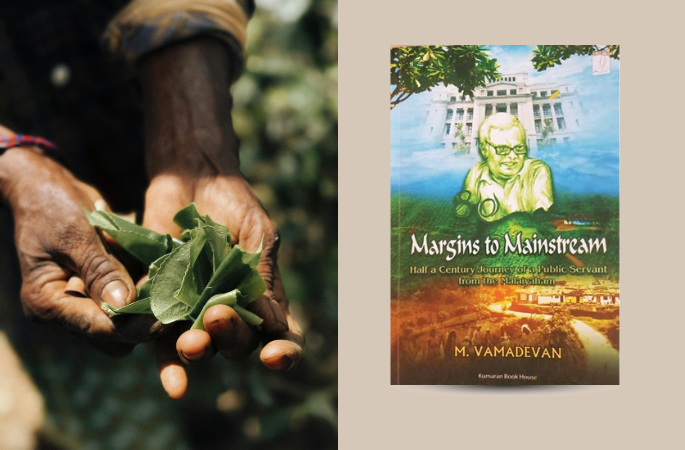
The book titled Margins to Mainstream: Half a Century Journey of a Public Servant from the Malaiyaham was officially launched on 7th September 2025 in Colombo. The book, published by Kumaran Book House, contains 12 chapters, each offering a life lesson. The author presents an important lesson in every chapter. For example, the narrative shows how the Sri Lankan educational system systematically excluded Malaiyaha Tamils, and why education is especially important for individuals from minority groups with lower economic status. It also highlights a life-changing decision he made after losing his father and sisters in a tragedy. He did not give up on his university education, even when a landslide (earthslip) took the lives of his loved ones.
There is very little written documentation on how Malaiyaha Tamils were affected by the JVP insurrections in 1979 and 1983. The author shares his experiences of how these events affected them, what the displacement camps looked like, and the support they received—and did not receive. An important aspect of this experience was how allies and activists from the majority Sinhalese community extended their support to the affected Tamil people in Colombo. Dr Kumari Jayawardene and other well-known political figures from the Sinhala community went against the majority and showed humanity towards Tamils, especially Malaiyaha Tamils. This is a lesser-known aspect of Sri Lanka’s history of peace and reconciliation. Narratives like these should be discussed more widely in mainstream media by activists and those who speak about peace and reconciliation.
The author also does not hesitate to reveal the structural barriers within state institutions toward minority communities, which are often hidden or avoided by bureaucrats. He speaks openly about how government documents and plans contained poor Tamil translations and were not given sufficient importance. This shows that the implementation of national language policy has historically been weak, with the state and relevant ministries giving less attention to equal language representation. He states, “…I explained to the translators how the language should be. But they were adamant about not making changes… After one month, they returned the document without any changes.”
As a person from a minority community, it is unavoidable to raise such issues in one’s own biography; otherwise, where else can they be addressed? His fearless approach is evident when he describes how difficult it was to work with politicians who lacked education and public interest.
Another important aspect of Mr Vamadevan’s life experience is how development agencies and the state should work together. We have seen that when these agencies work in silos, the results are not effective. However, when they collaborate, vulnerable and marginalised communities benefit. Every individual has a social responsibility toward the development of their community and the country as a whole. Mr Vamadevan has fulfilled both. His contribution to community development is vast. One example I greatly admire is the formation of the ‘Sivalingam Memorial Committee,’ which reflects his respect for his teacher and has encouraged research among Malaiyaha writers and scholars.
I fear that we do not have enough documentation on the socio-economic history of Malaiyaha Tamils, both in pre- and post-independence Sri Lanka. Margins to Mainstream is undoubtedly an important historical document of the Malaiyaha Tamil community; it is not just the story of an individual, but a reflection of an entire society. The book has been released in English and Tamil, with hopes for a Sinhala edition as well.
In conclusion, poverty, discrimination, and policy barriers cannot prevent a person’s development entirely, but persistence and commitment will lead to success in life. The story of Mr Vamadevan offers an important life lesson for minorities in Sri Lanka.