
 Naveen Rosario
I will be on leave in the second half today, as I have a check-up at 4. Akila notified her team in the group about her early absence. She shut her office laptop and unlocked her phone with her thumb. She scrolled back to the messages that had come in the early morning from her husband.
Happy Anniversary, Pondatti.
Thank you, Mr Husband. Same to you. She trailed her reply with six kissing face emojis, one for every anniversary.
Happy Valentine’s Day, Darling.
Missing you badly, my Valentine. Akila suffixed that message with a random number of crying emojis. They had planned to ger married on Valentine’s Day, hoping to double their celebration, but the plan proved to be a double-edged sword, if they missed one, they missed both.
Soon! Next month. Can’t wait to cuddle you both.
The last message she sent had two smiling faces, one from each of them. Akila was six months pregnant.
Parvathi knocked on Akila’s bedroom door. “Akila,” she called her daughter-in-law.
“Coming, Athai,” replied Akila. She kept her phone on the table and cautiously stood up. She walked towards the door with her hands resting protectively over her belly. Even though her doctor confirmed that the baby would not fall, Akila ignored her consultation.
Akila opened her bedroom door. She hoped her mother-in-law hadn’t noticed her cluttered desk, the unfolded quilt, and the now dried-up towel on the footboard of her bed. “Have you packed up, Athai?”
“Everything is done, Akila. It’s just two bags. What about Amma? When is she coming?”
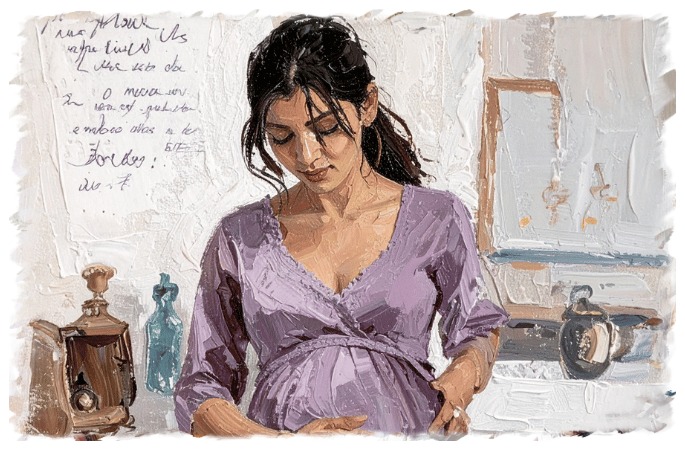
Parvathi wore a bottle green mulberry cotton saree and matched it with a beige and brown tote bag. Her hair was more silver than grey, with few strands of black that shone. While Akila stood on the opposite side of the doorway in her comfortable purple maternity nightie that came with pockets, she aimed for a messy bun hairstyle, but it turned out messier and nothing like a bun. Akila’s friends usually referred her mother-in-law as “Slay queen!”
“She will be here in the evening to take me for the check-up, Athai.” Akila was preoccupied with admiring Parvathi’s saree and her neat hair that she hadn’t noticed at first glance, the subtle difference in her mother-in-law, even though it was staring right at her. Parvathi’s forehead was empty.
“Athai, Pottu?”
Parvathi searched for the missing black, round bindi with her right hand. Her fingers came up empty. After her husband’s death, she switched from red to black but never missed keeping one.
Parvathi pulled the backup bindi from her tote bag and placed it on her forehead without the assistance of a mirror. An impressive feat but Akila felt something else was still missing. “What happened, Athai? You look dull.” She held her mother-in-law’s hand. The oddly firm grip, for a lady in her late-60s, was missing.
“I-I-I don’t know, Akila. I have been feeling uneasy since this morning. I have a feeling that something bad is about to happen.”
Akila didn’t let go of Parvathi’s hand but held it tighter, giving her strength to her.
“Did you speak to Prasanna? Where is he now?”
“He was in Jammu yesterday, Athai. But today he is en route to Srinagar. He said he will call once he reaches there.” To cheer Parvathi, she added, “He assured me that there is nothing to worry about, Athai.”
“Heh,” Parvathi let out a quite cynical laugh. She had heard different versions of the same line from her late husband, Manoj, before he died in his line of duty in a crossfire.
Parvathi gave a long pause and said, “I never wanted to hide anything from you, Akila. I was trying to find the right time to share.”
Akila stood clueless; she didn’t respond to Parvathi’s vague statement. And before she could respond, she was interrupted by the driver’s call.
Parvathi looked at the time on her watch; she hated being unpunctual. Her flight to Coimbatore was in three hours. “Everything I wanted to say is in the letter.”
The last letter Akila received was from her bank when they dispatched her new Mastercard two years ago.
“The letter is in the top drawer of my room. Please don’t disclose about the letter to anyone, not even to Prasanna.” Parvathi gently touched Akila’s belly and whispered, “Take care.”
“Bye, Athai. Take care. Message me after you land safely,” Akila said instinctively; her mind was consumed by the mysterious letter and Parvathi’s odd behaviour.
Holding her belly with both her hands, she briskly walked to her guest bedroom. The contents of the cryptic letter intrigued her. In the six years Akila knew Parvathi, she never minced her words, even when it was about Prasanna. Why does a lady like that need to hide her words inside a letter?
The room looked fresh and neat, as if room service had visited only Parvathi’s room. Akila’s mother also kept it clean, but she could never match the obsession and discipline of a military spouse and military daughter.
Akila pulled the drawer in search of the mystery letter. It had a couple of notebooks, a 2018 diary, the charger her mother misplaced last time — it was neatly wrapped and kept — a box full of safety pins, a green microfiber cloth that is used to wipe laptop screens (washed and neatly folded) and on top of that, a white envelope and a letter opener. The front of the envelope had Akila written in cursive. Parvathi’s handwriting matched the finesse of printing. Akila picked up the envelope; it felt slightly heavier. The envelope was sealed. She ignored the letter opener and tore the flap with her bare hands, abandoning etiquette. Inside the envelope, there was a neatly folded four-page letter and a ring.
Akila took out the ring. It was a 22ct gold ring with black enamel at the top and an emerald stone in the middle, surrounded by seed pearls. The ring’s design indicated it was old and antique. Akila kept the ring in her pocket and read the letter.
Dear Akila,
Since the day you said yes to my son, I have been pondering every night to tell you about me, our family, and the ring. The longer I waited, the harder it got for me to share. I am choosing a letter to help me pour everything out without interruption.
Even before your engagement, I warned you about the risks of his job and whether you were prepared to take him as your husband. I pestered you constantly about your confidence and motivations for marrying into a military family. These are not the questions a mother would ask her would-be daughter-in-law, but I had my reasons.
I warned you of the sadness that will creep into you when he is not beside you. It is going to get harder with a child. No one prepares you for it; there is both respect and honour in that loneliness. It is our duty, too, but nobody talks about our plight. The difference between knowing pain and being in it is vastly huge. Deep down, the seed of worry takes root, and discomfort branches out.
I am sorry, dear, if I have scared you. My intentions are not to frighten you. But I want to provide comfort through a gift. A gift that sets us apart from other women in our plight: the ring.
The ring is our family heirloom; you are the seventh-generation Thiruvanchiyam woman to inherit it. The men in our family take pride in their valour and bravery. They are branded as men who are immune to fear and obsessed with loyalty. The ring was gifted to our ancestor when she lost three of her four sons on the battlefield. The queen gave the ring to our ancestor as her three sons sacrificed their lives to protect the queen’s only son, the prince.
The ring’s unique ability is to bring back to life a person who has lost his life on the battlefield. Despite the severity of the injuries, the deceased person will return.
But every miracle has limitations; this ring can be used only once. You can make your wish by crushing the emerald stone. And, once it has been used, the ring loses its power and becomes nothing but a broken ornament. The first Thiruvanchiyam woman who wielded the ring didn’t use it. She didn’t know whom to revive; asking a mother to choose her favourite child is a sinister ploy. She passed the ring to her last son’s wife. Since then, the ring has been passed on to a Thiruvanchiyam woman to use when she needs it. This secret is hidden from the men in our family, for their own good.
With our family’s history and the number of men we have lost over the years, a question arises: why has no woman used it? Why didn’t I use it when Prasanna’s father, Manoj, was killed?
I never shared the same sentiment about our legacy as others in our family. The ring’s purpose was to bring peace to the woman. But it never did. My mother had the ring before me; her left hand always clutched it, ready to use its power for my father. The power of the ring caused her more agony, and I despised my father’s job for it. She put on a brave face in public, but in private, she was tormented. I swore I would stay away from any job that normalised sacrifice.
But the further I tried to run, the closer I got to it. Manoj was kind and honest. He understood me in a way that no one else did. I was conflicted between the man I loved and the job I hated. Finally, I chose the man whose job I despised. I married Manoj. The blame is all mine for believing in changing my fate.
I did love Manoj, and he loved me back and our country equally. Call me selfish, but all I ever wanted was to share my life with him until the end. Enjoy the small things. But the line between love and duty blurred in our marriage. Should I have held on to our love longer? Isn’t that a duty of a military wife? What about his duty, the duty of a husband?
As he climbed the ranks, we travelled with him. Whenever orders came, he uprooted us; there were no discussions, but executions. We grew apart so much that his presence exhausted me. The more I attended their social gatherings and dinner parties, the less I recognised myself. I confess, Akila, being perfect is tiring.
Prasanna didn’t understand when I made the decision; nobody did. I moved out. We never divorced but stayed separate. There isn’t much I can complain about, Manoj, except that he wasn’t there for me. He was a perfect gentleman, but I couldn’t recognise the man I fell in love with anymore.
My family didn’t stand by my side either; they thought I was mad. The tongue few of them had, and the words they spat out of it, felt like being behind enemy lines. Some cursed me and said that I didn’t deserve Manoj. They called me disloyal to my country and a disgrace to the family. I felt my mother would have understood me if she were there, but she was gone, and my father was disappointed in me.
The year 2008 was a bad one for both our nation and me. Tragedy struck me first, four months before November 26. Militants killed Manoj in a shootout in Rajouri. I was broken; I thought moving away from him emotionally would be enough, but it didn’t. The agony I faced both as a wife and a citizen was immense.
I faced the most challenging question many of our ancestral women had faced: Should I use the ring to resurrect Manoj or pass it on for Prasanna’s sake? It was either my husband, from whom I had moved on, or my son, who would need it later. One thing I was sure of, and so was Prasanna, was that he would follow in his father’s footsteps. After careful consideration, I chose to pass on the ring. Manoj would have wanted the same if he had known about the ring.
Till this day, I am still haunted by that decision. No woman must be forced to choose between her husband and son. Why do women sacrifice more than men?
As I write this letter, I feel the burden of treason lifted. I have been carrying this pain for so long, and it feels good to share it. When I walked to get the Ashok Chakra for Manoj, I felt like a traitor and an imposter. I felt naked, knowing the truth. I didn’t deserve to stand there that day to receive the posthumous award. I had the power to save him, and I didn’t; I chose to let my husband stay dead. Every step I took felt heavier than the last; I didn’t deserve to stand there that day; it was meant for courage, and I was a coward who ran away.
God forbid, but you might walk the same path and be at the same crossroads as I was. At that time, make a choice that makes you happy because all the pride and glory of a martyr’s spouse die after a few years. Loneliness will be your forever companion in the end.
Are we fools to believe in a power that we haven’t witnessed? That is for you to decide. I have shared with you my life and its secrets. Our family’s heirloom is now yours. The decision to use it or pass it on is solely yours and yours only.
With love,
Parvathi Manoj Thiruvanchiyam
Akila picked up the ring that held generations of grief. She rotated the ring and appraised it. Inside the shank, there were engravings, but it was illegible for her to read.
She searched for her phone to call Parvathi about both the letter and the ring. But she had left it near her laptop.
When Akila reached the doorway of her room, her phone was already buzzing nonstop. Her phone was flooded with notifications and messages. The number of unread messages from various groups and personal messages was at a staggering 93. Most messages were in CRPF wives’ groups, and the noisiest was Tribe 76. Before she could read messages from that group, another new notification dropped on her phone.
She clicked the notification, it expanded and read, Breaking News: Pulwama Terror Attack. Convoy hit. 40 CRPF personnel of the 76th battalion were killed.
Akila momentarily lost her balance; the 76th battalion was Prasanna’s unit. She understood the cause of the outburst: wives scrambling for the whereabouts of their husbands, wishing for a hint that they were safe, pouring out their prayers. She hoped Prasanna was elsewhere, anywhere except there.
She called Prasanna’s number, but it was unreachable. It wasn’t unusual; connectivity was unreliable in that region. But she prayed it would connect to him briefly, just long enough for him to send a message that he was okay. She opened her Google Maps and searched for Pulwama. It was the first time she heard of that place.
She switched on her television and searched for the remote. It was conveniently placed on the showcase near the TV unit for easy access. Akila knew Parvathi must be the one who kept it there. The news channel made everything worse. Deadliest Terror Attack in bold scrolled across the screen. They showed clippings of a burning vehicle up in smoke, debris all around, jeeps with sirens, armed men on patrol, and victims being carried in stretchers. The clippings ran in loops.
Her phone never stopped buzzing. Akila’s inbox, which was previously filled with anniversary wishes from her friends and family, was now flooded with enquiries and messages of solidarity.
Confused and helpless, Akila collapsed on the couch. The family heirloom pricked her thigh. The idea of using the ring to bring him back comforted her.
She tried calling Parvathi multiple times, and each time, it was unreachable. She thought it was fate. She kept trying to reach Parvathi; she was the one who taught her how to be an army wife. She hated her mother-in-law for abandoning her when she needed her the most.
The number of calls and messages grew as time flew by. Akila didn’t attend any of them. She was scared one of the calls could be the one she had been trying to avoid for the past couple of hours. She latched onto the ridiculous rationality that If I never hear it, it didn’t happen. The looped clippings from her television and the buzz from her phone never shut off.
Akila’s hands trembled as she frantically scrolled through the messages in Tribe 76. She searched there for answers but ended up with more questions. She prayed for Prasanna not to be part of those 40 jawans. She knew it was selfish, but she had no other choice. The thought of losing her husband on their anniversary was too painful for her.
Every minute that passed, she felt a ticking time bomb of bad news about to burst. She reread the letter, searched it for clues, to see if she had missed a key detail. It was clear, smash the ring and wish for his return. She rushed to the kitchen without holding her belly. She looked around, trying to find something substantial to crush the ring. Between the wooden rolling pin and the mini Ammi Kallu her mother gifted her, she chose the latter. She kept the ring on the kitchen slab and positioned her legs so that her hands could swing freely. She raised her hand above her head. Everything until that point happened quickly, but Akila’s hand stayed up and never came down.
Parvathi’s faded love flashed before her, and questions exploded like a flash bomb. What if I, too, stopped loving Prasanna? What if he hated me for using the ring on him and not passing it on? What if he despised me after knowing that I robbed him of his sacrifice, his honour? With one hand holding the ring in and another the grinding stone, she froze in that position. She hated the idea of losing Prasanna. She was the one who proposed to him. Her family had warned her that she would regret her hasty decision one day. Akila screamed at the ring.
“No, he will understand,” she consoled herself. “I will convince him to quit. We will travel the world. I will recollect today, ‘Remember our sixth anniversary, Prasanna? I almost let you stay dead.’ We will laugh about it.” Akila forced a smile on her.
The sweat of her palms had made it hard for her to hold the grinding stone. She wiped her hands on her maternity nightie. She positioned the ring, tightened her grip, but her hands trembled, and her legs shivered. She dropped it with full force, but just before the impact, the child in her womb turned and kicked. She stopped it. The love for her husband was overshadowed by the love for her child. “All the women before me had chosen their children over husbands. Am I a bad mother? What if they grow up and hate me for breaking the ring? Will they abandon me?
She mumbled, “I will bear the pain for my children. I will pass on the ring. I will pass on Prasanna’s memories, our love, to them.” Akila failed for the second time.
Akila left both the ring and stone on the kitchen slab. She walked back to her drawing room. She was convinced that it was the honourable thing to do. She took her phone to call her mother. Google Photos popped up a new notification: Check out this new memory of Prasana and me. It was a collage of photos from last year when they celebrated their anniversary. They had promised to renew their vows every year. She had promised she would always be loyal and stick with him till the end. Tears flowed from her cheeks and fell on her phone. She slowly fell on her knees and cried loudly. With her clenched fists, she slammed the wooden coffee table that was in front of the couch.
She sobbed continuously as she prayed for a sign that could show her the path of righteousness. The news channel showed photos of the deceased jawans. Akila recognised some of them. She knew their wives as well. She had lunch with them and went shopping with them. She shut her eyes and plugged her ears with her fingers. She didn’t want to see Prasanna’s picture or hear his name. The emotional distress had caused her unborn child to be more active than usual.
She felt sick; she hated all the women who held the ring before her. Why didn’t they use it for themselves? They didn’t take away the pain; they unloaded their responsibility, their suffering. The ring is not hope, but a symbol of despair. The rage inside her peaked when she thought, how many such rings did the queen hand out? She picked herself up, wiped her tears with the sleeves of her maternity nighty. Her back ached. She walked steadily to the kitchen, her right hand on her back and left on her tummy. She seized the grinding stone that lay there, lifted it as high as she could; she borrowed strength from her unborn child and struck the ring with all their strength. The emerald shattered, and the pieces of different sizes flew in all directions. The ring itself had flown and landed beneath her refrigerator. She didn’t see any of it; her eyes were closed.
When she opened her eyes, the power had tripped, shutting the noise from the television. The entire house was empty, and all Akila heard were annoying buzzes from her phone and her own panting breath. She grabbed a bottle of water and chugged it. Her doctor had recommended that three litres a day is essential for the baby’s growth. Her hands were still trembling, and the water spilled on her dress. Her purple maternity nightie was wet with her tears, sweat and water.
When Akila picked up her phone and checked it, there was a message from Prasanna. She tried unlocking her phone, but her thumb was wet as well. She tried wiping it on her dress, but it didn’t help. Three failed attempts forced her to use the secret pin. It was her wedding day, 1-4-0-2-1-3. It unlocked, and she clicked the message, which read. Safe, darling, don’t forget to breathe, will call you later.
Akila felt the noises in her head go numb. She hoped it was all a bad nightmare, but once the backup came, the news on the television remained the same; pictures of Prasanna’s fallen brethren were shown. Some women in the group Tribe 76 confirmed that their loved ones were safe, and some were still searching for answers.
Akila wasn’t sure if it was all a coincidence or if the ring worked. But her baby had calmed down. She accomplished what generations of women couldn’t. She destroyed her family heirloom.