
 Shyamolima Saikia
Born in the eighties, I consider myself a witness of many epoch-making changes in society and the world around me. It feels like standing at one point and watching the world transition from a traditional way of life to a drastically technology-driven one. When did these changes become apparent? Perhaps it was with the arrival of the internet and devices like the mobile phone. For me, they sounded the first alarm of transformation in my own life.
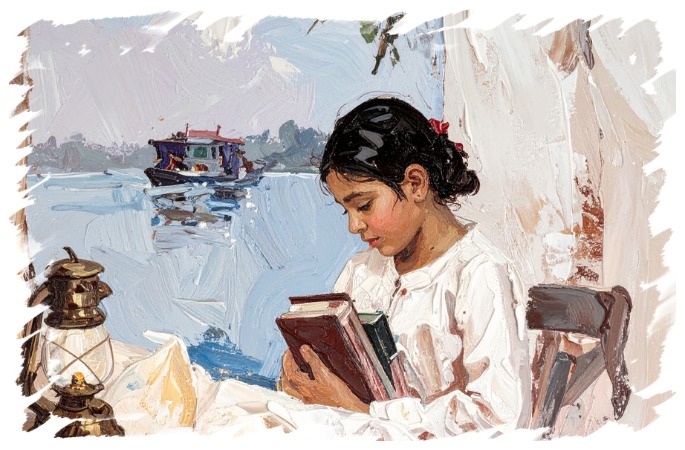
I spent my childhood and teenage years in a time untouched by the technical boom. Those were simple times. There was no luxury I craved except books and stationery, like a coveted pencil box that classmates would bring to school, or a Barbie doll. As for books, there were no online stores to purchase them. Bookstores, school libraries, and public libraries were our only gateways. Visiting the district library of our small town, with its limited collection, was a sheer joy. I waited for the books handed out once a week during school library hours. I also remember other beautiful moments from childhood, such as the hours spent during load-shedding when we would light kerosene lamps to study, or sit outside in the garden, stargazing and watching glow-worms hover in the dark.
Travelling was always a dream for me as a child. The excitement of travelling to my grandmother’s home in Tezpur, first by day bus, then by ferry across the Brahmaputra, still lingers in the pages of my life’s diary. Travelling by ferry was an adventure for toddlers like us back then. It was much later, after the Kolia Bhomora Bridge was built across the Brahmaputra, that we began to travel by road. The journey, though tiresome, was full of experiences: the joy of seeing the Brahmaputra up close, meeting passengers from diverse backgrounds, and the sheer elation of reaching our destination. Moreover, the unique joy of witnessing the frothy river water trail alongside the ferry was another memorable experience.
Another joyous occasion for my elder sister and me was the anticipation of new clothes during festivals. The smell of new fabric, fresh from the mill, is what still remains vivid in my mind’s canvas. I remember my mother’s passion for sewing and knitting. During every Bihu or Durga Puja, her hands would deftly craft a beautiful and unique frock for me and my sister. She knitted countless sweaters, caps, and mufflers, too, for us. Those were the days before the internet and online shopping entered our homes. We didn’t have to scroll through endless pages or agonise over choices to buy a dress. Instead, we were happy with whatever fabric our father brought, which our mother then transformed into pretty little dresses.
Crossing the threshold of childhood brought changes, ushered in gradually. Until my undergraduate years, life moved at a consistent, slow pace. We communicated with our friends and relatives first through inland letters and postcards, then through landline phones at home and PCOs outside. Interestingly, while I was doing my master’s, I saw the first mobile phone. It looked more like a wireless phone in the hands of one of our revered teachers at the university.
And with the mobile phone, the internet arrived. That was truly an epoch-making change. The rest, as they say, is history, and I need not reiterate what followed.
What we lost is the warmth of books, the joy of reading, and the indulgence of writing letters and postcards, as digital devices and platforms invaded our lives. I miss letters, postcards, greeting cards, bookstores, and visits to libraries. Today the internet dishes out information and resources at the click of a mouse. I also miss the dresses sewn and designed by my mother. Now we have innumerable products online, ready to be delivered to our doorstep, and we are spoilt for choice. Yet we are never satisfied, nor do we derive lasting joy from buying them ,the happiness of shopping has become momentary. We’ve lost the joy of waiting a whole year for a new dress and basking in the warmth of wearing it during festivals. The passion for travelling and discovering new places remains, but journeys as a child were different. It was slow, immersive, and fulfilling.
What remains are wistful memories of a childhood spent with the bare minimum, yet happy and satisfied to the core. Looking back, I regret how spoilt for choice we are, surrounded by things we can actually do without; how lazy we’ve become, venturing outdoors less to libraries and bookstores and instead studying or grabbing copies online; how we focus on reaching the destination rather than enjoying the journey; and how we no longer write to each other, resorting instead to texting and video calls. It is therefore essential, once in a while, to revisit the past and unearth lessons for the future. The memories of our past teach us to live a slow life, to enjoy the moment and to be happy with whatever little we have.


Beautifully portrayed .
The innocence and simple bliss of the days before the arrival of this device which has frozen the small joys of everyday life to a large extent.
Reading Dr. Shyamolima’s article is so refreshing. It is like taking a short trip to childhood memories, where we relived every experience for a short while until we realise that we have come to the end of the article. Always craving to read more of her works.