 Swarnavel Eswaran
Introduction: Ideology, Form, and the Cinema of a Society
Few terms circulate as freely through the study of South Asian visual culture — and resist definition as stubbornly — as “Dravidian cinema.” Used loosely, the phrase is a geographic convenience, aggregating the film output of Tamil Nadu, Andhra Pradesh, Karnataka, and Kerala against the all-India reach of Bombay’s Hindi film industry. A sharper usage treats Dravidian cinema as a datable historical phenomenon: a body of films, overwhelmingly Tamil, formed in conscious ideological and aesthetic alliance with the goals of the Dravidian movement — the formation that grew out of the Justice Party and Periyar’s rationalist Self-Respect movement, and that reached its apogee when the Dravida Munnetra Kazhagam (DMK), commanded by celebrated playwright-politicians, formed the government in Tamil Nadu in 1967. That victory permanently rearranged the state’s political order: no all-India national party has governed Tamil Nadu since.
The argument advanced here is that these two senses — geographic and ideological — cannot be prised apart, because the ideological project occupied geographic space methodically and remade it in its own likeness. Dravidian cinema was never the industrial reflection of a politics that existed elsewhere; it was one of the principal technologies through which a self-aware political community called “Dravidians” was discursively and materially assembled. This understanding finds important support in M. Madhava Prasad’s theorisation of “cine-politics.” Rather than treating cinema simply as a medium that represents politics, Prasad argues that, in South India, cinema became one of the institutions through which political subjectivity and political existence were produced. His account indicates that film and politics entered into a constitutive relationship, making cinema an integral part of democratic political life rather than merely a vehicle for political messages (Prasad, 2014). The question therefore resembles “What is Soviet cinema?” far more than “What is German Expressionism?” — it asks about the bond between a film industry and a political world-making enterprise.
As Theodore Baskaran, M.S.S. Pandian, and M. Madhava Prasad have shown from differing vantage points, Tamil cinema offers one of the most sustained cases of a film culture serving as a central ideological apparatus of a successful counter-hegemonic movement — one that opened in the rhetoric of social revolution and closed in the administration of a regional state. The welding of cinema to regional politics in Tamil Nadu has few close parallels in the history of mainstream global media. A productive comparison may be made with Third Cinema in Latin America, although Third Cinema encompassed militant filmmaking, alternative production and exhibition, activist documentary, and revolutionary cultural practice rather than belonging simply to the art-cinema domain. Few mainstream commercial cinemas sustained an intervention against state and social power on the scale achieved in Tamil Nadu.
Ravi Vasudevan’s territorial history of the subcontinental cinema clarifies just how deliberate this welding was. In his account, while the formation of nation-states in 1947 split the great northern film territory which had bound Lahore to Bombay, the emergent Tamil industry “retained its wider territory” — trade discourse of the 1950s routinely counted Ceylon and Malaysia within the South Indian market — and its leading producers, S. S. Vasan, A. V. Meiyappan, and, in the Telugu industry, L. V. Prasad, actively targeted the Hindi market. Against this integrative pull, Vasudevan (2011, pp. 208–209) reads the DMK film as a decisive movement away from the pan-Indian market: its significance did not lie in its share of local production but in the consensus it promoted around anti-Brahminism and, for a time, “an autarchic Tamil nationalist viewpoint pitted against the pan-Indian nation-state” — a consensus consolidated once the movement captured state power in the late 1960s. The ideology, in other words, did not simply inflect the industry; it redrew the industry’s map. Vasudevan’s account, arrived at from outside the Tamil field, thus confirms this essay’s founding claim: the geographic and ideological senses of “Dravidian cinema” cannot be prised apart, because the ideological project reorganised the very territory across which Tamil films circulated.
Philology, Race, and the Architecture of Self-Respect
Dravidian cinema is inseparable from the linguistic and civilizational upheavals that transformed the Madras Presidency across the late nineteenth and early twentieth centuries. The word “Dravidian” entered modern politics through the side entrance of comparative philology: Robert Caldwell’s A Comparative Grammar of the Dravidian or South-Indian Family of Languages (1856) demonstrated that Tamil, Telugu, Kannada, and Malayalam form a language family wholly distinct from Sanskrit and its Indo-Aryan descendants. Caldwell’s comparative linguistic argument was subsequently entangled with claims that the speakers of these languages descended from an aboriginal population older than, and separate from, the “Aryan” north; colonial anthropology thereby hardened a linguistic distinction into a racial one.
By the early twentieth century this Aryan/Dravidian opposition had matured into a political grammar for the grievances of the oppressed: if the Tamil country’s subordination was not the eternal decree of varnashrama dharma but the residue of a historical invasion, lost glories were recoverable. As philologists like Caldwell and visionary intellectuals like Pandit Iyothee Thass excavated an ancient, egalitarian, pre-Aryan “Dravidian” past, non-Brahmin elites acquired a vocabulary for indicting the Brahminical socio-religious hierarchy.
The institutionalisation proceeded in stages. The South Indian Liberal Federation — the Justice Party, founded in 1916 — framed non-Brahmin demands in the constitutional idiom of representation and reservation. Periyar E.V. Ramasamy, breaking with the Congress in 1925, radicalised that inheritance into the Self-Respect Movement: a rationalist, atheist, anti-caste, and feminist campaign that assailed Brahminical discipline at the level of everyday ritual — marriage, worship, the sacred thread, and the Hindi language pressed upon the South. In 1944 Periyar reconstituted the movement as the Dravidar Kazhagam (DK) and raised the demand for a sovereign Dravida Nadu, but the DK abstained from elections; it was his lieutenant C.N. Annadurai who, splitting from him in 1949, founded the DMK and converted a social movement into a vote-seeking party — a conversion which demanded the public rally, the party press, and above all the cinema as three stages of one continuous rhetorical performance.
The ideologues read their media environment shrewdly. Literacy was low; the talkie, arriving in Tamil in 1931, became an exceptionally powerful technology for addressing a dispersed linguistic community jointly in its mother tongue; and Tamil political culture had already developed a rich, alliterative “platform Tamil” that fused classical style with everyday speech. The movement’s decisive insight — that the talkie was not, at bottom, a visual medium but an amplifier of speech, an industrial machine for distributing oratory at scale — determined the entire formal character of Dravidian cinema.
The Republic of the Screenwriter: Anna the Scholar and Karunanidhi the Artist
In his foundational study The Tamil Film as a Medium of Political Communication (1981), Karthigesu Sivathamby showed how, within a deeply caste-stratified society, the Tamil cinema hall became an unprecedented common public space across a deeply divided social order. Before the talkies, the traditional performance arts — Carnatic music, dance, religious discourse — were spatially segregated on principles of purity and pollution. The commercial cinema partially unsettled that feudal arrangement: spectators from otherwise segregated caste and social groups participated in the same mass-cultural event, even though ticket classes, differentiated seating, and unequal sightlines preserved economic hierarchies within the theatre. The medium, in Sivathamby’s insight, carried an inherent democratic capacity the movement seized with remarkable dexterity.
As I have observed in my extended study of studio history, the early decades of South Indian cinema were dominated by religious mythologicals and hagiographies of saints — films steeped in Sanskritic diction and underwritten by a fatalism that legitimated cosmic-social hierarchy. Meanwhile, as Theodore Baskaran has documented, drama troupes serving as party propaganda wings had already rehearsed the conventions of Dravidian political theatre — the speech of indictment, the editorial song, the finally vindicated subaltern — and Annadurai and Karunanidhi carried those plots straight into the studios. Dravidian cinema proper begins, then, not with a director but with a screenwriter. Annadurai’s screenplay for Velaikkari (1949, dir. A.S.A. Sami), adapted from his own play, together with his contribution to Nallathambi (1949), fixed the template: a melodramatic social plot built around the violated dignity of the poor and the treachery of landlords, priests, and moneylenders served merely as scaffolding for platform speeches charged with social criticism. The narrative existed for the speeches, not the reverse. Between Velaikkari and the provocative dialogues Karunanidhi wrote for Parasakthi (1952), this intervention effected a radical epistemic break in the Tamil imagination: the mythological heavens gave way to materialist earth, and attention swung from gods and kings to the disenfranchised — the rickshaw puller, the orphaned sister, the rationalist youth.
Real-World Political Controversies and Rejoinders
One of the most consequential and least appreciated features of this screenwriters’ cinema was its direct engagement with the live political controversies of its day. For instance, released amid the controversy surrounding Chief Minister Rajaji’s (C. Rajagopalachari’s) Modified Scheme of Elementary Education—condemned by the Dravidian movement as the Kula Kalvi Thittam (Hereditary Education Policy)—films such as Malaikkallan (1954), with dialogues by M. Karunanidhi, articulated a competing allegiance to educational and social equality. The scheme combined reduced school hours with vocational instruction outside the classroom, an arrangement critics worried would return children to hereditary caste occupations and legally reinscribe the varna hierarchy. Read in this context, the films’ advocacy of educational equity formed part of the movement’s broader rejoinder.
Thirumbi Paar went even further. When Prime Minister Jawaharlal Nehru publicly dismissed the DMK’s agitation—including the blackening of Hindi lettering on railway station signboards—as childish, Karunanidhi answered through cinematic satire. Contemporary and subsequent commentators widely read Sivaji Ganesan’s Nehru-style cap, dress, mannerisms, and repeated exclamation “Nonsense!” as an allusion to the Prime Minister’s dismissal of the agitation and at a time when the Congress leadership still commanded enormous national prestige, such a pointed intervention in a commercial film testified to the growing confidence of the Dravidian movement in cinema as a political medium.
The Congress government of Madras was hardly oblivious, and the DMK films of the 1950s endured repeated bouts of censorship. The party answered with a “poetics of insinuation” that audiences read fluently: the rising sun — the DMK’s electoral symbol — surfacing in song sequences and scene transitions; the party’s red-and-black in costumes and set design; heroes named “Anna”; dialogue cast in slogan-ready rhyme. Paradoxically, censorship simply honed the movement’s mastery of coded signification.
The Eclectic Adaptation of Source Materials
A second relatively underexamined feature of Dravidian screenwriting is the extraordinary eclecticism of its sources. From Hollywood, Annadurai — a devoted student of American cinema — drew directly on George Cukor’s 1944 psychological thriller Gaslight, with Charles Boyer and Ingrid Bergman, to fashion the story of Rangoon Radha, for which Karunanidhi then wrote screenplay and dialogue; transposing Cukor’s tale of a husband’s calculated psychological abuse of his wife from an Edwardian London townhouse to a Tamil setting expressed the movement’s wager that global cinematic forms could be naturalized as vehicles of Tamil social critique. Drawing on the Tamil classics, Karunanidhi adapted an episode from Kundalakesi for Manthiri Kumari and from Silappatikaram for Poompuhar—not as exercises in cultural prestige but as acts of political philology that reclaimed, for popular circulation, texts long monopolised by dominant-caste cultural institutions. Moreover, from hagiography and folklore, Karunanidhi wove plot elements from the life of the medieval poet-saint Arunagirinathar and from the narrative of Indiran into Thirumbi Paar — the characteristically Dravidian manoeuvre of redeploying traditions against the very caste hierarchy they had been made to serve.
A Lost Testimony: Sorgavasal (1954)
Among Annadurai’s scripts of this period, Sorgavasal (1954, dir. A. Kasilingam) holds a distinctive and tragic place. No complete publicly accessible print is currently known to survive; reconstruction therefore depends heavily on reviews, reference works, the song-and-dialogue booklet, surviving songs and photographs, and collaborators’ recollections — a cue that any assessment of Dravidian cinema must reckon with films we can no longer watch.
The film derived from Bhairavan, a play Annadurai wrote before he had any reputation as a screenwriter — one that, according to Kalyani Ramasamy, wife of the “Nadippisai Pulavar” K.R. Ramasamy, was never staged. Its title came from an urban legend of old Madras: “Vaikunta Vathiyar Street” in George Town was said to commemorate a Vedic Brahmin priest famed for rites that guaranteed the dying passage to heaven. Annadurai converted this lore of religious commerce into his villain — a court priest scheming to erect his own sorgavasal, a “gateway to heaven,” to profit from the credulity of king and subjects. Jupiter Pictures filmed the play in 1954 under the banner of Parimalam Pictures — named for Annadurai’s elder foster son — reuniting the writer with K.R. Ramasamy as Mathivanan, a reformist poet tried in a court bent to the will of religious charlatans: the king, manipulated by the guru, dispatches Mathivanan to negotiate a royal marriage; the princess falls in love with the poet instead, before the lovers are united and the false guru exposed. The Dravidian ideologue Udumalai Narayana Kavi’s songs, sung in Ramasamy’s inimitable voice, carried an explicitly atheist charge — above all “Enge sorgam… enge sorgam endru thedugireer… adhu ange illai… adhu inge undu” (“Where is heaven… where is heaven, you search… it is not there… it is here”), a Periyarist inversion of eschatology delivered as popular song.
However, the film’s afterlife is as much a story of censor mutilation. By 1954, alarmed by the DMK’s cinematic reach, the Congress government’s censors slashed its political content: the provocative song line “Asthigam edhu, naasthigam edhu” [What is theism, what is atheism?] was forcibly altered to “Aagum neri edhu” [What is the righteous path?], dialogue sequences lampooning the religious establishment were excised, and scenes had to be hastily modified to bridge the structural gaps. Contrary to the massive expectations for an Annadurai screenplay with a stellar cast, the heavily mangled film underperformed at the box office, though the surrounding controversy lent it immediate cult status. That we cannot analyse Sorgavasal as we can Velaikkari, Parasakthi, or Manthiri Kumari makes it an important limit case: the corpus we study remains an incomplete artefact of selective survival. Through such adaptations, the Dravidian filmmakers fused elite literature, world drama, and local political events into rhythmically charged Senthamizh (classical Tamil) dialogue. Two authorial features merit theoretical attention. First, the corpus inverted the international norm of authorship: at the very moment French critical culture was constructing the director as the auteur, the Tamil industry constructed the writer as principal author, advertising Karunanidhi’s name above the director’s and trusting that the public went to “hear” a film as much as to see it — here mise-en-scène was subordinated to mise-en-discours. Second, the corpus operated within, not outside, the commercial studio system — financed by the same Madras studios (AVM among them) that produced devotionals and mythologicals, competing with the same attractions of stars, songs, and comedy tracks: a radicalism embedded in an unreformed culture industry.
The Tamil Mother and the Language Wars: Language as a Counter-Hegemonic Weapon
No dimension of Dravidian cinema has been more central to analyses of its plot and ideology than its linguistic politics: the industry deliberately weaponised Tamil itself as the primary instrument of counter-hegemonic struggle. To see why, one must grasp the double linguistic siege the movement confronted: the ancient pressure of Sanskrit from above, and the modern, state-sponsored pressure of Hindi from the north.
Sanskrit’s dominance was neither recent nor accidental. For centuries, the ritual domains of Brahminical Hinduism had reserved Sanskrit as the exclusive medium of sacred utterance, while Tamil—despite an extraordinary classical antiquity anchored by the Sangam corpus (commonly dated across the final centuries BCE and the early centuries CE) and the ethical philosophy of unmatched concision found in the Tirukkural—was structurally cast as a mere vernacular, adequate only to domestic needs and spiritually inferior. Sanskrit belonged to the gods and to Brahminical legitimacy; Tamil to the soil and the lower castes. Periyar’s Self-Respect movement understood that caste hierarchy could not be toppled without overturning this language hierarchy, for the two structures of oppression propped each other up.
The second siege was overtly political: from Rajaji’s imposition of compulsory Hindi in the Madras Presidency’s schools in 1937 to the Union government’s drive to make Hindi independent India’s sole official language, the Congress’s Hindi policy was regarded by Tamil speakers as the bureaucratic arm of northern dominance (Ramaswamy, 1997). Tamil Nadu consequently witnessed two major anti-Hindi agitations, in 1937–40 and 1965, the latter erupting into violence and producing martyrs; related language-policy conflicts continued in 1967–68 (Forrester, 1966; Ramaswamy, 1997). The DMK’s resistance was no electoral opportunism but a civilizational claim: Tamil is not a dialect of Aryan descent nor a regional idiom awaiting absorption into an all-India order administered from Delhi, but an independent classical language with an unbroken literary tradition older than most of the languages seeking to supersede it.
Dravidian cinema became that claim’s most powerful amplifier. Where the mythologicals had naturalised divine speech in Sanskritic diction, the DMK films intervened with a deliberately purified, rhythmic, politicised new Tamil style — not the restoration of an unchanging classical tongue but the invention of a new performative idiom, drawing prestige from the classical texts while bending it toward democratic, anti-caste, and anti-Hindi ends. The figure of “Dravida/Tamil Thai” — Dravidian/Tamil Mother — had spread since the late nineteenth century as a goddess to be protected and exalted; in the Dravidian films, she migrated from the political poster to the screenplay. Language ceased to be merely an object of veneration and became itself a performance: each time a Dravidian dialogue resounded through the theatre’s loudspeakers, Tamil was audibly enthroned as sovereign.
The Playwright-Ideologues
This language revolution did not arise spontaneously on the screen; rather, it was theorised and institutionally transmitted by two men whose dual identities as ideologues and trained playwrights gave them singular authority over both the content and the form of the new Tamil. Annadurai and Karunanidhi were, first and foremost, figures of the Tamil dramatic tradition, and the theatrical apprenticeship they underwent shaped the very Tamil they later brought to cinema. Scholars ranging from K. Thirunavukkarasu (Dravida Iyakkamum Thiraippada Ulagamum [The Dravidian movement and the film world], 2007) to Kumaran Das (Thiraiyilum Uthittha Sooriyan [The sun that rose on the screen too], 2025) document the many others who worked alongside them—including Murasoli Maran, Asaithambi, and several more—whose contributions cannot be discussed here because of constraints of space. Readers looking for a more comprehensive account should consult these works, along with the landmark book by Paaventhan and Subagunarajan (2009). My concern here, however, is to define Dravidian cinema through a selective study of its key films and participants, particularly during its defining decade: 1947-1956.
Annadurai wrote prolifically for the stage, his plays circulating through the movement’s professional troupes. His theatrical language was self-consciously classical in vocabulary yet fiercely demotic in argumentative force: the educated non-Brahmin urbanite experienced it as dignified, while the relatively unlettered in the gallery seats could take pleasure in its phonic beauty without parsing every word. This engineered doubleness produced a shared aesthetic experience across the literacy divide, binding the Tamil-speaking community into a collective through language rather than caste or class. When Annadurai fashioned Rangoon Radha’s story from Gaslight, or composed the provocative speeches of Velaikkari, these were demonstrations that Tamil could hold the psychological layer of Hollywood melodrama and the fervour of anti-feudal politics within a single ornate, alliterative sentence.
Karunanidhi’s contribution was, technically, still more radical. Where Annadurai’s Tamil possessed a poetic grandeur, Karunanidhi forged a style more overtly combative, rhythmic in its alliterative cascades, and built toward rhetorical climax. His dialogues — above all for Manthiri Kumari (1950), Parasakthi (1952), and Rangoon Radha (1956) — were structured like musical arguments, deploying classical Tamil rhetoric — alliteration, antithesis, and the siledai, the pun yielding two meanings at once — as weapons against the Sanskritic discourse which had long monopolised elevation. In placing the Silappatikaram’s Kannagi in the Pandya court for Poompuhar and adapting Kundalakesi for Manthiri Kumari, he staked a decisive claim: the Tamil classical tradition was the living, democratic heritage of the very subalterns whom Sanskritic culture had declared beneath it.
The two playwrights were thus not simply suppliers of content but creators of a new public Tamil — classical enough to command respect, alliterative enough to delight the ear, politically charged enough to serve as propaganda, theatrical enough to survive the migration from open-air rally to darkened hall. Theatre was the laboratory in which this Tamil was forged; cinema, the industrial apparatus that extensively produced it across the state.
Language, Electoral Capital, and the Construction of a Linguistic Nationalism
Why this involvement in linguistic form served the movement’s electoral ambitions so effectively demands a more precise explanation than the conventional accounts provide. It is not enough to say that the Dravidian parties used cinema as propaganda—after all, every political party has done so. Nor did Annadurai consider the charge worth denying. In his published defence, he argued that art is in no way culpable for serving propagandistic ends and that a country so urgently in need of social reform required such propagandist art all the more. The distinctive property of Dravidian cinema was that it produced a particular kind of linguistic subject: a Tamil-speaking citizen whose relationship to the mother tongue was emotionally and aesthetically transformed through the sustained experience of hearing Senthamizh in the theatre. To hear one’s language handled with classical authority, celebrated as a civilizational achievement, and wielded as a weapon of justice against the elites who had demeaned it did not simply inform spectators; it formed their identity, producing Tamil speakers who understood themselves as heirs to a superior yet unjustly subordinated civilisation — and who therefore experienced the DMK’s initiatives as the institutional expression of that self-understanding. This is ideological interpellation in Louis Althusser’s precise sense: the cinema hailed the Tamil speaker directly — “Tamilan!” — and in answering the call, applauding the alliterative dialogue, memorising the monologues, humming the songs praising Tamil as the most ancient of classical languages, spectators confirmed within themselves the citizen-position the movement had prepared for them.
Herein lies what Bernard Bate identifies as the democratic function of the Dravidian aesthetic. The Senthamizh resounding in the theatres was elevated speech calibrated so finely that people with no training in Tamil literature could enjoy it: literacy was no precondition for the pleasure of alliteration, and the cadence thrilled the ear before the argument reached the mind. The project thus lifted Tamil out of its assigned “low vernacular” status while reaching the humblest spectators, whose relation to the classical texts was wholly oral and affective — a synthesis only commercial cinema, reproducing this aural experience on hundreds of screens simultaneously, could accomplish at the scale a linguistic nation required.
The political harvest was neither accidental nor deferred. The historic 1965 agitation—which produced language martyrs and helped compel assurances that English would continue as an official language—contributed powerfully to the conditions in which the DMK won state power in 1967; the Official Languages Act was subsequently amended in 1967, and related protests continued into 1968 — was not fought primarily by readers of Caldwell but by young men and women raised on films like Parasakthi and Poompuhar, who experienced the imposition of Hindi as a personal, civilizational insult. Across two decades, Dravidian cinema had built, screen by screen, the affective infrastructure of that mass militancy.
Oratory, Senthamizh, and the Remediation of the Political Stage
In his pioneering anthropological study Tamil Oratory and the Dravidian Aesthetic: Democratic Practice in South India (2009), Bernard Bate examines how the movement discovered an entirely new form of political speech. Before the 1940s, he argues, formal public oratory in the Tamil region was not a democratic, mass-mediated practice. Through intensive engagement with the classical corpus, the movement arrived at the register of Senthamizh — ornate, alliterative, majestic — designed expressly for the open-air platform and addressed to vast crowds of newly enfranchised citizens. Rejecting both the dry prose of colonial administration and the esoteric idioms of the spiritual elite, it offered a rhythmic, affectively charged alternative that conferred on the subaltern listener a powerful sense of civilizational dignity, demanding distinctive bodily postures, vocal modulations, and poetic metaphors equating the beauty of the Tamil language with the sovereign freedom of the Tamil people.
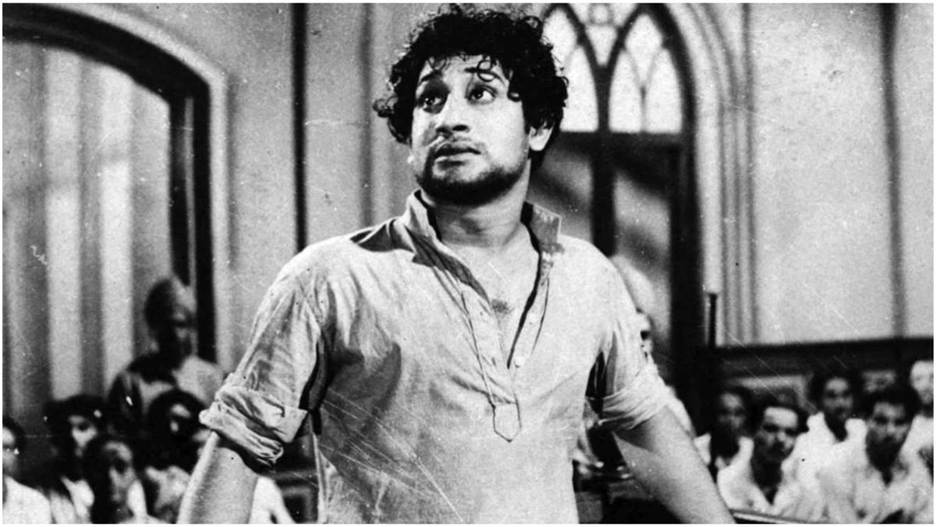
Dravidian cinema functioned as a direct structural remediation of that platform. Annadurai and Karunanidhi did not write naturalistic conversational prose; they imported Senthamizh’s expansive rhythms straight into the script. When Sivaji Ganesan stands in the witness box in Parasakthi delivering his blistering critique of institutional religion and judicial corruption, he is performing an authentic Dravidian platform speech, and the cinema hall becomes a synchronised extension of the political sphere. In the manner of the Tamil public Bate describes, theatre audiences behaved as a vocally responsive collective: spectators threw coins at the screen, roared approval at alliterative flourishes mid-dialogue, and memorised entire monologues to re-perform in fan clubs and party offices. The screenplay’s virtuosity burst the bounds of the diegesis, democratising linguistic capital by placing the high aesthetics of Senthamizh within reach of the subaltern, and producing a political community linked together by shared sonic rapture.
The Aesthetics of Frontality: Breaking the Bourgeois Gaze
The political efficacy of Dravidian cinema is encoded in its visual grammar itself, and no formal strategy is more distinctive — or more frequently misread — than the aesthetics of frontality. Classical Hollywood rests on the illusion of the “fourth wall”: the camera as invisible voyeur, characters conversing without meeting the lens, direct speech rationed toward avant-garde alienation effects and comic rupture. Dravidian cinema inverts this bourgeois scopic regime entirely; read alongside the sonic landscape just described, frontality anchors the movement’s mise-en-discours in visual form.
As synthesised from my own theoretical work and that of other scholars, frontality in the Tamil context is a deliberate aesthetic choice aligning the cinematic image with the democratic structure of the public meeting. In the typical Dravidian scene — especially at moments of intense ideological exposition or musical performance — the actor turns squarely toward the camera, flattening spatial depth as body and face come into direct correspondence with the lens. The result is an epistemological shift: the spectator is no longer a passive voyeur peering into a private world but is summoned as citizen, juror, participant. When the hero delivers a searing indictment of caste oppression while looking straight into the lens, that gaze tears through the fictional fabric and confronts the real spectator in the darkened theatre; the character addresses not an on-screen antagonist alone but the entire Tamil public.
The frontal aesthetic also visually remediates the bodily structure of traditional street theatre — therukoothu — and of the political rally, where the speaker stands face-to-face with the assembled crowd. It is no symptom of technical naivety but an intricate method of political subject-formation: collapsing the distance between the imaginary space of the screen and the material space of the theatre, converting viewing into political witnessing, and replacing the bourgeois separation of the classical gaze with a relational, confrontational, democratised visual contract.
This visual grammar could also be situated within the more expansive theorisation of Indian film form advanced by Geeta Kapur, Ashish Rajadhyaksha, and Ravi Vasudevan. Kapur defines the iconic as “an image into which symbolic meanings converge and in which moreover they achieve stasis” (quoted in Vasudevan, 2011, p. 110), and Vasudevan grounds this iconicity in mise-en-scène: frontal planes of composition relay what he calls the work of “iconic condensation” and gather figures into the tableau, whose temporality—Barthes’s “pregnant moment,” suspended amid past and future—can be extended cinematically across an entire sequence (pp. 111–112; Barthes, 1977, pp. 73–74). Crucially, Rajadhyaksha (1998) expands this formalist reading by arguing that these structures of address convert the cinematic narrative into a dynamic site of political subject-constitution, where the formal instructions of the frame become a direct negotiation over citizenship and spectatorship (pp. 171–175).
Two of Vasudevan’s caveats are especially relevant to the Dravidian case. He cautions against deriving frontality from a timeless “darshanic” culturalism, noting that comparable structures of direct address are observable far beyond India—even, he suggests, in the films of Frank Capra (pp. 68–69)—and he insists that iconicity in the cinema is reconstructed under modern conditions rather than inherited intact. This caution protects the argument advanced here from any charge of cultural essentialism: Dravidian frontality is not the survival of temple sightlines on celluloid but their deliberate, secular remaking—the rationalist orator seizing the frontal position that devotional address had prepared, and converting darshan into deliberation.
Stage Aesthetics and Visualisation in Dravidian Cinema
Within this art form, the melodramatic stage devices of tableau and staging were never mere scenic arrangements; they operated as a visual language, converting emotion into discourse—first, the tableau — the politics of frozen moments. Films like Parasakthi held their characters, particularly in songs, motionless for seconds at a time, like figures in a painting: not ornament but a logic that fixed and displayed how a human being cowers, or rises, before social injustice — in a courtroom scene, the statue-like placement of the wronged character beneath the judge’s elevation made the space’s power hierarchy palpably legible.
Consider, for instance, the visual architecture of the song “Porule illaarkku” (“For those without wealth”) in Parasakthi (1952), with music by R. Sudarsanam, lyrics by K.P. Kamatchisundaram, and vocals by T.S. Bhagavathi. The sequence offers a model of transfiguring melodramatic stage devices into a potent socio-political discourse. While Parasakthi is globally famous for its rapid, firebrand oratory, this musical interlude shifts the temporal register entirely, relying on the staging of the tableau—the politics of the frozen moment—to articulate the trauma of absolute destitution. The sequence frames Kalyani’s ultimate predicament as the archetypal “helpless woman,” wandering entirely alone with her infant child after the tragic deaths of her husband and father, structurally disconnected from her brothers by the geopolitical disruptions of the Second World War. The camera frequently locks her into static, painterly compositions, capturing her desolate, despondent figure as she walks through the mist and tears on the streets outside remote, isolated homes. Rather than serving as simple historical ornament, this visual stillness functions as a deliberate diagnostic tool, capturing exactly how a subaltern subject cowers and is physically immobilised under the burden of systemic gendered and economic violence.
Vasudevan’s account of the heterogeneous popular format clarifies the theoretical stakes of such sequences. Melodrama, he argues, is not coterminous with the popular format’s loose assembly of attractions: comic and musical numbers can stand in relative autonomy from the narrative, arriving prefabricated for audiences who already command their conventions. Among the exceptions he identifies are “narrational songs”: musical sequences “shot through with elements of melodramatic mise-en-scène and stylisation,” addressing “the injustice visited on protagonists” and “performed for a larger diegetic public” (2011, pp. 43–44). Dravidian cinema’s signal formal achievement was to make this distinctive form its rule: in “Porule illaarkku,” as in the editorial songs of the corpus at large, the format’s most autonomous attraction is systematically captured for ideological address, so that the very element the popular film most often ceded to pleasure becomes, in Tamil, the vehicle of pedagogy.
Second, melodramatic staging. Melodrama here was not simply heightened emotion but the vehicle that carried ideology to the lowest rungs of society: blocking, the distances at which characters stood, and the camera’s angle were organized around the twin poles of power and oppression — the platform-gaze of dialogue converting concern for social justice into public proclamation, the demarcated physical interval between a wealthy character and a poor laborer transforming family entanglement into an emblem of class struggle. Third, lighting—chiaroscuro as staging. In films bearing the indirect imprint of Dravidian cinema’s anti-State narrative though simultaneously operating as an aesthetic countercurrent, such as Andha Naal, S. Maruti Rao’s shadow-and-light compositions tempered melodrama’s excesses and generated ethical ambiguity—a subtle experiment in anchoring melodramatic undertones within intensified realism. These strategies did not simply narrate their scenes; they positioned spectators before social injustice as judges or witnesses, constructing a visual apparatus that compelled thought.
The CRT (Confrontational-Radical-Transformational) Scene: A Structural Analysis
By analogy with Critical Race Theory’s commitment to exposing the structural and institutional production of inequality (Crenshaw et al., 1995; Delgado & Stefancic, 2017), I propose the distinct term “Confrontational–Radical–Transformational” (CRT) scene to describe the narrative structure through which Dravidian cinema stages oppression, ideological confrontation, and transformative social change. If frontality supplies Dravidian cinema’s formal visual staging, the CRT — Confrontational-Radical-Transformational — scene is its primary narrative engine: a codified structural unit in which the latent contradictions of caste, class, gender, and institutional power are forced into open crisis, the key moment at which the subaltern protagonist abandons passive endurance and moves toward radical, transformative expression. Its anatomy is programmatic.
First, the staging of hegemonic dominance: the spatial and social authority of the oppressor — an upper-caste landlord, a corrupt priest, a state official — is established through elevation, seating order, or architectural opulence, pressing the subaltern into subordination. Second, the catalyst of rupture: a specific event or verbal provocation violates the basic dignity or survival of the subaltern community, pushing structural violence beyond the point of deniability. Third, the frontal axis and linguistic inversion — the acoustic climax: linear continuity halts, the subaltern hero turns frontally to the camera and, wielding the weapon of Senthamizh oratory, systematically demolishes the ruling order’s moral legitimacy through alliterative cascades, historical evidence, and rationalist argument. Fourth, epistemic and physical transformation: the oppressor is exposed, silenced, or removed, and the subaltern community reclaims its spatial sovereignty, permanently altering the power relations of the filmic world.
This anatomy is, at bottom, a spatial dramaturgy, and Vasudevan’s account of melodramatic space in the Indian popular film clarifies both its mechanics and its originality. Vasudevan observes that in the popular format “the capacity of characters to articulate the scene, and offer a perspective, very often devolves on a particular centring of character in narrative space,” an iconisation accomplished across “a multi-shot sequence” (2011, p. 43); the tableau, in his analysis, is no static ornament but a form whose shape sets “the geometrical terms of the temporal construction of the scene” and whose function, through its interruptions, is “to encode a socially and communally defined address to the spectator” (pp. 111–112). He further argues that popular narratives set their hierarchised worlds in motion through escalatory performance, culminating in “a publicness of address severed from oppressive social forms” (p. 46).
The CRT scene codifies these dispersed possibilities into a repeatable political weapon. Its opening tableau of dominance grants the scene-articulating centre to the oppressor — the elevation of the bench, the seating order of the assembly, the architectural grandeur of the durbar — while the subaltern is held at the composition’s margin, a figure inside someone else’s frame. The rupture and the frontal turn then enact, shot by shot, a transfer of that centring: the subaltern seizes the position from which the scene itself is articulated, and the escalating monologue converts performative escalation into explicit ideological pedagogy— a publicness of address severed not merely from the oppressive social forms of the diegesis but from the precise legitimacy of the institutions housing them. The tableau’s arrested time, the pregnant moment in which the hierarchy stood displayed, is released into transformation: space changes hands before any verdict is spoken.
The Formula’s Exemplar: Parasakthi (1952)
The most sublime realisation of this formula is the iconic courtroom scene of Parasakthi, written by Karunanidhi—the scene that immortalised Sivaji Ganesan on screen. The celebrated monologue in which Gunasekaran indicts a selfish society that permitted his sister’s destitution and her near violation inside a temple by its own priest remains the most storied passage of dialogue in Tamil cinema, memorised and emulated for more than seventy years. Parasakthi concentrated the entire Dravidian semiotic repertoire at a single point: the critique of religious hypocrisy staged inside the temple itself; the displacement of the Sanskritic deity by Tamil enthroned as mother and goddess; family melodrama figured as an allegory of the Tamil people’s dismemberment and reunion; and Karunanidhi’s rhetorical architecture of alliteration, antithesis, and puns, rendering ideology audible as pleasure.
The courtroom is the terminal site of institutional hegemony; yet through a minutes-long monologue delivered in rigorous frontality, Gunasekaran reverses the narrative’s direction, placing state, temple, and the bourgeois family itself on trial — not simply resolving a plot point but performing an act of epistemic liberation for the audience, and establishing the CRT scene as the definitive site of Dravidian political modernity. By staging these structural oppositions via a highly frontal mode of address, the films operate within what Ravi Vasudevan (2011, pp. 8, 14, 43–44) theorises as “melodramatic publicness” — a mode that splits its rhetorical address to speak simultaneously to the diegetic courtroom and the non-diegetic, politically charged Tamil spectator in the theatre.
Vasudevan’s spatial account also illuminates what precedes the courtroom. In his reading of the 1950s Hindi social, the street functions as “a kind of idealised public realm” where “the protean space of the street, of multi-ethnic commingling and social anonymity,” serves to distance the audience from “the inflexible dictates of a respectable society founded on the probity of lineage” (2011, p. 51). Parasakthi takes up this melodramatic street and inverts its valence. Gunasekaran’s picaresque descent through wartime Madras — fleeced by the conwoman, reduced to vagrancy and masquerade among beggars and touts — provides anonymity not as liberation from lineage but as destitution without witness: the street is where the Tamil nation’s degradation is inventoried, item by item, in the body of its returning son. The Dravidian street is thus an evidentiary space, accumulating the injustices that the courtroom monologue will later discharge as indictment; the horizontal drift of the picaresque feeds the vertical strike of the CRT scene. Where the Hindi social’s street loosens the social order the better to romance it, the Dravidian street files charges against it.
The Architecture of Address: Sanctum, Hall, and Court
The CRT sequence — dominance, rupture, frontal axis, transformation — does not unfold in the same spatial register across the corpus. The scale of the space in which a character speaks, its degree of publicity, and its institutional character together determine the scope of the political claim being staged. Dravidian cinema constructs a graduated series of spaces recreating the full scale of the Tamil public meeting, from the most intimate confrontation to the plenary assembly of the sovereign state; read in sequence — sanctum, hall, court — they clarify how the corpus’s aesthetics and its politics constitute a single operation at the level of mise-en-scène.
The Sanctum Sanctorum: Transgression in Solitude
At the narrowest end stands the sanctum — the temple’s inner chamber, from which the public is excluded in ordinary Hindu ritual practice. That very exclusion becomes Dravidian cinema’s most powerful weapon. In Velaikkari (1949) and Parasakthi (1952), the sanctum is staged not as a place of collective worship but as a site of deep solitude, where transgression occurs as an almost private transaction — the hero alone before the deity, or the priest alone with a defenceless woman. This solitude is the precondition of the transgression: it is because no one is watching that the priest in Parasakthi can attempt to rape Kalyani inside the shrine, and because no one is watching that Anandan in Velaikkari can pour out his fury upon the goddess Kaali.
Anandan’s tirade — “Your devotee has come late; he has missed the hour of worship… How could you permit the plot and the treachery of the man who caused my family’s ruin?” — is addressed to an idol, not a crowd; its power lies in the asymmetry of a lone man confronting a silent deity whose silence the film’s rhetoric figures as conspiracy with the rich against the poor.
When Anandan tears the garland and hurls the ritual articles away, the violence is contained within the sanctum’s four walls — only the dyad of supplicant and god is exposed as a grand deception. Parasakthi radicalises the logic by converting the sanctum into a site of actual sexual violation: a man clothed in institutional sanctity preys upon a woman precisely because the space that confers his authority also conceals his crime. The two scenes form a diptych — Velaikkari exposes piety’s silence as moral abdication, Parasakthi exposes institutional sanctity as a working cover for predation — and in both, the witness-less structure of the space is itself the argument. The narrative’s subsequent movement is always oriented away from this space, toward a larger arena where the transgression can be spoken, witnessed, and judged.
What the sanctum scenes perform is, in Vasudevan’s terms, a radicalised “reconstruction of the icon” (2011, pp. 112–113). Analysing Mother India, Vasudevan shows how the popular film presents “relatively stable iconic instances” — the devout wife, the authoritative matriarch — precisely to destabilise them through the narrative’s movement. The Dravidian sanctum scene compresses that operation into a single sacrilegious gesture: the film must first stage the deity in full iconic frontality — garlanded, centred, luminous — for Anandan’s tirade to register as transgression at all. The iconoclast requires the icon; the disenchantment draws its entire voltage from the enchanted frame it violates. Dravidian cinema thus does not abandon the iconic mode of the mythological and the devotional genres; it occupies that mode and detonates it from within.
The Hall: The Public Sphere of Speech
The second register is the hall — the college auditorium, the community gathering place, the assembled room of citizens: cinema’s version of the public meetings Bate identifies as the birthplace of Senthamizh political oratory. Where the sanctum isolates, the hall gathers, its publicity operating as an intermediate zone between the plenary court and the dyad of supplicant and deity. Here Pandari Bai and Sivaji Ganesan deliver some of the corpus’s sharpest exchanges: in the darker register of Andha Naal, where Usha confronts Rajan in increasingly tense encounters moving toward the film’s noir-lit revelations, and in the opening movement of Parasakthi, where Kalyani’s progression through displacement and peril is staged before small clusters of onlookers — neighbors, employers, strangers — an intermediate jury witnessing her suffering without yet adjudicating it. Sivaji Ganesan’s Thirumbi Paar performance belongs to this register, turned toward irony: Parandhaman’s recurrent “Nonsense” — aimed through cap and dress at the figure of Nehru — is delivered in the loose, semi-institutional spaces, his rhetorical “attraction” (in Tom Gunning’s sense) intimate enough to circulate as personal habit rather than sworn testimony. The hall is where Dravidian cinema rehearses its case before the final verdict: argument lacking judgment, provocation without adjudication.
The Court: The King and the Modern State
The most expansive terminus is the court — the principal site where assemblies gather formally and with the gravest consequences, and where the protagonist’s speech culminates in a final judgment before a body empowered to decide. Along the corpus’s historical axis, the register divides in two: the royal durbar of the period films — Manthiri Kumari, Poompuhar — and the law court of the modern state in the social-realist films — Velaikkari, Parasakthi. In Poompuhar, Kannagi’s cry for justice before the Pandya king Nedunchezhiyan is staged with the full appurtenances of monarchical power — throne, courtiers, the domain’s assembled hierarchy — and her famous question, “What work has justice in the land of a king who has strayed from righteousness? Is this the dharma the wise exalt?”, draws its force from the very grandeur of the assembly it addresses. The court becomes the paramount site where an ordinary citizen can shake power’s centre, converting private grievance into a referendum on the legitimacy of the entire monarchical order — and the burning of Madurai follows directly from the injustice perpetrated inside power’s highest structure.
Velaikkari and Parasakthi transpose this architecture of terminal address to the courtrooms of the modern colonial and postcolonial state — judge, state counsel, public gallery — replacing throne with bench while preserving the logic of address to the highest available seat of judgment. Gunasekaran’s monologue is delivered precisely there: before an institution empowered to judge, culminating in the epistemic transformation of the entire social order. The substitution is itself a potent Dravidian argument: the structures of judgment the epics located in kingship have their contemporary equivalents in the institutions of the Indian state, as susceptible to corruption and entrenched power as Nedunchezhiyan’s court — which is why Gunasekaran’s indictment of temple and judiciary in a single breath carries such force.
The courtroom terminus also situates Dravidian cinema precisely within — and against — the all-India melodramatic field that Vasudevan has mapped (2011, pp. 48–51). He distinguishes a horizontal organisation of melodrama, confined to the plane of family, kin, and paternalist authority, from a vertical axis in which the family is articulated to a superordinate public authority that will “resituate the family’s functions”; melodrama, in his formulation, “scatters families and individuals” only to reassemble them within a differently configured public order. In the post-Independence Hindi social — Mother India (1957) is the emblematic case, analysed at length elsewhere in the book (pp. 112–114) — that superordinate ground is the Nehruvian state, on whose newly figured ground the suffering family, its victimhood recognised, achieves “symbolic restitution.” Parasakthi runs the same vertical axis in reverse. The scattered family is indeed reassembled on public ground, in the courtroom itself; but the court — Vasudevan’s very site of state recognition — is arraigned in the act of reunion, and the authority that redeems the family is not the state but the imagined Dravidian counter-public assembled in the darkened theatre. Where the Hindi social asks the state to witness the family’s suffering, the Dravidian court scene asks the Tamil people to witness the state’s complicity: the vertical axis of Indian melodrama, arrived at and inverted.
Rangoon Radha and the Domestic-Communal Confessional
Between hall and court lies the domestic-communal gathering: an assembly organised not around law or political debate but around the rituals and obligations of a joint family, exemplified throughout Rangoon Radha (1956) by the ancestral house-compound of the landlord Dharmalinga Mudaliar in the village of Kottaiyur. This space belongs entirely to the patriarch; its publicity is borrowed, extended to neighbours and kin only at his invitation, so that even inside a room full of witnesses the politics of who may speak transcribes the family’s internal structure of authority.
The first of the film’s two major gatherings is staged as condemnation: the community assembles to witness a premeditated exorcism in which the landlord torments his wife Rangam on the claim that a spirit possesses her. The ritual beating with neem leaves is performed before neighbours and relatives whose presence, far from interrogating the violence, confers tacit sanction — the site borrows the hall’s publicity and the sanctum’s ritual intensity and bends both toward communal complicity. The narrative later returns to the same house for a second gathering, identical in structure and inverted in function: under the innocuous pretext of a celebratory function for the landlord’s son, the film stages its true climax, resolving the questions of Rangoon Radha’s parentage and of Rangam’s long-suspected chastity before the very community which had sanctioned her persecution — now not the credulous chorus of the exorcism but the witnessing jury of a confessional mode. Dharmalinga Mudaliar repents and seeks expiation in the same room, before the same audience, and concord is recovered entirely within the architecture of the house.
This spatial doubling is the theoretical key. Where Gunasekaran’s monologue requires the instruments of the modern state to certify its verdict, Rangoon Radha’s confessional mode bypasses the state altogether: justice is confessed rather than institutionally delivered, validated by the same communal witnesses who had earlier validated the cruelty. The containment is a legible sign of ideological compromise. Velaikkari and Parasakthi insist that private grievances be carried into the state’s courts, because private suffering is a symptom of state-implicated structural failure; Rangoon Radha seals its moral economy within the patriarch’s house, repackaging a story that began as a Hollywood psychological thriller into the conciliatory logic of much domestic melodrama. When histories of DMK cinema note that the party’s social-reform themes were progressively softened, as its electoral ambitions grew, to court broader and more conservative audiences, this is precisely the concession they identify — a means of staging religious fraud, patriarchal cruelty, hideous bigamy, and the abuse of a faithful woman without risking the alienation of devout spectators that a Parasakthi-style indictment might provoke. The diminution of radicalism from Nallathambi (1949) to Rangoon Radha (1956) recalls Periyar’s critique of vote-bank politics.
Architecture as Rhetorical Extension
Read together, these registers constitute a cinematic remediation of the full scale of the Tamil public meeting from which Dravidian oratory sprang. Just as Senthamizh was engineered to operate at every scale of address, so the Dravidian screenplay built for itself a cinematic space capable of staging its indictment of social evil at whatever scale of publicity the accusation required. The sanctum supplies the most intimate theological argument, with no audience but the silent deity; the hall supplies debate and accusation without final verdict; the domestic-communal gathering — as Rangoon Radha’s doubled household shows — can stage the harshest indictment of complicity, where witnessing itself becomes the crime, or perform the quieter, conservative work of private confession; and the court, Pandya throne or modern bench, supplies the fullest register, where the frontal monologue becomes, within the fiction, an actual instrument of social transformation. This graduated architecture of address is no accident of set design; each space extends the rhetorical platform Annadurai and Karunanidhi first built for the Tamil public sphere.
Ideology, Form, and the Battlefield of Structural Binaries
Crucially, the narratives of Dravidian cinema were never monological propaganda. They were built on sharp structural binaries articulating transformations of society, gender, and civilisation — binaries that turned the theatre into a democratic battlefield and its spectators into politically awakened witnesses.
Theism versus atheism. The corpus’s greatest field of epistemic rupture subjected the spiritual hierarchies propping up the feudal order to materialist rationalism. Anandan’s address to Kaali in Velaikkari is the classic form: exposing the god’s silent complicity in the landlords’ conspiracy and — in Udumalai Narayana Kavi’s lyrics and Annadurai’s dialogue — rejecting the otherworldly heaven for this-worldly justice, it shows that theism’s silence is moral abdication. Parasakthi adds a sexual-political charge: the priest’s exploitation of the sanctum’s solitude to prey upon the destitute Kalyani shows institutionalised theism as a hiding place for predation. At the same time, Gunasekaran’s witness-box speech converts interrogation into the defensive weapon of the oppressed.
Mathi versus vidhi — rationalist intellect versus fate. Where the early mythologicals justified the social order by attributing life’s sorrows to vidhi — fate, the karmic fruit of past births — Dravidian cinema argued that fate could be conquered only through human mathi: reason, law, logical intelligence. In Devaki (1951), scripted by Karunanidhi, Devaki (V.N. Janaki) endures the patriarchal family’s cruelties as a woman submissive to “fate,” driven to the brink of suicide, while Madhuri Devi’s Leela — educated abroad and newly returned — embodies independent mathi, rescuing Devaki from her abusive husband through reason and threats of legal consequence: a woman acting on her own ethical terms. In Sorgavasal, the very name of Annadurai’s reformist poet “Mathivanan” is a cypher for mathi — the intellect that, by argument, dismantles the schemes of a court priest trading on the people’s fatalism.
North versus South. Against the backdrop of Caldwell’s philological theories, the Aryan/Dravidian binary emerged in Tamil cinema with intense ferocity, bypassing state censorship through sharp allegories of regional sovereignty. In Manohara, this conflict crystallises into a confrontation with northern dominance. Vasantha Sena—the courtesan who plots her artist-husband’s death and seduces the king—was available to contemporary Dravidian interpretation as a culturally alien, predatory force disrupting a righteous southern order. However, the film’s allegorical coding should not be mistaken for an explicit statement of her regional origin. The film’s political climax peaks when Prince Manohara, breaking his chains at his mother’s command, denounces the northern dominators as “jackals” from his own court, serving as a transparent allegory of southern resistance against Delhi’s centralised rule. In Parasakthi, this geopolitical binary shifts from royal allegory to stark visual and economic critique during the “Rasikkum seemane” dance sequence featuring Kumari Kamala. As Gunasekaran returns from Burma with his sister’s wedding gift, he is lured into an opulent, hookah-scented salon of counterfeit northern refinement. The sequence functions as an illustration of exploitation: stripping the middle-class Gunasekaran of his wealth provides a visual flashpoint, pitting the naivete of the educated southerner against a luxurious, hypocritical urban elite coded through signs of cosmopolitan and north-Indian refinement; the connection to northern official power is allegorical rather than explicitly established by the sequence.
The terminal confrontation between the institutions of power and the defenceless citizen becomes the corpus’s most sublime spatial register. In Poompuhar, the challenges Kannagi—an ordinary citizen who has lost her husband—hurls at Nedunchezhiyan’s throne put the king’s very sovereignty on trial. Modern films transpose this confrontation to the postcolonial courtroom. The hookah-scene swindle initiates the catastrophe that orphans Kalyani and delivers her into the priest’s violence; out of that moral collapse, Gunasekaran hurls his blazing lines from the dock toward the bench, conquering institutional law with the moral justice of the oppressed. None of these oppositions was merely a storytelling mechanism. Spoken directly into the lens via the aesthetics of frontality, they broke the fourth wall. They transformed the Tamil public in the theatre into a collective political force—witnesses of their own sovereignty.
Affective Bodies: Sivaji Ganesan, Madhuri Devi, and the Dravidian Screen
If ideologues like Arignar (Scholar) Anna and Kalaignar (Artist) Karunanidhi drew the linguistic maps of Dravidian cinema, converting those doctrines into living, affectively resonant bodies demanded artists of exceptional gift. Crucially, Madhuri Devi was not identified with the DMK as a party ideologue. At the same time, Sivaji Ganesan’s relationship to the movement was more complicated: emerging from Dravidian political theatre, he joined the DMK and remained associated with it until approximately 1956, but did not bind his entire subsequent screen persona to the party or to Periyar’s rationalism as completely as S.S. Rajendran (SSR) or M.R. Radha did. Nevertheless, in scholarly assessment and popular memory alike, they stand as the ineradicable, supreme figures of Dravidian film history: their bodies, voices, and screen choices gave the ideologues’ lines their complete and enduring form. The distinction matters, for it clarifies how Dravidian cinema delivered its ideological substance not only through committed party volunteers but also through artists whose creative work stood beyond the bounds of any ideological program.
Sivaji Ganesan: From the Theatrical Tradition to the Cinematic Stage
Long before entering the film industry, Sivaji Ganesan’s roots were firmly planted in Dravidian theatre. Born Villupuram Chinnaiah Ganesamoorthy, his breakthrough arrived when he portrayed the Maratha ruler in Annadurai’s stage production Shivaji Kanda Hindu Rajyam—a performance so powerful that Periyar publicly bestowed the name “Sivaji” upon him. When he transitioned to cinema with Parasakthi (1952), he brought an extraordinary range of performances. Trained in Bharatanatyam, Kathak, and Manipuri, and adept at mastering massive dialogue structures on stage, he transformed Karunanidhi’s ferocious, politically charged script into an unforgettable cinematic onslaught.
The film was adapted from Pavalar Balasundaram’s successful stage play Parasakthi, performed by the Devi Nataka Sabha and admired by Sivaji Ganesan before he was signed on to play the role on screen. Karunanidhi substantially reworked the play for the screen, while directors Krishnan and Panju helped translate its Dravidian ideological commitments into filmic form (Krishnan & Panju, 1952). As Gunasekaran, Ganesan carried the Dravidian theatre’s rehearsed performative style—indictment monologues, direct address, and alliterative rhetoric—into the new medium. His achievement lay in preserving the theatre’s confrontational directness while reshaping its outward vocal articulation to the camera’s intimacy: the frontal close-up endowed the celebrated courtroom monologue with exceptional emotional intensity. With his majestic voice and precise Tamil diction, he immortalised what is still identified as Tamil cinema’s most enduring piece of rhetoric — “Odinaal, odinaal, vaazhkaiyin orathirkke odinaal” (“She ran, she ran—she ran to the very edge of life”).
His early-1950s roles absorbed the movement’s entire ideological range. In Thirumbi Paar (1953), scripted by Karunanidhi, he played Gunasekaran’s complete inversion — the anti-hero Parandhaman: framer of thefts, womanizer, sham trade-union leader who traps the honest worker Pandiyan in a theft case, and a drunkard who attempts to violate a woman he does not recognize as his own sister Poomalai, in a scene seeming to anticipate the climax of Ritwik Ghatak’s Subarnarekha (1965). Poomalai, the film’s moral centre, thunders “Theeyavane, thirumbip paar!” (“[You] Monster, look back!”); after a brief repentance, he is shot dead by his unrelenting sister. Within this hyperbolic melodrama, he delivers the movement’s most daring provocation — the Nehru cap and the uttered “Nonsense.” If Gunasekaran’s darkness was a luminescence of grief at injustice, Parandhaman’s is an ideology-less void: words without conviction, nihilism posing as radical insurgency. The incomparable Ganesan expanded this charismatic-villain mode into a new psychological register as the cruel Kottaiyur Dharmalinga Mudaliar of Rangoon Radha (1956).
Andha Naal (1954), directed by S. Balachander for AVM — notably not written by the Dravidian ideologues — drew fully on the star persona those films had moulded. Ganesan played Rajan, a radio engineer killed the night the Japanese bombed Madras, whose life is reconstructed, Rashomon-style, through the contradictory testimonies of his wife, brother, sister-in-law, lover, and neighbours. The climactic revelation is the film’s most radical experiment: denied government support for his scheme to build inexpensive radios for the poor, Rajan had sold India’s military secrets to Japan — and when his wife Usha, shattered, wavers between betraying and loving him, the gun in her hands goes off. Dispensing with songs, dances, and fights, and distinguished by S. Maruti Rao’s chiaroscuro cinematography, the film received a Certificate of Merit at the National Film Awards; Sivaji’s distinct, morally opaque portrayal—a sharp departure from the oratorical frontality of Parasakthi—demonstrated a versatility attuned to the visual idioms of international cinema and even in films unaffected by the movement’s thinkers, Dravidian rhetoric — dialogic ferocity, the interrogation of hierarchies of power — had spread as a subtle discursive infiltration. In Manohara (1954, dir. L.V. Prasad), which Karunanidhi comprehensively rewrote from Pammal Sambandha Mudaliar’s play, Ganesan staged the clearest emblem of the North/South opposition. King Purushothaman — infatuated with the courtesan Vasantha Sena, who had murdered her artist-husband Kesarivarman on her path to the throne — casts off his queen Padmavati and banishes his son Manohara; sentenced to death, the prince escapes, leads a popular revolution, and enthrones his parents.
Karunanidhi refashioned the blinded, chained Samson bringing down the Philistines’ temple as the prototype of Manohara’s captivity, splicing Tamil royal melodrama with the Hollywood film Samson and Delilah (dir. Cecil B. DeMille, 1949). For many scholars, the climactic “jackals” dialogue, “Naattai kavilkkum kullanari velai thaan seidhena?/ Did I engage in the petty treachery of a jackal, plotting to bring the kingdom down?”, has allowed Manohara to be read as one of the DMK corpus’s most radical assertions of regional sovereignty. Operating within a royal fiction, the film bypassed the pluralist compromises of the postcolonial Indian state, delivering a critique more direct than the courtroom speeches of Parasakthi or Poompuhar. The martial liberation of the kingdom functions as a historical variant of the modern courtroom climax, anchored by P. Kannamba’s iconic command as the wronged queen mother: “Porutthathu podhum; pongi ezhu, magane!” (“Enough of forbearance—rise, my son!”), a rallying cry that deeply electrified audiences.
In Annaiyin Aanai (1958), driven by Murasoli Maran’s incisive dialogue, Ganesh (Sivaji Ganesan) imprisons his father-in-law, Paropakaram (S.V. Ranga Rao), within his own basement as retribution for patricide. This architecture of domestic captivity can be read through Nicolas Abraham and Maria Torok’s psychoanalytic theory of the crypt (1994): the secret basement chamber physically reifies the unspeakable moral deficit lodged within the domestic sphere, representing the repressed historical traumas enacted under a rigid Dravidian patriarchy. Furthermore, the systematic violence borne by Prema (Savitri)—Paropakaram’s daughter and Ganesh’s wife—starkly exposes the hidden domestic cost inflicted upon women by a justice-seeking mechanism that systematically refuses to examine its own structural cruelties. While such narrative arcs exposed the social costs of patriarchal and institutional power, the linguistic and rhetorical engine driving these critiques was forged in the discipline of the Dravidian stage.
S.S. Rajendran — hailed by Periyar and Annadurai as the “Latchiya Nadigar,” the Actor of Ideals — came from the rigorous TKS Brothers company; his crystalline diction was a political refusal of Sanskritized speech, and his 1962 victory on a DMK ticket made him the first film artist elected as a legislator in independent India. K.R. Ramasamy, the “Nadippisai Pulavar” — bard of acting and song — was the DMK’s early financial mainstay, his theatre income enabling the purchase of the party’s first headquarters. C.R. Vijayakumari brought exceptional clarity to Tamil diction for women — Vijayakumari’s Kannagi in Poompuhar remains one of the most extended and celebrated monologues delivered by a female performer in Tamil film history — and G. Sakunthala, a key member of MGR’s drama troupe who debuted in Manthiri Kumari (1950), carried the disciplines of the open-air stage into cinema’s enclosed chamber. The role of such significant collaborators is long; for instance, Chandrakantha (Lakshmikantham); this essay, unfortunately, has no space for it.
M.R. Radha: The Revolutionary Conscience of the Dravidian Stage
Among the artists who gave body and voice to the Dravidian cultural project, one stands apart for his ideological purity and institutional independence. Madras Rajagopalan Radhakrishnan — universally M.R. Radha, or “Nadigavel,” the title conferred by Pattukkottai Azhagiri — kept a principled distance from electoral politics, grounding his art in the older, uncompromising Periyarist tradition of the Dravidar Kazhagam. Across his career, Radha performed in more than five thousand live stage plays saturated with the anti-Brahminism, anti-superstition, and rationalism of Periyar’s programs — works such as Keemayanam, his parody of the Ramayana — performed in direct address to the audience, not constrained by the illusionist conventions of bourgeois theatre: precisely the trait that later became one of Dravidian cinema’s defining features.
Periyar, deeply suspicious of conventional art forms, delivered a definitive verdict in praise of M.R. Radha. In a public address reported in Viduthalai on 18 January 1966, he declared: “What we need are plays that reform the people, not plays that beautify the old.” Radha’s landmark Rathakkanneer, written by Thiruvarur K. Thangaraj, was precisely such a work; his performance traced a man’s descent from Westernised affluence to leprosy and abandonment—the consequences of moral decay and social hypocrisy confronted directly in one’s own body. Following the death of the comedian-reformist N.S. Krishnan (Kalaivanar), Periyar proclaimed that Radha stood alone in “courageously advancing progressive ideas of change and expounding them through his plays.”
What set M.R. Radha apart was his refusal to subordinate ideological substance to decorative spectacle. Periyar’s commentary on Sivaji Ganesan provides the telling counter-illustration: after attending Ganesan’s play Kalam Kanda Kavignan (The Warrior-Poet, written by Thanjaivanan) in 1965, Periyar praised the performance while condemning its lavish production values, observing that thousands left the theatre discussing the beauty of the grand sets rather than any socio-political lesson. Radha’s staging, by contrast, was intentionally minimalist—relying on a few painted curtains and bare scenery—to leave only argument, spoken dialogue, and an unmediated encounter between an artist of fierce ideological clarity and an audience provoked into critical thought. In the lineage of Dravidian performance stretching from the political platform to the cinema screen, Rathakkanneer acts as a decisive milestone.
Madhuri Devi: The Progressive Woman and the Limits of Dravidian Patriarchy
If Sivaji Ganesan absorbed the full complexity of the male subaltern, Madhuri Devi’s contribution was of an even more radical character. She was the Tamil actress who most closely embodied Periyar’s ideal of the independent, autonomous woman, performing it not through proclamation but through her physical bearing, her articulation of desire, and her refusal of the diminished position of the abalaippen — the “helpless woman” — within which even the most progressive Dravidian screenplays confined their female characters. Her significance resides in the gap between the lines Karunanidhi wrote for women and the form she gave those characters through her presence.
Her passionate lover, Poongodhai, in Ponmudi (1950), established that her desire and self-possession were indivisible. Based on the revolutionary Dravidian ideologue and poet Bharathidasan’s poem Edhirpaaraadha Muttham (“The unexpected kiss”), directed by the American Ellis R. Dungan and produced at Modern Theatres, this tragic romance, set amid the surroundings of Yercaud, used J.G. Vijayam’s painterly cinematography to stage an uninhibited expression of female desire as free and entirely her own choice.
Its fullest expression arrived in Manthiri Kumari (1950)—co-directed by Ellis R. Dungan and T.R. Sundaram, with dialogue by Karunanidhi inspired by an episode from the classical Buddhist epic Kundalakesi—which earned Madhuri Devi the identity of Tamil cinema’s “revolutionary wife.” As Amudhavalli, the minister’s daughter, she marries the incorrigible criminal Parthiban (S.A. Natarajan), son of the Rajaguru, and endures his deceptions until he attempts to murder her. The film’s Marudhamalai mountain climax contains a decisive cinematic gesture: following an over-the-shoulder shot in which Parthiban declares “Nee saagathaan vendum!” (“You must die!”), her initial shock yields to a resolute close-up—a woman reclaiming her agency at the threshold of patriarchal violence. Feigning compliance and circling him under the guise of ritual circumambulation, she hurls him from the cliff to his death. The courtroom scene that follows—Karunanidhi’s early experiment with the oratorical trial sequence—presents her self-defence as the feminine counterpart to the Dravidian courtroom monologue, culminating as women seeking justice sing her praises before her memorial bust.
In Devaki (1951), she played Leela, who saves her sister from a suicidal leap from a bridge — a scene anticipating the plight of the “helpless” Kalyani in Parasakthi — confronts the husband Durai, and threatens legal consequences. Devaki is rare among Indian films of its era in granting a foreign-returned woman dignity rather than caricature, and Leela is the direct ancestor of modern cinema’s legally empowered heroines. Similarly, Madhuri Devi’s cross-dressed male roles in Aayiram Thalai Vaangi Apoorva Chinthamani (1947) and Kanniyin Kaadhali (1949) likewise put on screen the theses of Periyar’s Why Were Women Enslaved?: a woman acting on her own desire and her own ethics, unsubjugated by the servitude of the family order.
The Countercurrent: Ore Iravu and the Limits of Dravidian Gender Politics
In marked contrast, Ore Iravu (1951) — adapted from Annadurai’s original play, directed by P. Neelakantan — demonstrates that the regressive pull on the corpus’s gender politics did not come from producers alone; here it arose from the compromising choices of the movement’s foremost ideologue. In the stage play, the abandoned heroine Sornam becomes a landlord’s mistress, bears him a son, and survives by the avenues open to her within the patriarchal economy — an explicit acknowledgement of a woman’s sexual and social existence outside marriage. The film erases this trajectory: Sornam lives for twenty years in chaste celibacy and is finally reunited with the man who abandoned her — a revision that strips the autonomy the play had granted and instead confers traditional Tamil cinema’s oldest consolation: a woman’s worth measured exclusively by preserved sexual purity. That the revision was carried out under Annadurai’s own supervision — reportedly written in a single night for a fee of ten thousand rupees — signals that the gender-political failures of Dravidian cinema were caused not by external factors alone but by internal compromise before a vast, heterogeneous public. It stresses how crucial the interventions of performers like Madhuri Devi were. However, in Ore Iravu, female autonomy was foreclosed in advance, at the textual source, leaving no room for any such intervention.
The Image Trap: MGR, Cine-Politics, and the Sovereignty of the Luminous Guardian
M.S.S. Pandian’s seminal study, The Image Trap: M.G. Ramachandran in Film and Politics (1992), demonstrates how the ideological framework forged by Annadurai and Karunanidhi was ultimately reconfigured around the star persona. M.G. Ramachandran joined the DMK in 1953, and over the following two decades, the centre of gravity in Dravidian cinema shifted from the screenwriter’s oratorical rostrum to the body of the star. MGR’s films—Malaikkallan (1954), the self-directed Nadodi Mannan (1958), Enga Veettu Pillai (1965), and a vast corpus constructed along identical lines—preserved the motif of the subaltern securing justice, but pivoted the narrative emphasis from structural critique to the totalizing charisma of a heroic redeemer. Embedded among the working poor as a rickshaw puller, labourer, or peasant, his screen persona possessed an almost superhuman capacity to breach elite spaces, enforce justice, and redistribute wealth. Constructed under strict moral discipline—abstaining from liquor and tobacco, shielded from irreversible physical defeat, championing women, and punishing oppressive landlords, smugglers, and profiteers—this persona transferred seamlessly from the cinema hall to the political platform, its visual appeal reinforced by DMK flag colours saturating his wardrobe and film lyrics serving directly as party campaign anthems.
Pandian critiqued this dynamic as an “image trap” that captured subaltern aspirations and politically immobilised them. The films routinely laid bare the harrowing realities of popular exploitation—the very hook that earned audience trust—only to resolve these systemic crises magically through the personal munificence of a righteous guardian, thereby deflecting structural revolution into a paternalist “welfare populism.” During his tenure as chief minister (1977–1987), MGR translated this celluloid persona directly into statecraft: the celebrated Nutritious Meal Scheme institutionalised the alimentary and paternal symbolism long cultivated on screen, where the hero routinely fed impoverished children.
M. Madhava Prasad generalises the model as “cine-politics”: a political form in which the star becomes a surrogate sovereign for a linguistic people who feel under-represented within the Indian national state — the practical afterlife of the unfulfilled demand for Dravida Nadu. The period marks at once the political triumph of classical Dravidian cinema and its ideological desiccation: cinema contributed substantially to the affective and organisational groundwork of the DMK’s historic 1967 victory, but the radical substance of the Self-Respect movement was progressively reduced to iconography. Moreover, the form proved seamlessly transferable — as demonstrated in 2026, when the film star Vijay’s new party, the Tamilaga Vettri Kazhagam, emerged as the largest single party in the assembly elections, winning 108 of 234 seats and subsequently forming a government with external legislative support (Economic Times, 2026). This result disrupted fifty-nine years of DMK–AIADMK dominance without giving TVK an independent legislative majority. Vijay’s tactical ascent—foregrounding Periyar, Ambedkar, and Kamaraj as his emblems while campaigning against the established DMK and AIADMK—confirms that cinematic charisma remains a potent engine of regional sovereignty, weaponising the very continuity of Dravidian political aesthetics against its institutional guardians.
The Limits of the Category: The Other “Dravidian” Cinemas
If “Dravidian” denotes, linguistically, a language family, then Telugu, Kannada, and Malayalam cinemas are logically Dravidian too. Within film studies, however, the term is never used that way without severe qualification, for the movement — despite its pan-southern rhetoric and Periyar’s maps of an independent Dravida Nadu — failed to exercise considerable ideological influence beyond the Tamil country. Telugu political identity formed less around anti-Brahmin rationalism than around the demand for a linguistic state, achieved with the creation of Andhra State in 1953; its dominant form remained the grand mythological, in which N.T. Rama Rao appeared to an entire generation as the Hindu gods incarnate — the exact inverse of the Tamil project, centred on the deification of the human rather than the rationalist de-deification of the gods — though it later produced, through NTR’s Telugu Desam Party in 1982, a cine-politics resembling the Tamil form. Kannada cinema was shaped by a literary-nationalist formation that consolidated regional linguistic pride, with Rajkumar as its cultural face; Malayalam cinema, rooted in Kerala’s exceptional literacy and robust communist public sphere, pursued a social-realist, modernist path, foregrounding class struggle over caste-racial taxonomies. Scholarly consensus therefore distinguishes the geographic collective noun “South Indian cinema” from the specifically Tamil ideological formation denoted by “Dravidian cinema.”
Nevertheless, their industrial infrastructures were profoundly intertwined: until the 1970s, Madras served as the shared production capital for all four southern-language film industries. This continuous exchange of creative talent, studio space, and remake circuits allowed the signature formal grammars of DMK cinema—specifically the alliterative monologue and the direct commentary of the editorial song—to migrate into neighbouring regional cinemas, even as they were stripped of their original radical ideology. In the contemporary media landscape, the pan-Indian ascendancy of southern blockbusters has effectively revitalised “Dravidian” as a generic emblem for a broader southern cultural resurgence against Bollywood’s hegemony. This phenomenon offers clear proof that the historic anti-Hindi affective structure continues to deeply inform the ways regional cinemas articulate and negotiate their cultural distinctiveness.
The Contemporary Transformation: From Anti-Brahminism to Dalit Neo-Dravidian Cinema
The harshest contemporary interrogations of classical Dravidian cinema come not from external northern rivals but from its own southern heirs. Dalit scholars, like Stalin Rajangam (2016), argue that although the movement promised the annihilation of caste, it delivered only a rotation of regional elites: power passed from the Brahmin minority to the dominant, landowning intermediate backward castes, while Dalit communities remained at the bottom of the hierarchy. In the 2000s, this vacuum produced the genre Karthikeyan Damodaran and Hugo Gorringe call the “Madurai Formula Films” — a cinema celebrating the violent valour, weapon-pride, and landed dominance of the intermediate castes, immobilising Dalit men as feeble victims or comic props, and elevating the landlord — his moustache and his sickle — as the authentic emblem of Tamil identity. The very hierarchies against which the movement once had sent its hero into the temple were now lovingly celebrated.
The preceding decades had witnessed a second, outward-facing revision, which Vasudevan analyses in the cinema of Mani Ratnam and Kamal Haasan (2011, pp. 210–212). In Roja (1992) and Bombay (1995), the melodramatic form undergoes a decisive recalibration: the familial-intimate sphere is “rendered somewhat autonomous of the metaphoric ties” that had historically bound the Dravidian family to the collective destiny of the Tamil people, as the modernized couple becomes the primary vehicle for remapping Tamil identity within the pan-Indian nation—the precise reversal of the DMK film’s autarchic address. Hey Ram! (2000), in Vasudevan’s reading, belongs to a parallel current that explicitly “challenges the Dravidian movement’s influence” by renarrating the nation over the region (p. 264). If the Madurai formula regressed inward by re-enthroning the localised caste hierarchies the movement had once assailed, the pan-Indianizing current dissolved outward by uncoupling the family from the region’s political trajectory—and neither movement offered a register of articulation for the Dalit subject.
This twofold retreat paved the way, in the 2010s and 2020s, for one of the most consequential contemporary interventions in Tamil film history: the rise of Dalit Neo-Dravidian Cinema, whose historical bridge is the lineage of Iyothee Thass, who had converted the discourse of “Dravidam” into an identity politics of the oppressed through the recovery of an ancient Buddhist-Dravidian heritage. Led by the iconic Pa. Ranjith (Attakathi (2012), Madras (2014), Kabali (2016), Kaala (2018), Sarpatta Parambarai (2021) and Mari Selvaraj (Pariyerum Perumal (2018), Karnan (2021), Maamannan (2023), Vaazhai (2024), this movement does not abandon the classical Dravidian inheritance; it revolutionises it from an uncompromising Dalit standpoint. Deploying classical Dravidian devices—the social-indictment monologue and the political-pedagogical song—as a Trojan horse within commercial form, these filmmakers shatter the old rhetoric’s abstract “Tamil public” by centring assertive Dalit protagonists, sometimes supplanting Periyar’s rationalist emblems with Ambedkar’s blue iconography and at other times allowing the black and blue to coexist.
In Ranjith’s Madras (2014), the conflict over a housing board wall becomes a symbol of regional political machinations and the political awakening of the oppressed, deploying the working class’s local idiom against elite narratives. His Kaala performs Parasakthi’s theological inversion in a new context: where Karunanidhi de-sacralized the temple, Ranjith inverts the Ramayana itself, setting the black-clad Ravana of Dharavi’s slums against the white-clad, saffron-hearted Rama who arrives as the representative of corporate power. Mari Selvaraj’s Pariyerum Perumal (2018) examines the structural humiliations confronting a Dalit law student in southern Tamil Nadu, directly confronting the violent pride of the intermediate castes. These protagonists are never passive victims awaiting a messianic redeemer; they dominate the screen as autonomous, radical subjects asserting their history and aesthetic sovereignty—a cinema that retrospectively reveals how an erstwhile revolutionary project ossified into a dominant establishment, thereby becoming the necessary ground for new critiques, revisions, and re-readings.
Conclusion: Aesthetic Form as the Battlefield of Sovereignty
What, finally, is Dravidian cinema? Not a discrete genre, for its manner pervades every form from social melodrama to historical martial fiction; not a formal aesthetic movement in the art-cinema mould, for it operated entirely within the commercial studio system; and not a national cinema, for the independent nation it imagined never came into being. It is a vast discursive formation in Foucault’s sense — or, in Gramsci’s, a project that began as a counter-hegemonic assault on feudal dominance and, upon capturing state power, settled into an expansive hegemonic project. It fused philological myth, anti-caste rationalism, devotion to language, platform rhetoric, and star charisma to create the very public in whose name it spoke. Once it had installed that public in state power, it became the basic identity-structure against which Tamil cinema has had to define itself ever since — as continuation, as commodified nostalgia, or as Dalit critique.
Dravidian cinema functions as monumental testimony to the transformational power released when the moving image joins a radical imagination of social justice: it captured a regional state, renamed it, and defended it for nearly six decades against the largest political machines in the world. By proving how politically explosive a commercial, song-and-dance cinema can be — and that a politically consequential cinema requires no Western experimental formal rupture — it delivers a solid empirical rejoinder to traditional film theory. Nevertheless, it also carries a double-edged lesson: the very cinematic image that liberates can become a trap that immobilises structural transformation. Every contemporary filmmaker who would speak for the oppressed works in the shadow of this twofold lesson — one that confirms the screen as an ever-sovereign battlefield on which the dignity, the history, and the future of the oppressed are continually won or lost.
Acknowledgement: I record my deep gratitude to Ravi Vasudevan — one of the foundational scholars of Indian film studies — whose theorisation of melodrama and the Indian cinematic public informs this essay throughout.
References
Abraham, N., & Torok, M. (1994). The shell and the kernel: Renewals of psychoanalysis (N. T. Rand, Ed. & Trans., Vol. 1). University of Chicago Press.
Anaimuthu, V. (1974). Periyar Ee. Ve. Ra. Chinthanaigal [Thoughts of Periyar E.V.R.]. Thinker’s Forum.
Annadurai, C. N. (2009). Kalaiyulagil piracharam koodadhaam! [Propaganda shouldn’t be in the art world!]. In E. Paaventhan & V. M. S. Subagunarajan (Eds.), Dravida cinema. Kayal Kavin Publications.
Barthes, R. (1977). Diderot, Brecht, Eisenstein. In S. Heath (Trans.), Image, music, text (pp. 69–78). Hill and Wang.
Baskaran, S. T. (1981). The message bearers: Nationalist politics and the entertainment media in South India, 1880–1945. Cre-A.
Baskaran, S. T. (2013). The eye of the serpent: An introduction to Tamil cinema. Tranquebar Press.
Bate, B. (2009). Tamil oratory and the Dravidian aesthetic: Democratic practice in South India. Columbia University Press.
Bharathi, K. (2013). Tamil cinemavil pengal [Women in Tamil cinema]. Vikatan Prasuram.
Bharathidasan. (1938). Edhirpaaraadha muttham [The unexpected kiss]. Puthuvai Senthamil Nilayam.
Caldwell, R. (1856). A comparative grammar of the Dravidian or South-Indian family of languages. Harrison.
Crenshaw, K., Gotanda, N., Peller, G., & Thomas, K. (Eds.). (1995). Critical race theory: The key writings that formed the movement. The New Press.
Damodaran, K., & Gorringe, H. (2017). Madurai formula films: Caste pride and politics in Tamil cinema. South Asia Multidisciplinary Academic Journal, (15). https://doi.org/10.4000/samaj.4359
Das, K. (2025). Thiraiyilum uthittha sooriyan [The sun that rose on the screen too]. Karuppu Pirathigal.
Delgado, R., & Stefancic, J. (2017). Critical race theory: An introduction (3rd ed.). New York University Press.
Dickey, S. (1993). Cinema and the urban poor in South India. Cambridge University Press.
Eswaran, S. (2015). Madras studios: Narrative, genre, and ideology in Tamil cinema. Sage Publications.
Eswaran, S. (2023). Dalit life, Tamil cinema and masculinity: Interventions of Pa. Ranjith and Mari Selvaraj. Intersections: Gender and Sexuality in Asia and the Pacific, (50).
Eswaran, S. (2025). Periyar, art, and cinema. In A. R. Venkatachalapathy & K. R. Manoharan (Eds.), The Cambridge companion to Periyar. Cambridge University Press.
Economic Times. (2026, May 5). How Vijay’s TVK won Tamil Nadu: From whistle to squirrel, the six-phase chronology of Thalapathy’s victory path. https://economictimes.indiatimes.com/news/elections/assembly-elections/tamil-nadu/how-vijays-tvk-won-tamil-nadu-from-whistle-to-squirrel-the-six-phase-chronology-of-thalapathys-victory-path/articleshow/130815334.cms
Forrester, D. B. (1966). The Madras anti-Hindi agitation, 1965: Political protest and its effects on language policy in India. Pacific Affairs, 39(1/2), 19–36. https://doi.org/10.2307/2755179
Geetha, V., & Rajadurai, S. V. (1998). Towards a non-Brahmin millennium: From Iyothee Thass to Periyar. Calcutta, India: Samya.
Gunning, T. (1986). The cinema of attraction: Early film, its spectator and the avant-garde. Wide Angle, 8(3/4), 63–70.
Guy, R. (2009, June 26). Using cinema to propagate reformative ideas. The Hindu.
Guy, R. (2010, October 23). Blast from the past: Ore Iravu (1951). The Hindu.
Hardgrave, R. L., Jr. (1965). The Dravidian movement. Popular Prakashan.
Kamatchisundaram, K. P. (1952). Porule illaarkku [song]. In R. Sudarsanam (Composer), Parasakthi [Film]. National Pictures; AVM Productions.
Kapur, G. (1987). Mythic material in Indian cinema. Journal of Arts & Ideas, 14–15, 79–107.
Krishnan, R., & Panju, S. (Directors). (1952). Parasakthi [Film]. National Pictures; AVM Productions.
Krishnan, R. K., Sriramachandran, R., & Subagunarajan, V. M. S. (2022). Rule of the commoner: DMK and formations of the political in Tamil Nadu, 1949–1967. Cambridge University Press. https://doi.org/10.1017/9781009197168
Manoharan, K. R. (2022). Periyar: A study in political atheism. Orient BlackSwan.
Mudaliar, P. S. (1907). Manoharan. [Original work published 1907].
Paaventhan, E., & Subagunarajan, V. M. S. (Eds.). (2009). Dravida cinema. Kayal Kavin Publications.
Pandian, M. S. S. (1992). The image trap: M.G. Ramachandran in film and politics. Sage Publications.
Pandian, M. S. S. (2007). Brahmin and non-Brahmin: Genealogies of the Tamil political present. Permanent Black.
Periyar, E. V. R. (2007). Why were women enslaved? (M. Kandasamy, Trans.). Periyar Self-Respect Propaganda Institution. (Original work published 1933)
Prasad, M. M. (2014). Cine-politics: Film stars and political existence in South India. Orient Blackswan.
Rajadhyaksha, A. (1998). Who’s looking?: Viewership and democracy in the cinema. Cultural Dynamics, 10(2), 171–195. https://doi.org/10.1177/092137409801000206
Rajangam, S. (2016). Tamil cinema: Punaivil iyangum samoogam [Tamil cinema: A society operating in fiction]. Pragnai Publications.
Rajangam, S. (Ed.). (2022). Pandithar 175. Chennai: Neelam Pathippagam.
Ramaswamy, S. (1997). Passions of the tongue: Language devotion in Tamil India, 1891–1970. University of California Press.
Sivathamby, K. (1981). The Tamil film as a medium of political communication. New Century Book House.
Thirunavukkarasu, K. (2007). Dravida iyakkamum thiraippada ulagamum [The Dravidian movement and the film world]. Nakkeeran Pathippagam.
Vasudevan, R. S. (2011). The melodramatic public: Film form and spectatorship in Indian cinema. Palgrave Macmillan. (Original work published 2010)