 Upeka Indeevari
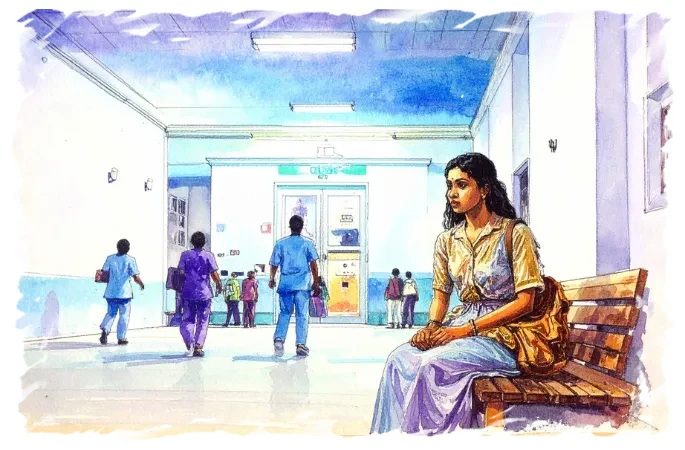
I am sitting in front of the Intensive Care Unit (ICU) of the Colombo General Hospital. Doctors and nurses are running here and there, people shouting in the background, while I am gazing at the door of the ICU without blinking and without having any idea of what is happening around me.
I got lost in my thoughts. How did I end up here? What happened to my mother? What does she look like now? Why did our lives end up in this situation?
Let me tell you our story of tears, the price of our dream.
We live in a plantation community, on the border of the Colombo and Kalutara districts. People call us ‘Wathu Demalu’ because we are descendants of hill country Malayaha Tamils, and we lived in an area where the majority of the people were Sinhalese. We have worked for the estate factory for years, or the garment factory in the area.
When I was just four years old, my mother left me for work in Kuwait as a housekeeper. She had got married young, around when she was sixteen, and had me when she had just turned seventeen. My father is an estate worker who worked for the plantation company for a minimal wage. The money he made wasn’t enough for us to cover three meals a day. He was an alcoholic. All the money he earned was spent on the hands of local alcohol suppliers. My mother tried her best to earn enough money to buy me a tin of milk powder. But every time, the money was not enough. We lived in a very small line room in the estate. There was no electricity in there. Most of the people who lived in the line room worked for the estate authority.
My mom was a woman with dedication. She was just twenty-one years old, but she wanted to give me the best. So, she decided to go and work in the Middle East. It was fifteen years ago. I still remember the day she left with a big travelling bag, which she secretly bought from a thrift shop in Ingiriya when she went to the hospital to get my MMR vaccine. Inside the bag, there was only one new but cheap saree. The rest were all worn out. Before she left, I remember she gave me a big hug and some advice.
‘I will send money each month. Spend well and have the best education. Go to the school in town. Go to university. Save money and help your father build a nice home for us. When you become a pretty young lady, I might not be there to protect you, but you should take care of yourself. Do not ever let a man inappropriately touch you, even your father, mark my words!’ she said.
She knew what kind of world, society, and community we live in. Even today, she is my hero.
After she went to Kuwait, every month she wrote a letter to me. It was addressed to me under my father’s name. Inside the envelope, she had secretly put pressed little flowers and tree leaves from Kuwait, maybe because she couldn’t send a better gift for me, now I only realise it. In those days, receiving a letter to my own name was a huge win for me. I ran all around the estate showing the letter to neighbours. But nobody seemed to care, even my father didn’t glance at it, because he had already received the money my mother had sent. That money was everything he ever wanted.
With time, I noticed a huge change in my father. That was not a good change, but a bad one. A really bad one. Each time when my mother sent him the money she earned with her blood and sweat, he spent all the money only on himself. He started drinking alcohol more than ever. He started partying all weekend with his friends and always wanted to show off the money: the money my mother sent him to build our dream lives. At the end of each month, he had not a single rupee to spend even on our meals or my education. Whenever I asked him for some money to buy books or go to a tuition class, he always said he had no extra money.
With the education quality of the schools in our community, attending tuition classes was a must, because we did not have enough teachers to teach us. Our school had classes only up to Grade 9, and the school was situated far away from the main road. We never received enough attention from the government or any other institution. The main issue was with the language. Our schools were taught in the Tamil medium, but we lived in an area where the majority of the Sinhalese lived. But there were none to teach us Sinhala. There were some small tuition classes in the area, and all the children went to those just to cover the basic curriculum. But according to my father, he had no money to send me to a tuition class.
I was good at studies. When the Grade 5 scholarship exam came around, I studied hard, on my own, because I always remembered what my mother told me when she was leaving. At the exam, I couldn’t answer the questions about the Sinhala language, but I did well with the other questions. Then, after a few months, the results came out. I was the only one who had passed the scholarship exam, even in the history of my community. I had good results to go to a school in the town. A big national school. That was my mother’s dream after all. But my father said he had no intention of sending me to a school in the town. Said he could not afford it. But my mother didn’t know anything. She sent a good amount of money each month, just to be wasted in my father’s hands. Meanwhile, those letters she sent me each month became fewer. She only sent letters once every few months. Yet she ensured to put something inside the envelopes. Sometimes it was toffee wraps or small papers torn into the shapes of flowers or stars.
Since my father didn’t support me in going to a good school, I started going to the same community school. The school lacked all the facilities and human resources, yet I was determined to study hard no matter what.
When I was at the age of thirteen, puberty hit me. One of my neighbour aunts, who was always kind to me, was by my side during that time. My father was thrilled because he could have another party and spend more money, and show off. He organised a grand event just to celebrate me starting menstruation, according to our traditions. But I was lonelier than ever. I remember crying in the corner of our only room, thinking how good it could have become if my mother were there with me. She didn’t know that her baby girl had become a young lady that day. She would have been happy if she had known. I secretly envied my friends whose mothers were taking care of them. I loved watching them cuddle and laugh.
At the end of age fourteen, I was supposed to go to another school in the area because my school had classes only from Grade 1 to 9. Those who were good at studies and whose parents supported their education went to that school. But my father wanted me to stay home or go to work. For the first time in my life, I had a fight with him. I was out of patience. I cried and tried to convince him to let me go to school. But nothing worked. And finally, I had to stay home. Those were the darkest days of my life. I decided to earn money. I went to pluck tea leaves with my neighbour women, I went to work in the estate factory, and even went to do chores in the wealthy homes of the area. I tried my best to earn my own money. Also, I wanted to save some money to build my mother’s dream home. But I had to forget my dream of education. That was the worst thing that could happen to a child.
When I turned eighteen, I went to work at the garment factory in the area. But the main issue was the language. I only spoke Tamil, and most of the workers were Sinhalese. But then, I secretly started to listen to their conversations, and within a few months, I was able to catch their words and conversations. There was some discrimination at the workplace, but I never gave it a thought, and I worked hard. A guy who was working in the garment with me expressed his love for me a few times. He also seemed a good guy, but I decided to ignore him because I had no time for romance. I had to survive. Meanwhile, the letters from my mother had stopped, and I started to feel that something was wrong. I spent my days looking at the only photo of my mother I had.
Then the unforgettable day came. I got home after work, and my hands were swollen because of the heavy work. I was all alone in the line room. My father still hadn’t come home yet since he had gone to drink alcohol. I heard one of my neighbour uncles come screaming, and he said the superintendent of the estate had summoned my father, saying something had happened to my mother. I couldn’t wait for my father. I ran at the speed of light. The superintendent told me to go to the Colombo General Hospital as soon as possible and said my mother is there. I was confused.
My mother? How? Isn’t she in Kuwait? When did she come? Why is she in the hospital?
To all these questions, there was only one answer. ‘I should go to Colombo, just now, in this moment, but how? I don’t care, I am going, I want to see my mother.’ That was the only thing my mind said.
It was around nine at night. I put a few clothes and a water bottle into my old school bag, and then I convinced one of my cousin brothers to drop me off at the Ingiriya bus stand on his bicycle, and I learned the way to go to the hospital. I got on the last bus of the day to go to Colombo, and I was all alone. But my heart was tougher than ever. The bus started to run. It took three hours for the bus to reach Colombo, but I felt it as forever. I pictured all the possible scenarios in my mind that could have happened, like a film, but I was very careful not to think any bad things about my mother, because she is my mother, simply my loving, strong mother.
Somehow, I managed to go to the hospital with the help of the bus driver. He was a friend of my cousin who dropped me off at the bus. I asked the hospital reception about my mother, and they directed me to the Intensive Care Unit (ICU).
This cannot be true; my mother is in the ICU. But why?
After around two hours, doctors came out of the unit. The chief doctor wanted to talk to a family member. So, I entered his room. Then, from him, I learned the truth. My mother had been tortured and punished in the home where she was working in Kuwait. Doctors had found a bunch of iron pins in her stomach. Her condition was serious. She had been sent back to Sri Lanka because she was sick for months, and they had no use for her. Finally, my mother had contacted the agency and managed to come to Sri Lanka. When she was conscious, she had asked to see me. Tears started rolling down my face.
I’m here, but when is she waking up? When can we go home again? When can I hug my mother for the first time after so many years? I had a lot of questions to ask her.
Three days have passed, but I am still waiting in front of the ICU, hoping for some good news. I can take care of her for the rest of my life. But all her sacrifices are in vain. All the money she earned by enduring all this pain has gone to waste for alcohol and parties. Her dream home is still a dream; her daughter has only had an education up to Grade 9…
What will she feel? Who is responsible for this? The government? Civil society? Or is the whole country like this? Is it just us, the forgotten, the marginalised? No, it cannot be. There must be more people like us. People who work hard, who dream, who sacrifice. But no one, no one should have to end up like this. Not for being poor. Not for being a woman. Not for being born into the wrong corner of this country.
This is just our story…
‘Hey, girl… your mother is awake. She wants to see you…’ someone said. I’m over the moon.
I step into the room. She’s lying there, thinner than I remembered, her eyes tired, but alive.
“Amma…”
She looks at me and tries to smile. I hold her hand. No words come out. We just cry.
I know I can’t bring back the years. I can’t heal her scars.
But from today, I will be the mother to my mother. I will rebuild her dream, brick by brick, with my own hands.
.