
 Swarnavel Eswaran
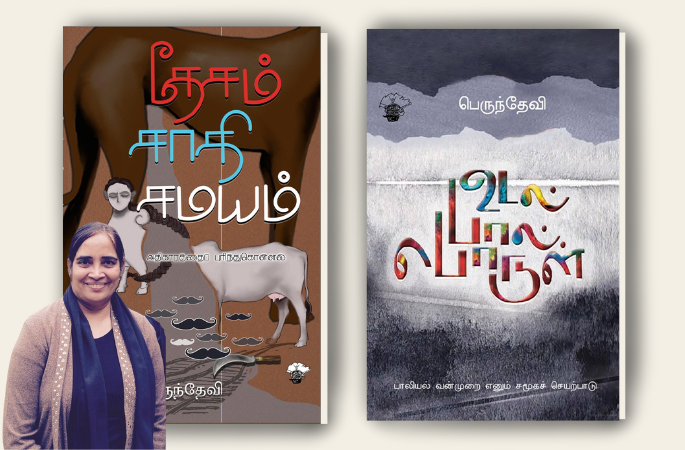
Perundevi. (2019). Udal-paal-porul: Pāliyal vaṉmuṟai eṉum camūkac ceyalpāṭu. Kalachuvadu Publications.
Perundevi. (2021). Desam-saathi-samayam: Adhikarathai purindhukollal. Kalachuvadu Publications.
It is a rare gift for a preeminent poet also to be one of a generation’s most formidable public intellectuals. In the contemporary landscape of Tamil letters, Perundevi has firmly established herself as one of its most essential critical voices. Celebrated for her vital contributions to contemporary Tamil poetry, she straddles the worlds of creative intuition and scholarly rigor with a grace that belies the fierce urgency of her work. Her prolific output as a poet and fiction writer is matched by the incisive power of her critical essays. In her collections, including Udal-Paal-Porul: Pāliyal Vaṉmuṟai eṉum Camūkac Ceyalpāṭu (Body-Sex-Object: Sexual Violence as a Social Practice) and Desam-Saathi-Samayam: Adhikarathai Purindhukollal (Nation-Caste-Religion: Understanding Power), she undertakes a profound intellectual excavation. A Professor at Siena College, Perundevi brings a formidable scholarly vision to her work, drawing on her academic background in cultural anthropology and South Asian religions to seamlessly connect ancient myths, colonial histories, and contemporary media events, delving beneath the surface of social phenomena to uncover the intricate, intersecting roots of power.
Her work, taken as a whole, posits a central thesis: that power operates through interconnected axes, where the regulation of gender and sexuality is inextricably linked to the dominant ideologies of nation, caste, and religion. Across her work, a single, resonant chord is struck: power is not a monolith but a rhizome. At the heart of this vision is a sophisticated theoretical framework deeply indebted to post-structuralist feminism, particularly the work of philosopher Judith Butler. Perundevi explicitly rejects essentialist understandings of “man” or “woman,” deliberately employing the Tamil term tannilai (subject/subjectivity) over suyam (self) to emphasise that identity is not a pre-given essence but is a constant state of becoming, forged in the crucible of social and historical forces and their attendant discourses. This lens offers a devastatingly clear insight: sexual violence is not a mere sequence of criminal acts but a complex “social practice” (camūkac ceyalpāṭu), a brutal, systemic ritual designed to produce and police gendered subjects within a suffocating heteronormative order. As she clarifies, her focus is on “the social violence that regulates sexualities,” shifting the analysis from singular events to the continuous, systemic pressures that shape and control individuals. By refusing to place caste, gender, and religion in separate intellectual silos, she reveals the deep, unifying grammar of oppression.
Integral to this intellectual project is a conscious and deliberate philosophy of language. Perundevi recognizes that to introduce new theoretical paradigms into Tamil discourse is to forge a new lexicon, a task she undertakes with intellectual precision, even at the risk of challenging readerly comfort. In her preface to Udal-Paal-Porul, she reflects on the difficulty of finding appropriate technical terms/jargons (kalaiccoṟkaḷ), noting that a word like etirpāliyal (heteronormativity) might initially appear “coarse” (karuṭumuraṭākat terikiṟatu). However, she defends this aesthetic choice as a necessity for intellectual progress, asking, “But without words that we are not so accustomed to, how can we advance new approaches, new inquiries?” Her prose is not for adornment; it is a precise tool for deconstruction, deliberately moving beyond lyrical ease and “worn-out slogans” to build a vocabulary capable of dismantling entrenched power structures. This forging of new kalaiccoṟkaḷ is itself a political act, creating the very language needed to articulate a new vision of social reality.
The Blade of Intersectionality: Deconstructing Violence, Language, and Culture
Perundevi’s sharp analytical method is most potent when turned toward the raw wounds of caste and gender violence. In her deconstruction of so-called “honour killings,” she powerfully critiques the very term kauravak kolai (honour killing) as a political and ethical misdirection. The phrase, she argues, is a poison chalice: it validates the perpetrator’s worldview by centering their “honour” (kauravam) while simultaneously allowing dominant discourses—both Western and Indian- to frame the violence as a primitive pathology of “other” communities, such as those in South Asia or Islamic cultures. This focus on the ephemeral emotion of “honour” conveniently veils the material realities of property, political consolidation, and the raw assertion of caste dominance. In its place, she insists on a term of stark clarity: peṇ virōta cātiyak kolai (misogynistic caste killing), a linguistic intervention that drags the brutalised woman (peṇ) and the structure of caste back into the unforgiving light.
This same critical intensity illuminates her analyses of contemporary events. In dissecting the sexual harassment allegation against former Chief Justice of India, Ranjan Gogoi, she theorizes how institutional powers work in concert to invalidate female testimony, perceiving them not as a series of isolated opinions but as a unified “circulatory system” of doubt. A woman’s words, she argues, are immediately rendered a “tainted witness” (kaṟaipaṭinta cāṭciyam) because they are “inconvenient truths” (vacatiyaṟṟa uṇmaikaḷ) that threaten to disrupt established power structures. Similarly, she frames the Pollachi sexual abuse scandal not merely as a series of assaults but as a violent enforcement of “family order” (kuṭumpa oḻuṅku), where the policing of female desire is central to maintaining social hierarchies.
Her reading of the film Pariyerum Perumal is equally sharp. She argues that the film’s radical power lies in its protagonist’s refusal to participate in the toxic “masculinity discourse” (āṇmaic collāṭalkaḷ) that defines and distorts inter-caste conflict. The film’s pivotal image, for Perundevi, is the protagonist’s father, a folk artist who performs in “female guise” (peṇ vēṣam)—being stripped and brutalised. This is not merely caste violence, she argues, but a violent exorcism of a body that defies rigid gender binaries, destabilising the very definitions of masculinity to which the dominant-caste youth cling. Pariyan’s liberation comes not from winning a patriarchal contest for the dominant-caste woman but from disengaging from its terms. He achieves this first by rejecting a romantic relationship with the girl, Jothi, and second, by embracing his father, thereby denying the very definitions of traditional masculinity upon which the contest is predicated. The film’s quiet, tense conclusion, two men, two teacups, is not a surrender but a radical call, drawn from the thought of D.R. Nagaraj, to replace the cycle of violence with the problematic, fragile work of mutual recognition.
The Politics of the Page: Literary Deconstructions
Perundevi offers similarly unconventional readings of modern Tamil literature, seeing in them cultural sites where gender norms are produced and contested. In her analysis of Jayakanthan’s famous short story, ‘Akkini Pravesam,’ she moves beyond moral interpretations to locate its true revolutionary power in the “conceptual removal of sexuality from the act of rape.” She illuminates the mother’s dialogue, which reframes the violation not as a sexual act laden with shame but as a profane, almost mundane event that can be washed away, thereby stripping the act of its power to define the victim.
Her analysis of Jayakanthan’s novel Sila Nerangalil Sila Manithargal reveals her debt to Foucault, arguing that modern power operates not just by silencing sexuality but by forcing it into endless discourse as a means of control. She treats the opening scene of harassment on a bus not as a mere plot point but as a “cultural text” (paṇpāṭṭup pirati) that illustrates the insidious process of normalization. The character of the uncle, Vengu Mama, becomes a quasi-clinical figure who relentlessly interrogates his niece about her sexual experience, turning the family space into a site of investigation where sexuality is constantly spoken of, analyzed, and thereby regulated. In this Foucauldian reading, power is not merely repressive; it is productive, creating a specific kind of sexual subject. In a similar vein, her reading of Pudumaippithan’s ‘Vipareetha Aasai’ inverts the typical narrative focus. Instead of centering on the victim’s suffering, she interprets the story as a profound exploration of the perpetrator’s psychological unraveling, revealing the internal logic of patriarchal violence.
Unmasking the Anxieties of Culture
Perundevi’s gaze turns with equal force to the anxieties pulsing beneath the surface of literature and society, revealing the subtle and overt ways caste logic operates. In her review of the influential anthology Saathiyum Naanum (Caste and I), she offers a crucial feminist critique, arguing that while the work is vital in its depiction of caste violence, it largely fails to analyze the intersection of caste with gender and heteronormative power. She points out that the logic which views women as property to be controlled—the peṇ-nilam (woman-as-land) paradigm—is fundamental to how caste reproduces itself, an aspect she finds underexplored.
This unsparing gaze is sharpened in her polemic against the uncritical celebration of Dravidian literature as purely “rebellious literature” (kalaka ilakkiyam). While acknowledging its vital role in opposing Brahminical dogma, she turns to the short stories of the ideologue C.N. Annadurai to reveal the movement’s deep-seated patriarchal shadow. She demonstrates how, even as it dismantled one form of orthodoxy, it simultaneously reinforced another, creating what she memorably terms a “husband-centric literature” (kaṇavaṉ maiya ilakkiyam). In this world, women who exist outside the strictures of marriage are punished, their lives circumscribed by a new, but no less rigid, patriarchal order.
In her analysis of Perumal Murugan’s Madhorubhagan, she cuts through the superficial debate over religious sentiment to expose the novel’s actual transgression: its violation of caste purity and patrilineal succession. The violent backlash, she argues, was fueled by the unspoken terror that the “god-given child” of the temple festival—a practice she links to the ancient concept of Niyoga—could be born to a Dalit man, thus polluting the dominant caste bloodline. This anxiety, she shows, is deeply tied to the material realities of land, property, and the consolidation of economic power.
Her analysis also dissects the gendered nature of the nation. In the essay “Cow, Motherhood, Hindu Nationalism,” she examines the process by which the cow is transformed into a sacred national symbol—a holy, vulnerable mother whose body must be protected from defilement, mirroring the ideal of woman as a passive, reproductive vessel. Her reading of the film Enthiran unmasks a different kind of myth-making, where the rogue robot’s chaotic desires must be dismantled in service of the rational, productive nation-state. In “Transnational Writing,” she explores the “dual displacement” of migrant women, whose loss of the motherland is compounded by the loss of the mother’s home. Finally, in her analysis of Sundara Ramaswamy’s Thiraigal Aayiram, she reveals the cruel paradox of “the performance of victimhood,” where a woman who has been violated must erase her subjectivity and conform to a public script of suffering to be believed. Her work is also fiercely contemporary, utilizing its theoretical lens to dissect recent phenomena, such as the #MeToo movement, which she analyzes as a powerful form of “collective agency” (kūṭṭu cuyātīṉam) that provides new platforms for testimony and resistance.
Beyond Critique: A Vision of Freedom
While much of her work is a meticulous deconstruction of oppressive systems, it is not without a vision of what lies beyond them. In one of her most poignant essays, “In a space without dress or honor, I wish to dance with joy,” she moves from critique to a more philosophical plane. Using the tragic case of athlete Santhi Soundarajan, who was stripped of her medals after failing a humiliating “sex verification” test, Perundevi critiques the brutal, categorical violence of imposing rigid biological definitions of male and female. The essay becomes a call for a more fluid understanding of identity, gesturing toward a utopian space of liberation—a world free from the oppressive “dress and honor” of fixed gender roles, where one can, and joyfully, be.
The Scholar-Poet of Our Times
In an age of increasing specialization, Perundevi stands as a testament to the power of the scholar-poet. Her critical essays are not divorced from her creative wellspring; instead, they are nourished by it. The poet’s sensitivity to the nuances of language, to the weight of a metaphor, and the subtle music of human experience informs every line of her analysis. Conversely, the scholar’s unsparing analytical rigor gives a profound intellectual backbone to her creative vision. This seamless integration of the analytical and the lyrical, the critical and the innovative, makes her a unique and indispensable voice. She does not simply write about culture; she inhabits its language, feels its pulse, and then, with the precision of a surgeon and the heart of a poet, reveals its innermost workings.
Conclusion: A Language Forged in Fire
Perundevi’s work, in its entirety, represents an act of immense intellectual courage, rigor, and political urgency. She forges a new vocabulary for Tamil critical discourse, one that is unafraid of its theoretical weight because she understands that new thoughts require new words. By weaving together literary analysis, film criticism, and social/cultural theory, she not only comments on the world but also provides an essential toolkit—a set of new kalaiccoṟkaḷ—for its deconstruction. By refusing to treat caste, gender, religion, and nation as separate domains of inquiry, she exposes the profound, structural logic that connects them. Her essays are academically accomplished and are a profound and necessary political intervention. They are a demand that we see the world in its full, intersecting, and often brutal complexity, and in doing so, find a new language for resistance. This is not just criticism; it is a crucible, forging in the fire of its analysis a new language for understanding—and resisting—the intricate nexus of power in modern India.
Works Cited
Butler, J. (1990). Gender trouble: Feminism and the subversion of identity. Routledge.
Foucault, M. (1978). The history of sexuality, Vol. 1: An introduction (R. Hurley, Trans.). Pantheon Books.
Murugan, P. (Ed.). (2012). Saathiyum naanum. Kalachuvadu Publications.
Perundevi. (2019). Udal-paal-porul: Pāliyal vaṉmuṟai eṉum camūkac ceyalpāṭu. Kalachuvadu Publications.
Perundevi. (2021). Desam-saathi-samayam: Adhikarathai purindhukollal. Kalachuvadu Publications.