
 FemAsia Team
Power, Performance, and the Politics of Seeing
Some gazes pierce more deeply than words might.
And there are looks that heal what was broken.
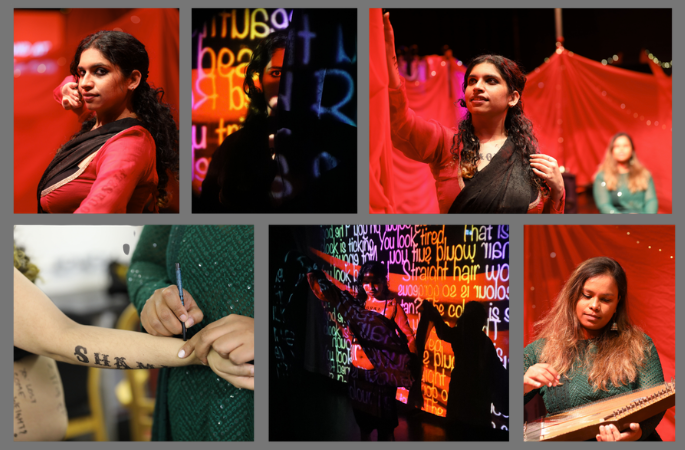
In The Gaze – you, me, us, and them, Himadri Madan does not just take the stage; she orchestrates a bold upheaval. Guided by postcolonial feminist thought, we become more than observers. We are drawn into an ancient rite of seeing, one that shapes who is noticed, valued, understood, and acknowledged as truly human.
The gaze, after all, is never innocent.
Melding Bharatanatyam, Kathak, Bollywood movement, theatre, live music, and interactive installation, The Gaze slips seamlessly across genres, illuminating women’s lives beneath society’s relentless scrutiny. It pulls us inward. It mirrors us. It demands that art and politics remain inseparable. From colonial ethnographic photography to today’s digital surveillance systems, looking has always been a tool of power. Empires catalogued bodies. They classified skin, clothing, posture, and gesture. They decided who was modern and who was primitive. The colonised subject was not only ruled but also displayed.
Feminist scholars such as Laura Mulvey have shown how cinema constructs a “male gaze” that reduces women to spectacle rather than subject. For women in the Global South, the gaze is layered. It is patriarchal, racialised, and Orientalist. It looks with fascination, suspicion, and pity. Madan’s framing of “you, me, us, and them” rejects a single viewpoint. We are not only the watchers or the watched. We shift between positions. We internalise scrutiny. We reproduce it. We are implicated.
Classical Indian dance forms carry reverence, devotion, and lineage. And they also carry expectation.The female dancer must be expressive but modest, graceful yet held back, present yet always confined. According to The Dancing Body: Labour, Livelihood and Leisure, contemporary discussions about dance in India closely examine the dancer’s body, highlighting both its celebrated and scrutinized aspects. Himadri reflects on her experiences dealing with these pressures as a dancer in India and the UK. Her body’s uneasy duet with scrutiny becomes the heart of the stage. The performance asks us to witness not just women’s defiance of patriarchy, but also the moments they unknowingly reinforce it. Shame, once internalised, becomes motion.
Part of the installation draws inspiration from Draupadi by Mahasweta Devi, a strong narrative confronting the violence enacted upon female bodies and the weaponisation of humiliation. The reference situates this performance within a longer South Asian feminist genealogy. The classical stage is not separate from political history. The body remembers.
The Body as Archive
In Madan’s work, the body does not sit quietly. Defiance glimmers beside exhaustion. Eyes overflow with untold stories. Intimacy hovers, refusing to be easily consumed. The figures remain partly hidden. Withholding is their power. We see this as a political act. For generations, brown and Black bodies have been put on display and silenced. Exhibited in museums, made glaringly visible in media, yet stripped of their own stories. Withholding becomes a way to reclaim selfhood. The choreography evokes fragmentation. Identity settles in shifting layers: colonial pasts, national fears, gendered demands, and the ever-watchful eyes of community. The gaze does not simply land on the body. It reshapes it.
From Empire to Algorithm
Where empires once mapped and photographed, today’s authorities trace and quantify through endless data streams. The rigid lines of colonial maps have given way to the glowing web of digital algorithms; extraction now moves from bodies etched on glass to identities scattered across glowing pixels. The gaze has migrated to the digital realm. We craft our own images, yet unseen algorithms still judge us. Pictures drift, stripped of context. Our bodies dissolve into digital points. In South Asian contexts, especially, women negotiate multiple audiences at once. Family. Community. Nation. Diaspora. Strangers online. The gaze comments, judges, screenshots. The Gaze, through its interactive installation, refuses to let the audience remain passive. Before the main performance, viewers wander through a space echoing the performer’s journey. They are called to confront their own reckonings with shame, expectation, and what it means to be seen. The gaze becomes relational.
Who Is “Them”?
The word that unsettles most in the title is not “gaze,” but “them.”
Who becomes them?
Religious minorities. Migrants. Lower castes. Queer communities. Hijabi women. Darker skin. Ageing bodies. Poverty. The Empire once used “them” to name entire regions of the world. But “them” is also a local category. According to Susanna Mancini, patriarchy is not simply imported from elsewhere but is also present and reproduced within the home, and Madan avoids associating patriarchal practices exclusively with any single group or culture. The boundary is always moving. At any moment, the viewer might glimpse themselves in that word. Here, the work slices with moral clarity.
To examine the gaze is to examine ourselves.
How do we look at domestic workers?
At queer youth?
At women who refuse modesty scripts?
At women who embrace them?
The gaze is not only global; it also threads through our own communities, determining how we see and judge one another.
Himadri shares the stage with Ankna Arockiam, an artist whose work bridges Indian and Western classical forms. According to Tarak Mehta, modern South Asian women artists use their collaborations to challenge traditional ways of looking by choosing solidarity over isolation, facing the gaze together as a form of resistance. All performances are designed to be accessible with audio description and integrated captions. Accessibility is not peripheral but embedded. By foregrounding access, the work confronts ableist structures of looking that have long intersected with the ways race, gender, and difference are policed on stage. In a work concerned with who gets seen and heard, this choice is significant.
At FemAsia, we seek art that unsettles, not soothes. The Gaze – you, me, us, and them lingers in discomfort, refusing to offer easy answers. There are moments when the subject quietly returns our gaze. Not with aggression or spectacle, but with a perceptive presence. When the gaze is returned, power shifts. To be looked at without consent is one experience. To be witnessed with dignity is another. The difference lies in care, context, and accountability.
Representation is never neutral. Visibility does not automatically equal freedom. Sometimes, the most radical act is to claim the frame for oneself.The gaze is everywhere. The question is not whether we participate in it. The real question is whether we allow the gaze to define us, or whether we choose to see with new eyes.
Himadri Madan is a performer, choreographer, and dance teacher trained in Bharatanatyam, Kathak, and Bollywood. She holds a BA (Hons) in Choreography from Bangalore University and an MFA from Trinity Laban Conservatoire of Music and Dance, London. Selected for Sadler’s Wells’ South Asian Dance Development Programme in 2024, her work blends Indian classical forms with socially and politically engaged contemporary performance. A core member of Theiya Arts, her recent works include The Ticking Clock, Maiden | Mother | Whore, and The Gaze – you, me, us and them.