 Sreedeep Bhattacharya
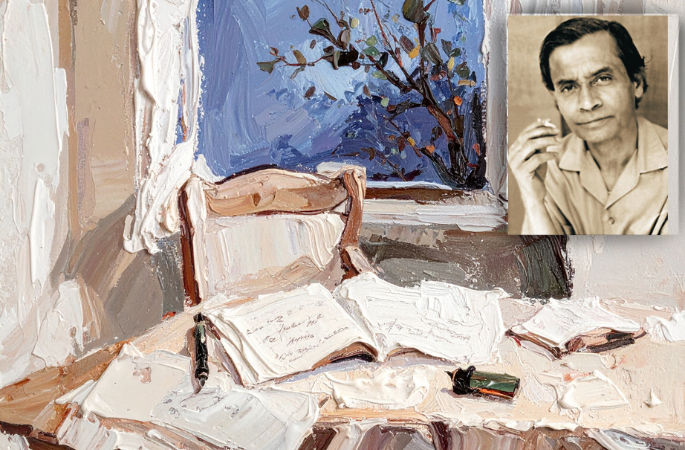
Most readings inform; only a handful wound, unsettle, or illuminate. Fewer still insist on an immediate translation, demanding to travel beyond the confines of their original language and find a wider readership. In my early twenties, I devoured several novels by Buddhadeva Bose. Recently, I turned to his collected essays, spread across four volumes. One essay on solitude held me captive.
As I sit in Merak—the last inhabited village on the shores of Pangong Lake—recording my reflections on that piece, I am struck by its unexpected warmth. Outside, June has surrendered to snowfall; my fingers are numb with cold. Yet Bose’s meditation on solitude continues to radiate a quiet heat, reminding me that some writings transcend weather, geography, and time.
Solitude and Company is a deeply introspective meditation on the creative significance of silence, solitude, and self-reflection. The essay is unapologetically self-absorbed—in tone, structure, texture, and subject matter—but never in a manner that feels vain. Rather, its inward gaze becomes the very condition of its philosophical inquiry.
The author finds himself stranded in a state of creative paralysis. Unmotivated and unable to write, he spends a substantial portion of the essay anatomizing the conditions that have produced this impasse. What might ordinarily appear monotonous—a prolonged account of creative stagnation—is transformed into a compelling exploration of artistic exhaustion. The essay dwells on the experience of blockage: a shutdown of imagination, a suspension of momentum, a lingering state of stasis.
Bose candidly acknowledges his creative decline. Words no longer arrive with their former ease; memory, once a faithful collaborator, now betrays him. Yet the irony is striking. Even as he laments his diminishing powers, he demonstrates an extraordinary ability to render that diminishment intelligible. His creative incapacities become the subject of creative expression. The failure to write is itself written into existence with remarkable elegance and precision.
The condition Bose seeks to describe, decipher, and ultimately overcome is not merely a familiar case of writer’s block. It is something far more pervasive and existential: a gradual erosion of expression, identity, purpose, and desire itself. What confronts him is not the temporary inability to write, but the unsettling prospect of becoming estranged from the very self that once wrote.
Armed with solitude, relentless introspection, and an unusual degree of self-sensitivity, Bose turns himself into both subject and observer. He watches, almost clinically, the slow process of his own fading—the diminishing of creative energy, the weakening of conviction, the creeping suspicion that his most vital faculties may have deserted him. There is neither melodrama nor evasion in this self-examination. Instead, the essay derives its emotional force from the author’s willingness to remain in the company of his own decline.
Most strikingly, Bose does not conceal his fear of self-extinction. He acknowledges it with remarkable candour. Beneath his reflections on creativity lies a deeper anxiety: that the loss of artistic expression may also signify the loss of a coherent self. The essay’s central drama, therefore, is not between inspiration and blockage, but between being and disappearance.
The remainder of the essay traces a gradual process of self-recovery, as the author begins to discover new meanings in life, experience, and existence itself. Through sustained introspection and deliberate self-intervention, an existential crisis is transformed into a search for inner equilibrium and unsuspected possibilities. What begins as a narrative of creative exhaustion slowly evolves into an account of creative renewal—one rooted in self-sufficiency, self-knowledge, and a deeper sense of fulfilment.
Most significantly, Bose reconfigures solitude. The fear of being alone, or the inability to endure one’s own company, gives way to an active and self-generating engagement with the inner workings of consciousness. In this process, the self enters into a quiet collaboration with nature and learns to move in harmony with time rather than in opposition to it. Solitude ceases to be a condition of deprivation; it becomes a mode of perception.
The essay is not a romantic defence of idleness, nor is it a celebration of withdrawal for its own sake. Rather, it functions as a subtle manifesto for alternative ways of seeing, feeling, and understanding life. By placing the self at the centre of creative labour, Bose challenges the modern cult of restless productivity. He urges the reader to abandon the compulsions of haste, anxiety, and perpetual busyness in favour of a more immersive solitude—one enriched by attentiveness, contemplation, and occasional companionship from the non-human world.
In this sense, Solitude and Company is not merely an essay about loneliness or creativity. It is a meditation on how one might reclaim agency over one’s inner life in a culture increasingly organised around distraction, acceleration, and performance.
‘Solitude and Company’ by Buddhadeva Bose translated by Sreedeep Bhattacharya
A person’s age keeps increasing. In its initial stages, it can be termed as growth and in the final stages—it is nothing but decay. I, who have now arrived at that latter stage, have for some days, begun to perceive clearly that deterioration. The physical and mental faculties have weakened to such an extent that one almost feels stunned. Even a few days ago, I could read a book in any kind of light. But now, my eyes have been so strangely affected that without glasses world-literature appears dim, and even with glasses the whole world seems blurred.
What more can be said about memory—its behaviour has taken shelter in the strand of insanity. At times such a state arises that, to recall the spelling of a simple word, one must consult a dictionary. And some trivial incident that should easily be forgotten remains stuck in the mind, refusing to depart until it has been replayed and retrospected again and again. Along with this has arrived a curious state of indecision: what should be done, what should not be done, what will happen, what will not happen—such ordinary doubts of daily life now leave me constantly bewildered. Before going to sleep, whether I had locked the door or not—to reassure myself, I repeatedly leave the bed and check again and again. Many people perhaps experience such things in life; but my discomforting confusion has advanced to such a point that before dropping a letter into the mailbox, I read the address ten times over—the house number, the street name, even the name of the city—yet still cannot trust myself that I have not made some mistake.
And whenever I sit down to write, no words seem to come. Thus the army of doubts surround me most stubbornly. Words and thoughts begin to play hide-and-seek in such unruly ways that; and ungainly display blockades of impossibility; and display such disorder that this act of writing has gradually become almost impossible for me. Twenty years ago; ten years ago; even five years ago, what used to be written in merely three hours now demands that I run a continuous cross-country race for the entire day just to finish it. In the process, how many times I have struck my knees against table edges, how many times I have stumbled into drains and ditches—the evidence of all this lies in the overgrowth of scratches and scars in the drafts, and in the countless traces of discarded notes and torn efforts that are thrown in the trash can underneath my writing desk.
Of course, such incidents have not occurred for the first time only in my life, nor is there any assurance from modern science that they will not happen in the lives of others for the last time. Therefore, trying as far as possible to avoid exaggeration, I have attempted to accept the matter calmly; I assume that the disease will continue to grow deeper and lock-downs will continue until there is a complete shutdown. And what other remedy is there? When one must burn down one’s own house in order to drive away the enemy, then war can no longer continue. When nature itself takes matters into its own hands, who has the power to oppose it?
Secretly, I had built up a certain compromise with the un-spelt reverse side of life that remained lodged within life itself. I even imagined at times that I might transform the compromise into a mature conviction. But at precisely that moment, the obstacle appeared. As I was arranging the final terms and conditions of the draft one by one, suddenly a symptom caught my eye. A doubt arose—not quite a doubt but a belief that my condition was gradually improving.
I do not say this arrogantly; I say it with profound sense of anxiety. For the meaning is not that I have attained some lofty spiritual wisdom; rather, it means that along with the decline of creative power, my capacity for unrest and anarchy has also diminished. Among ordinary middle-class people like us, two things remain curiously intertwined: if the share of unrest decreases, one must understand that we are approaching extinction and one’s identity is on the verge of getting rusted. My condition is improving—that means I have lost my true character and identity. I can no longer express myself intensely. I am getting more and more confined and content with smaller gains and trifling matters. I have become more patient than before; even when contradicted I no longer flare up in anger; if my wishes are obstructed, I do not curse fate; even when inwardly I burn with agitation for ten whole minutes, outwardly I can sit without revealing more than a faint trace upon my face.
That is to say, the impulses and the sharpness of my personality—what people call my faults and what I would call the campaigns of my existence—have begun to abandon me one by one. Slowly I am moving toward a harmless, flavourless, ordinary goodness—in other words, I am fading away or drowning. Beyond this, I know nothing more terrifying. I feel supremely concerned about myself. If the other blows of time can somehow be endured, this humiliation does not seem bearable—at least not yet. I feel perturbed about myself. To seek some initiatives in speech and behaviour, and to conceal the signs of this despondency, I restlessly wander everywhere—only to plunge further into a depressing zone. If things continue in this manner, then one day, inevitably, the editors of newspapers will describe me as “a noble friend, affectionate father, and ideal husband”—and the thought alone increases my fear of extinction.
With this condition of mind, I had to leave Calcutta and come far away. A new country, offering unfamiliar faces, and for the present I have neither the means nor the strength to establish a permanent or fake friendships. The task for which I have come here does not demand anything great. Survival rests upon my savings. I have taken up residence in a desolate village—or not exactly a village, rather at the far edge beyond the city—which is devoid of neighbours that: “whether heavy rain fell yesterday,” or “can waterlogging occur in this place?”—there is not even the slightest possibility of getting into such conversations here. What is called gossip, that cheap form of sociability, has completely ceased; there is scarcely any occasion even for the mechanical use of words. Recently I have spent several days in such a way. Apart from instructing or thanking my overtly silent servant, two or four times day, I have not uttered a single word.
For the sake of change and variation, all that I have done is: travel from one room to another, or leaving the room and sitting on the veranda, or strolling alone over the grassy ground in front of the house at evening. I go nowhere, no one comes. Outside there is grass, trees, sky; inside there is only my own mind. Yet the days are not dragging on tediously like or feeling chocked. Rather, with such an easy and fluid motion, the calendar pages keep turning one after another that I myself am astonished.
From this I have made a new discovery about myself, which makes me feel that I am perhaps not entirely a man of society after all; perhaps there has always existed somewhere within me a tiny seed of solitude. And now it seems that the strength of that solitary impulse has grown stronger. I no longer merely have to tolerate loneliness—but to relish solitude is no longer a terrible impossibility.
Earlier, this capacity was not there in my youth. Among all the conditions of human life, loneliness was perhaps what I dreaded the most. Loneliness does not simply mean being companionless; it means the lack of all means by which the mind may be kept occupied. In younger days, these means appeared to me very clear and tangible—confined within a few specific activities. As long as a person remained awake, I believed, s/he must remain engaged—either working, or conversing intimately with loved ones, or reading books and watching plays, or at least passing time by moving from one place to another. Beyond these, I could imagine nothing. Having no work in hand, no book either, and merely sitting silently by oneself—this was the sort of picture that was beyond my imagination.
I have seen certain people who can sit alone doing nothing, or remain quietly absorbed in themselves; I have pitied them, and at times envied them too, but such idleness was never granted to me. Perhaps there was always within me a small but intense restlessness; therefore I used to think of indolence as another name for mental defeat. Quite early in life, I understood that behind this, lay my incapacity to remain alone. thereafter, I had inwardly constructed a theory that people are fond of adding the adjective ‘self-love’, but in real, they love themselves the least, since they cannot bear their own company.
At least my own habits seemed to support this theory. In student life, I needed to go and sit among people in a gathering place—even to the point of risking the greatest danger of being crushed to death in a crowd to keep the mind occupied. Flow of work and gossip continued till midnight. Even after that I needed to take a book in hand while going to sleep. When the night grew late and at some point I found myself alone, I would actually feel comforted by the thought that, once I returned home, I would reunite with some book or another. Often, early in the morning, the first thing I did after opening my eyes was to reopen the book I had been reading the previous night.
Later on, the accessories of this habit may have changed, but its basic tune did not. Whenever an evening arrived with no invitation from anywhere, I would spend the hours restlessly like an alcoholic denied of drinks. Sitting alone to watch a play or a cinema was impossible for me—until companions gathered according to my liking, no plan for travel and amusement could take shape in my mind. Therefore, comparing past and present, it becomes quite clear that at this stage of life I have at least become somewhat self-sufficient; the engine of my life no longer requires outside fuel to keep burning. This is a small gain indeed, because human circumstances are not always within one’s control. In course of time and space, friends may go emotionally and geographically far. Books could be unavailable and work too could be unstable, yet a person must constantly endure himself, and if necessary must learn to rely upon himself alone. That I have become somewhat dependable to myself—this is one good thing I have gained by coming here.
But I do not wish to suggest that this achievement belongs solely to me, or is merely an inner event of my mind. I know that time has certainly changed me, but even more than time, the environment here has changed me. Had this place been a big city, then lack of friendships would have been a matter of concern—for cities may be unbearable for and unkind to the newcomer. Again, had I come to some village or remote small town, where there are no libraries, no electricity, no attached and clean bathroom, no proper food, not even good tea—then I can scarcely imagine what miserable condition I would have fallen into. The first condition for drawing some good from life is physical comfort; for only when the body’s demands can be forgotten—does the intellect of the mind gain the leisure to awaken.
Now it seems to me that nearly all the things I count as conveniences have somehow come together here. This settlement cannot exactly be called a city, yet neither would it be correct to call it a village or a mofussil town. All the mechanical comforts of urban life are available, yet there is no crowd, no noise, no bitter taste of loneliness amidst a sea of people. Every arrangement favourable to physical ease has been gathered together, and alongside it there is stillness, gentleness, leisure. And this leisure does not mean an absence of work, but rather that state in which time itself seems to remain in one’s hands it does not mean merely having free time in one’s hands; it means a harmony within the environment, in which the mind can properly discover itself and tune its own melody with the melody outside. Then even doing nothing no longer feels like wasted time, and even work loses the pressure of compulsion when rest mingles with labor, when there is no frantic haste, there is movement but no anxiety. That unburdened state of mind alone deserves the name of true leisure. Great souls perhaps create such a condition within themselves, but for people like us it is rare—we may perhaps taste it only by good fortune, through some unexpected gift of place, climate, or companionship. If, in this foreign land where I am only a temporary resident, I am able to enjoy even a drop of that leisure, I do not believe I have earned it through merit; rather, gratitude is owed to my surrounding circumstances.
I cannot say how others might feel, but the arrangement of life here has suited the nature of my body and mind perfectly. There is no pressure of friendship, yet neither have I suffered from the lack of compulsive companionships; even the burdens of social obligations do not weigh heavily upon me. All around there is enough solitude and invitation for my sense of joy, and enough variety too. The scenery is beautiful, the climate pleasant. The heat is mild, the air dry, and rain not uncommon. The season I love most is summer, and here its moods never seem to exceed the proper measure of either restraint or intensity—hence its warmth is most enjoyable. Or perhaps one should say that it is not warm at all, but it is pleasant like autumn. There are no extremes here. Nature here is so constituted that, even though there may be no startling spectacle of sudden transformation, the possibility of gentle variation within each day remains abundant. When night falls, cold arrives; when rain comes, a dreamy coolness or a drowsy languor descends.
The dawn does not rise here suddenly like a sword dissecting the horizon. It appears slowly like smoke from the earth, drifting and gathering across the sky like memories of recent dreams. By daytime the sunlight spreads across the fields in shifting patches of brightness and shadow. Some days the tiled roofs leak drop by drop until the rooms fill with dampness. And after two or three days, northern winds make you shiver faintly upon the morning tea-table, like the chill mornings in the month of Kartik in Bengal. Yet even this mood does not linger long; change arrives swiftly. Sometimes within the span of a single day and night one seems to receive the hint of six different seasons. One wakes in the morning to mist, wrapped in the feeling of a newly awakened winter—tempting one to return to the warmth of the quilt. But before long the sun rises, smiling in splendid radiance. The afternoon, in turn, becomes golden like autumn; then before evening rain descends suddenly with a gust of cold wind, and the drums of monsoon thunder begin beating upon roofs and leaves.
And yet, to gather the richness of this vastness and appeal to the heart and mind requires an elaborate arrangement. There seems to be no deficiency of that either. All around the immense open fields shine brightly, while beside them stand two stunt trees spread their branches in deep red clusters of blossoms. Toward the southern hilly greenery—all day long, light and shadow play across the slopes of the hills. And in the west, a low patch of sunlight slowly descends into the lake, which tries to hold on to the last rays of the sun for a little longer. Wherever the eye travels, there are fields, and beyond the fields the outline of trees; looking through any window, one sees vast stretches of sky.
All these elements do not register separately as fragments—they compose a harmony, and harmony itself means completeness and fulfilment. Therefore, although I had imagined before leaving that I would visit all the famous places nearby, I have not gone to a single one. Local attractions have often called out to me, yet I have remained here quietly wrapped within this life of solitude. The doves coo in a plaintive tone; in the early morning, near my bedroom, some bird unknown to me cries out in a human-like voice. In the dark, rainy mountain weather, electric lights bloom suddenly beneath the ferns. Throughout the day sometimes I write a little, sometimes I read a little, but most of the time I do nothing—only keep looking and looking. And I enjoy simply looking.
To tell you the truth, this habit of looking is itself something new in my life. Earlier too, I had caught glimpses of the world’s beauty—in the gaps between studies, in the gaps between writing, while hurrying along the road. But at that time there was always haste and doubt, because the urge to look was strong, yet there was no fullness in it; that is, I could never immerse myself wholly to seeing.
Books on trains and steamers were indispensable companions to me; I would absorb them greedily even amid the crowd and noise. They are still indispensable—even now I do not dare sit in a railway carriage without one or two books in hand. Yet often they remain unopened, or are only occasionally glanced through. While traveling these days, I seem to look more and read less. The bars of the railway window has narrowed the pleasure of seeing. Remarkably, not everything appears picturesque all the time; very often the ordinary itself reveals beauty. And now, journeys of three days pass simply in looking.
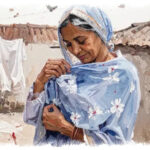
And here, lately, it has occurred to me that this act of seeing is itself a task, meaningful in its own right. With a new kind of joy I keep gazing outward: the changing colors of the sky; the shifting play of light and shadow on the earth; a woman carrying cane basket—clad in a blue sari, spreading out in the sun and fluttering in the wind; a black dog suddenly tossing upon the grass in the evening; the mountain at sunset half lit while the other half sinks into violet shadow…
Seeing all this, it is not only that my eyes are fulfilled; within my mind too an indistinct stirring awakens. That is, it is not merely a mood of eager excitement, but a feeling of vitality itself—when one senses that whatever exists in the world is not meaningless, and that one’s own existence among it is meaningful too. And from somewhere within that feeling there arises a desire to say something, though perhaps it cannot always be expressed clearly. It is as if there is an expectation hidden within it: something will happen, someone will arrive, someone is coming—this kind of a faint hint.
It seems as though, from within the surrounding world, some signal is constantly reaching me: I feel it silently, receive it, and prepare myself for something—though I do not know for what. ‘The very waiting along this path is joy’—only now have I begun to understand the meaning of this line; and perhaps for this reason alone, my present solitude has become meaningful.
Yet what I call solitude is not truly solitude, because through letters and mental exchange I remain continually connected with my loved ones and with my own sphere of work, even while living far away. One who is cut off from all such connections at once, severed from every possible relation of human society, would be fortunate indeed if he did not go mad. And one who no longer even desires those relations has already gone insane, or else he is a sage. In this world, only those who live entirely fulfilled within themselves, can survive in utter solitude; as if there is no compulsion to share his make-belief of the world with anyone else. They are insane; and only great sages can endure such emptiness. What we ordinarily call solitude bears no comparison to that kind of absolute isolation; in certain circumstances, even its joy cannot be compared.
The poets and sages who have spoken of companionship and solitude have essentially spoken of the same thing—at least in the case of poets. For poets are able to turn their solitude into companionship, and they possess the skill to move alone amidst the multitude of chaos and cacophony. I had already realized the truth of Baudelaire’s words, but now I wish to add one more thing to the poet’s role: it is receptivity. The Bengali word ‘niskriya’ (inactive) does not fit here; for it suggests merely a negation. But the English word ‘passive’ contains a certain positivity—the power that has no action of its own; yet it remains ready to receive the actions of others. This quality too is necessary for poets, because they carry within themselves a feminine element of creation: they receive emotions and impressions, hold them, give them birth—without themselves knowing from where the seed first entered.
Just as women require the shelter of the inner quarters, poets too need a certain enclosure of solitude—whether consciously or unconsciously. For many days I remained outside the bounds of my own inner self; but now, within this vast and quiet stillness, the feminine nature within me seems to awaken due to the favourable solitude and its variations. I feel as though I am waiting; my inner being has spread itself open and surrendered itself to possibilities and desire. It seems that there is no other meaning in my silent gazing—only a call of ‘come, come’—an indistinct invocation. I do not know whether anyone will ever come, yet the fact that I am waiting—this alone, perhaps will leave some trace of my identity, so long as all writing does not dissolve into dust.
(Originally written in 1953)