 Kavita Ezekiel
(Episode four of my series “Once upon a Mountain Town”)
Saturday was the day I most looked forward to. It was a chance to leave the school campus and venture out into the town. It was a time to visit the many shops, enjoy the food at the small eateries, interact with the locals, and see a completely different side of Mussoorie. Our campus was in a deeply wooded area and the bustling dusty town lay beyond all the greenery. It had a character and charm all of its own. Quaint would be a good adjective to describe its quintessential character.
Sometimes I went to the bazaar with my family and sometimes with a friend. On both occasions we walked for about a half hour to get to the top of Mullingar. In the distance you could see the iconic Clock Tower, a historic landmark, built in the 1930s. It had an especially beautiful look when the mountain mists swirled around it, giving it a mysterious, almost mystical aura.
When I went to town with a friend we usually met at the school gate. The arched gate with boldly announcing the name of the school is still a beloved icon for me. Fortunately, both of us valued punctuality and usually met at precisely ten in the morning. Wearing strong walking shoes and comfortable gear was necessary. My friend, always a highly organized person, had a list of things she needed from town, but I was the random spontaneous type of personality, and happy to go with the flow! On the way in we passed Cozy Corner, a small but popular place with staff and students alike. The owner whipped up Maggie Noodles and “bun omelets” at all times of day and night. Continuing our walk on the unpaved road we encountered several small shops selling the local liquor and a band of gypsies, ironsmiths hammering away at their metal creations, while their children played outside their caravans.
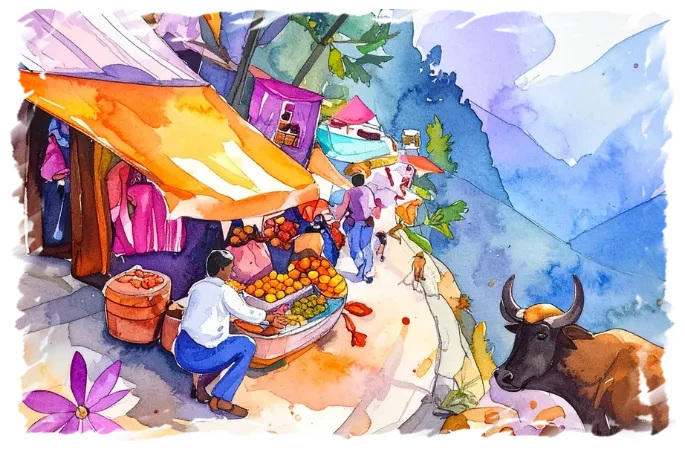
As we walked down the winding narrow slope it carried us past a barber shop at the corner where it was usual to see the barber shaving a customer with shaving foam all over his face! This was the old style of service the barber provided, apart from cutting hair. Often, we would come across a large bull, the locals had named Ramu. He was huge and bellowed and snorted as he made his way leisurely up the slope. To avoid him we had to jump on the small ledges outside the shops and pray he would not turn in our direction and charge at us! When we returned to Mussoorie for the first time after seven years overseas, our video camera captured the bull as he slowly ambled up the hill. We couldn’t believe he was still there!
Past the barber shop as we carefully descended the uneven slope, as the road became flatter we stopped at Abhinandan’s, the tailor’s shop, to buy some fabric. Abhinandan sat cross-legged surrounded by yards of colorful fabric and was always happy to welcome us. Also, located in this part of the bazaar were the Indian sweet shops with a tempting display of sweets like jalebis and ladoos which made the mouth water. The shops selling fruits and vegetables attracted the rhesus monkeys. Occasionally, one could see a monkey with an extended paw swoop down stealthily from the roof of the shop and snatch up a piece of fruit to eat. Monkeys were a permanent feature of the town. The grain merchant with his sacks of rice, wheat, and lentils too formed part of the scene. A small hole-in-the-wall shop selling sweet cigarettes, much loved by my children, and the large and well-stocked Ramchander store where we bought chips and fizzy drinks were impossible to miss. In 2005, on the way to the school, our cab stopped at the store, and we were warmly greeted by Mr. Ramchander himself. Another usual sight we saw was that of an oversized truck blocking our path as it was unloading its wares. Patience is an essential quality on these narrow mountain roads.
We were always hungry when the aromas of so many different foods invaded our senses – a welcome invasion! So we stopped at the South Indian restaurant serving crisp, piping hot dosas with sambhar and a variety of chutneys. Being young, our stomachs still had room for the delicious Tibetan momos at Momo’s restaurant. The bazaar was crowded with carts loaded with guavas in season and we would buy some to take back home with us.
Occasionally we would come across the famous author Ruskin Bond walking along the bazaar. He acknowledged us with a smile and a gracious nod when we greeted him. Seeing him was a real treat for us. Ruskin Bond turns ninety-one this year. He has been described as the grand old man of the hills and has lived in Mussoorie all his life. His cottage, named Ivy Cottage in Landour was close to our school. I am proud to call him our neighbor. So many of his books have pride of place on my shelf. Most of all, I love his children’s stories.
Often we would wander further down to the Kulri Bazaar. This part of town was even more bustling with life with shops offering trinkets, handicrafts, Kashmiri shawls, and other interesting wares. A visit to the Cambridge Book shop was invariably an important stop. I would pick up children’s books for my toddlers. Reading the stories to them at bedtime was a much-loved ritual. It was the only bookshop in town.
One of my most beautiful and peaceful memories is singing in the school staff choir at the historic Christ Church on the Mall Road, a long walk from our school. We had been invited to sing there for the Easter service. Christ Church was established in 1836 and said to be the oldest church in the Himalayan region. I was part of the school choir that sang at the St Paul’s church at the top of the hill, near Char Dukan, and we sang there quite often.
On Sundays, I attended the service at the St Paul’s Church, ate lunch at one of the small shops at the Char Dukan, and sometimes walked along the Sister’s Bazaar. In my next episode, I will describe my experiences in this beautiful and most scenic part of Mussoorie, at the top of the hill, on the other side of the town below.