 Kanchan Balani
“I hate everything about myself during this time. Literally every damn thing.”
In a conversation with my closest friend recently, this is what I told her. This is the bitter truth I return to every single month. It’s the moment my body begins shedding the lining of my uterus. Almost as if sadness and self-loathing are just another part of the menstrual cycle. Not always on schedule though.
The first time it happened, we never had a proper conversation about it: my mother and I. There was no unpacking of what my body had just started doing. All I had to understand was that this were to happen to me for an average of five days, once a month, for the next 35 to 40 years. I was supposed to simply accept it. That’s how the conversation or lack of it had gone down between my mother and her own mother, too.
Then began years of buying pads tucked into a black polythene bag and smuggled home. No one was supposed to know. Not the neighbours, not the watchmen, absolutely no one. The shopkeepers played their part diligently. They’d slide the bag across the counter all hush-hush as if they were selling packets of weed. As if bleeding were a crime.
If history is any proof, it’s older than that. Around the year 77 CE, the Roman naturalist Pliny the Elder claimed menstrual blood could make seeds infertile, wither crops, and drive dogs mad. That even a glance from a woman on her period could kill bees (!) The Manusmriti, one of Hinduism’s most influential ancient codes of law and conduct, declares a menstruating woman impure, untouchable, barred from cooking, from prayer, from anyone’s hands until the bleeding stops. It didn’t go unchallenged, though. In 1927, Babasaheb publicly burned copies of the Manusmriti at a protest against everything the text upheld, caste chief among it.1
But is impurity really about the blood? From menarche onward, a menstruating body is proof of a body that can make life. And therefore a body that is still worth watching, managing, and controlling. Strip away the scripture and the shame, and here’s what’s left: a woman’s worth is tied almost entirely to her fertility. A womb has always been looked at as having exactly one purpose. A vessel to be used, and the moment fertility ebbs, it is just as quickly dismissed. I’ve lost count of how many times near-strangers haven’t hesitated to ask, the moment they hear I’ve been married for four years: “Aur bacho ke baare mein kya socha hai?”
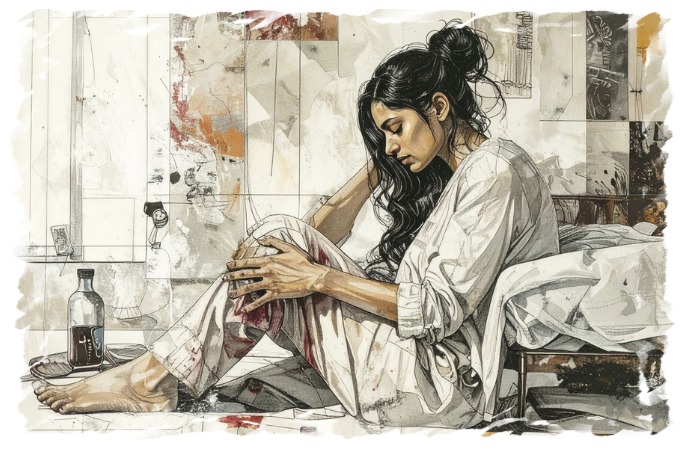
I came across an old journal of mine recently. One look at the entries from those disorienting early years of bleeding, and I realised how much I’ve dreaded the arrival of my period. Every single month, for a long time. It’s never been easy. The maddening mood swings. The sugar cravings. The rage. The waves of despair. The wanting to do nothing, lying on the floor, and ugly-crying. The 2 am ‘add to cart’ (once I started making money). The extreme fatigue. The body aches. The skin breakouts. The cramps from hell, making me feel like a stranger in my own body. The self-bashing. The feeling of all walls closing in on me. The questioning of existence. The darkness.
In my tumultuous 20s, I kept telling myself there was nothing I couldn’t handle. My menses couldn’t stop me from being a girl boss (a term I’ve come to despise). That sharp drop in estrogen and progesterone levels couldn’t, of course, get in my way – of meeting unrealistic deadlines, handling unreasonable bosses, proving my competence in those horribly cold white-light corporate cubicles for 10-12 hours at a stretch, surviving bullshit meetings that didn’t even deserve to be an email.
Here’s the thing: I’m not in the business of saving lives. I’m not a doctor or a scientist or a firefighter or a social worker. I write stories for brands for a living. But my warped sense of ambition had made me blind to how capitalism doesn’t ask if you’re bleeding or in pain. What gave me sleepless nights was how even a slight delay in the deliverable would put me behind. And how resting was unacceptable.
Behind whom? Unacceptable to whom?
In hindsight, I see a direct correlation between those years and my addiction to nicotine. The more things got stressful, the more I vaped. The more I vaped, the more frequent the anxiety attacks.
Over the years, though, a lot has shifted. The many, many conversations with friends on their experiences of bleeding and hormonal turbulence have been a salve. They’ve made me feel less alone in this madness.
Small things have helped too. Magnesium supplements. Unapologetic amounts of dark chocolate. Writing it all down. For years now, Hansal has been making me this period drink. An unglamorous concoction of ajwain and saunf water which makes my cramps a little more bearable. When I snap at him for no reason at all, he asks me how else he can help ease the pain.2 And when I was diagnosed with PCOS (recently renamed PMOS) and a uterine fibroid, so much made sense, finally. Learning about the condition and stubbornly reversing it over several years has been its own kind of education.
The more I read, the more I understood why women’s bodies simply haven’t been studied the way men’s have. Until 1993, women of childbearing age were routinely excluded from clinical drug trials in the US.3 They were deemed too hormonally complicated. Too much of a variable to account for. Science has a long way to go. And yet, funnily, an entire period-wellness industry has figured out exactly how to profit from that gap. From hormone-balancing gummies and cramp patches to whole wellness aisles, a market worth billions of dollars is thriving around selling relief for something the culture stigmatizes in the first place.4
What’s been undeniably effective is trying to stay active, especially lifting weights during the follicular and ovulation phases. It has helped me fight off the luteal demons. Not entirely, of course. I am just a little more prepared now for when they arrive. Rewatching Sridevi’s English Vinglish and Gilmore Girls for the zillionth time helps tackle them, somehow. It’s a matter of a few more days. Slow down. There’s no need to rush, I tell myself. You’re doing the best you can. Stop being so hard on yourself, my closest friend tells me. And my mother reminds me to use the heating pad she gave me.
The walls will stop closing in. The rage will loosen its grip. The darkness too will lift. After five days, I’ll be back to regular programming.