
 Mudassar Javed
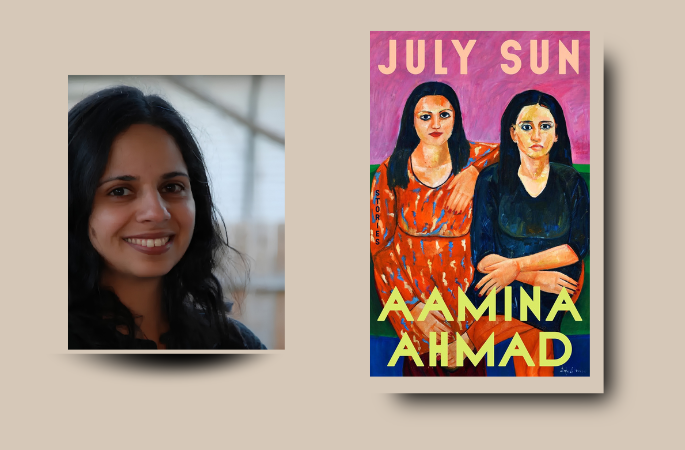
In 2022, Aamina Ahmad’s debut novel The Return of Faraz Ali announced the arrival of a significant new voice in Pakistani English literature, one attuned to the moral complexities of power, the quiet violence of patriarchy, and the dignity of ordinary lives lived on the margins. With July Sun, her first collection of short stories, Ahmad deepens that vision. These seven stories, written over many years and previously published in literary journals including The Southern Review and One Story, are not apprentice works but fully realised portraits of Pakistani life. They are concerned with what it means to be poor, to be a woman, to be beholden to systems that offer no escape.
Ahmad writes with a kind of devastating restraint. Her sentences are clean, almost plain, but they accumulate a quiet power that leaves the reader breathless. She is interested in the everyday—the preparation of a paratha, the stringing of flower garlands, the weight of a child against a mother’s hip—and in the extraordinary pressures that bear down upon that everyday. The result is a collection that feels both intimate and expansive, a tapestry of lives stitched together by shared geography and shared sorrow.
The stories move across Pakistan’s social landscape with the confidence of an insider who refuses to exoticise her subjects. “Ghee” places us in a cramped Lahore room where seven people live, where women string flower garlands for piecemeal wages while a husband lies drugged on the roof. “The Encounter” follows Inspector Khalid, tasked with executing a prisoner named Usmaan near abandoned uranium mines, only to find his constables have conspired to let the man escape after discovering a birthmark that spells God’s name. “Remnants” introduces Bebe, a seventy-nine-year-old servant in a Lahore household, whose alliance with a younger batman named Akram reveals the brutal hierarchies—of age, caste, religion—that govern even the servants’ quarters. “The Red One Who Rocks” takes us to the shrine of Lal Shahbaz Qalandar at Sehwan, where a widower named Humair brings his mother-in-law to pray, only to encounter a pregnant girl named Imli who seems to know more about his guilt than he does himself.
TThe title story, “July Sun,” is perhaps the collection’s most harrowing. Ghulam Ali, a truck driver, glimpses his wife’s friend Zeenat kissing a boy in the sugarcane fields. He says nothing. Days later, Zeenat and the boy attempt to elope; her brother Ilyas pursues them. When Ghulam Ali returns home, his wife Shehr Bano is weeping. Zeenat has disappeared. The story unfolds with the terrible inevitability of Greek tragedy: the silence, the complicity, the honour killing that follows, and Shehr Bano’s slow unraveling as she realises her husband’s inaction has cost a life. Ahmad never lectures; she simply shows us how ordinary men become accomplices to atrocity through cowardice dressed as caution.
“A Small Kindness” shifts to urban middle-class Lahore, where twelve-year-old Sana watches her father park the family Toyota by a pipal tree and disappear into a housing colony. Left in charge of her younger siblings, Sana eventually follows him, only to discover not a mistress but something more complicated, a gathering of men, a secret life she cannot name. The story captures the particular loneliness of children who understand too much and are understood too little, the way adult failures become children’s burdens. “Punjab,” the final story, follows irrigation officer Atif as he discovers the army siphoning water from a canal, and finds himself drawn into an unexpected intimacy with Captain Izzat Baig that threatens everything he has suppressed about himself.
What unites these stories is Ahmad’s unwavering commitment to the texture of everyday life. She knows how parathas smell when fried in dwindling ghee, how the Loo wind blusters through Lahore in summer, how the Indus looks from a train window: “dry, cracked, unsettled, empty of people and animals.” She knows the social choreography of Pakistani households: the deference owed to elders, the contempt reserved for Christian servants, the way women navigate spaces that are never fully theirs. Her Pakistan is not the Pakistan of terrorist thrillers or diaspora nostalgia; it is a place where people worry about school fees and hospital bills, where miracles are both hoped for and doubted, where the state is present mostly as a threat.
Thematically, July Sun is preoccupied with what might be called the politics of witnessing: who sees, who looks away, and what it costs to do either. Ghulam Ali sees Zeenat’s transgression and chooses silence; Khalid sees his constables’ mercy and is both relieved and shamed; Sana sees her father’s duplicity and is punished for looking. Again and again, Ahmad asks: What do we owe the suffering of others? Can survival ever be innocent? The questions are never answered directly; instead, they accumulate, story by story, until the reader feels the weight of a society built on collective looking-away.
Ahmad’s prose is deceptively simple. She favours short sentences, concrete nouns, the rhythm of spoken Urdu translated into English without losing its music. When Zarina’s sister-in-law Salma screams at her brother, the insults tumble out in a rush: “You useless waste, you chutiya, you pimp, you motherfucker.” The coarseness is earned; it erupts from years of swallowed grievance. Yet Ahmad can also be lyrical when the moment demands it. In “The Red One Who Rocks,” the shrine at Sehwan becomes almost hallucinatory: “The whole world was here: the dying, the filthy, the despised.” The prose never calls attention to itself; it serves the story, the character, the emotion.
This restraint is also the collection’s greatest strength. Ahmad refuses the melodrama that lesser writers might indulge. When Bebe, in “Remnants,” throws utensils at the Christian servant Lambhi Amma for drinking from her teacup, the scene is terrible not because of the violence but because of what follows: Bebe’s shame, Akram’s opportunistic defence of her, and her eventual realisation that she has become the kind of person she once despised. The emotional arc is slow, almost imperceptible, and all the more powerful for it.
If the collection has weaknesses, they lie in its occasional unevenness. “The Encounter,” while conceptually rich, sometimes strains under the weight of its symbolic machinery: the birthmark, the vanishing prisoner, the wife’s religious mania. The story wants to say something about faith and state violence, but its surreal elements sit uneasily with the gritty realism of the other tales. Similarly, “Punjab,” though beautifully written, feels slightly underdeveloped; Atif’s attraction to Captain Izzat arrives late and resolves ambiguously, leaving the reader wanting more. And the recurrence of certain themes, honour, female sacrifice, male cowardice, can feel repetitive by the final stories. One wishes, occasionally, for a note of joy, however small, to relieve the prevailing melancholy.
Yet these are minor criticisms of a collection that achieves so much. In the landscape of Pakistani English literature, July Sun occupies a distinctive place. It lacks the historical sweep of Kamila Shamsie’s Home Fire or the satirical edge of Mohsin Hamid’s Exit West, but it shares with Daniyal Mueenuddin’s In Other Rooms, Other Wonders a profound empathy for Pakistan’s working poor, and with Bina Shah’s fiction a feminist attention to women’s constrained choices. What sets Ahmad apart is her refusal to turn her characters into symbols of suffering or resilience. They are simply people, trying to live, often failing, sometimes surprising themselves with their own cruelty or kindness.
For Pakistani readers, these stories will feel urgently familiar. The Lahore of narrow alleys and piled bricks, the villages where honour is worth more than daughters, the government offices where files move slower than glaciers, this is the Pakistan that exists alongside the shopping malls and smartphone apps, the Pakistan that literature too often ignores. For international readers, the collection offers something rarer: not the Pakistan of headlines but the Pakistan of kitchens and courtyards, of shrines and sugarcane fields, where the political is always personal and the personal is always, finally, about who gets to survive.
July Sun is not an easy book. It offers no redemption arcs, no tidy resolutions. Zeenat is dead and will not be resurrected; Khalid will not become a hero; Atif will not come out. But in its clear-eyed refusal of consolation, the collection achieves something more valuable: it honours the complexity of lives that are too often reduced to statistics or stereotypes. Aamina Ahmad has written a book that matters, not because it tells us what to think about Pakistan, but because it makes us feel what it costs to live there, day after day, in the July sun that vanquishes water from the wells, “making you wonder if they had ever been anything but dry.”
Mudassar Javed Baryar is a PhD scholar in English Literature at the University of Faisalabad, and serves as a Subject Specialist in English.