
 Muditha Dharmasiri
Floating in Isolation
With nameless characters, the film, “Spring, Summer, Fall, Winter…and Spring” revolves around life and the struggle with time and its inevitable changes. It feels like walking into a painting, with a few dialogues, leaving us to decipher the meaning. Written and directed by Kim Ki-Duk, this Korean film takes us through a poetic landscape, delivering a profound message.
A temple floats on a peaceful lake surrounded by a forest, an old monk and a young monk live inside, separated by doors (from which one could go around, but they never do, except for on one occasion) As the title of the film denotes, this centres on the theme of change. From Buddhist to Western philosophy, change is a constant concept that has been passed along for centuries. In fact, change is the only constant thing in life. Buddhist philosophy’s basic concept is the impermanence of things. Like a river, our thoughts just simply come and go. “A man cannot step into the same river twice, because it is not the same river, and he is not the same man” says the Greek philosopher Heraclitus too. This thought appears in Stoicism later upheld by Seneca and Marcus Aurelius in ancient Rome. One of Stoicism’s main concept is living with nature, and nature is the best teacher to teach us about change, “Every new beginning comes from some other beginning’s end” says Seneca.
Out of the few dialogues in the film, two strike out:
“You will carry the stone in your heart for the rest of your life”.
At the start of the film, the young monk is sent to collect herbs from the forest. While he is at it, he ties a fish, a frog and a snake to rocks, separately, making it difficult for them to move. The film doesn’t give any reasons as to why he does that, symbolising some of the actions people do without thinking. He laughs when he sees how these animals struggle to move. But we can see the old monk is watching him. Again, we never know how he even got to the forest with one boat in the lake. However, the next morning, when the young monk wakes up, he is tied to a heavy rock. He struggles to walk and asks the old monk to remove himself from this burden. The old monk asks him to free the animals first, but with a warning, “if they die, you will carry this rock in your heart forever.”
We all do mistakes. The young monk learned a lesson from his mistake. This resonates at the very end of the film as well. Life is a cycle of making mistakes, learning from them and fixing them as we walk along, is a part of our existence. If we don’t correct them, it will be like a rock that we will carry throughout our lives.
“Didn’t you know beforehand how the world of men is? Sometimes we have to let go of the things we like. What you like, others will also like.”
A young girl who is sick comes to stay at the temple in the summer to be cured, again we don’t know what’s wrong with her. The old monk says, “when she finds peace in her soul, her body will return to health.” But her stay wakes up the sexual desires of the young monk. Seeing all this, the old monk doesn’t interfere, he lets him experience. But says, “lust leads to desire for possession, and possession leads to murder” another powerful line from the film. Once the young girl leaves the temple, the young monk wants to follow her. Another season passes. The young monk who went out in search of happiness but finds himself back again coming to the temple, realises that one can never find happiness and peace outside but within. It is a state of mind.
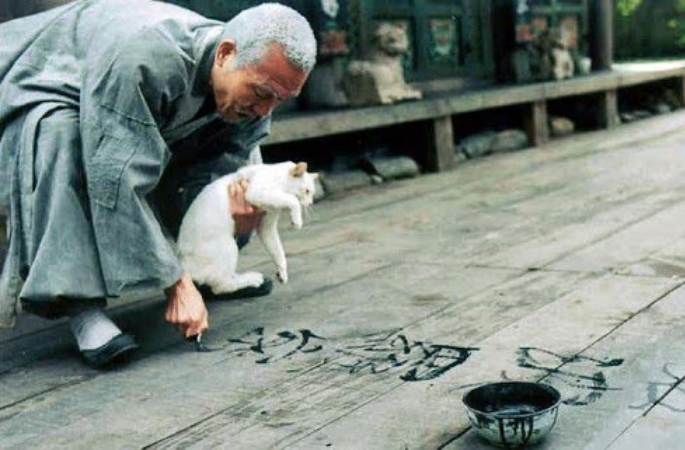
The cinematography is so striking in the film, as I have repeatedly mentioned in different words. The scene where the young monk leaves the temple in pursuit of a girl, he carries the most precious object a temple shrines in, the Buddha statue. He takes it with him in his bag, taking the small boat to the other side, in search of another life. In the next shot, the old monk gets back into the boat (we never know how this boat reached him when the young monk left on it) he carries in his bag a cat. The parallel with this imagery is quite striking and has quite a profound feeling to it. The cat becomes quite useful later when the old monk writes a few lines from a Sutra on the deck, by using the tail of the cat as a paint brush.
“Know that the Bodhisattva, holding to nothing whatever, but dwelling in Prajna wisdom, is freed of delusive hindrance, rid of the fear bred by it, and reaches clearest Nirvana.”- Prajñāpāramitāhṛdaya Sutra –
We hear a few lines from Prajñāpāramitāhṛdaya Sutra (“The Heart Sutra”) at the very beginning of the film, and it is possible that the lines written on the deck could be from the Sutra too. Apart from the cat’s tail being a paint brush this whole scene becomes so fascinating due to so many reasons. As a punishment for a crime the young monk committed, the old monk wants him to carve these lines on the deck. The police officers who come to arrest him will have to wait until he finishes it too. Though aggressive at first being police officers, gradually these two also become part of this spiritual act by helping through the process.

This slow-moving poetic cinematic work will take you on a journey on the timeless truth that we must understand in our brief time here on earth. Quite meditative. Inspiring. Cinematic. Profound.
Muditha Dharmasiri
*The title was inspired by a review written by Roger Ebert.