
 Veronca Holsinger
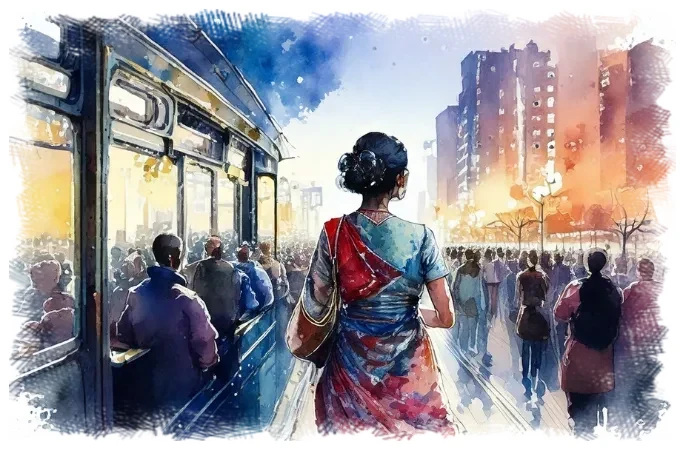
“Office rush meant body crush.” – The dreaded thought clung to Nelum as she lifted the hem of her saree to climb the steep steps of a packed Leyland bus. Inside, the air was heavy with the smell of day ‘s-end sweat and overworn shirts. Tired bodies fell over each other. Tired Hand reached for support, and naughty hands reached out for reasons less innocent.
Nelum tightened her handbag against her chest, a small shield to guard her breast from the unnecessary brushes that came too easily in the crowd.
Her daily commute from Bambalapitiya to Dehiwela covered barely six kilometres, but during peak office hours it stretched to 60 minutes. The 101 bus dragged itself along Galle Road like a hungry beast, greedy for more passengers. It stopped everywhere and anywhere, jerking forward only to halt a few meters later.
“I must make it to the middle row, the pushing is less there,” Nelum told herself. It was her daily defence strategy. If luck held, someone might even vacate a seat.
But luck was not on her side. Nothing seemed to be going smoothly in her life at the moment. She blamed it on the stars. An astrologer had warned her that Leos would run into obstacles in September, that their support systems would prove unreliable, and that this was not the time for big decisions.
Nelum had been planning to quit and start working remotely, but she held that thought back, telling herself to wait until the stars shifted in her favour.
The conductor’s shout, “Tikkat ganna!” snapped her back to reality. Nelum dug into her bag and pulled out a hundred-rupee note. As she pressed it into his hand, he melted into the crowd without returning her ten-rupee change.
Hot and angry, Nelum gripped a seat rail, swaying like a rag doll, each time the driver held the brakes.
Then she felt a body press hard against her from behind. At first, she thought it was an accident; there was hardly room to breathe, let alone stand without touching someone. But the pressure grew bolder, more persistent. She turned, hoping it was a woman, only to find a middle-aged man, who hardly looked like he was travelling from an office. His crumpled shirt hung loosely over a dirty sarong. A streak of betel juice stained the corner of his lips as his mouth twisted into a sly smile.
It was happening again. This wasn’t the first time, and she knew it wouldn’t be the last.
Once, she had glared at a man who pressed too close, only to be met with a smirk, as if her resistance amused him. Another time, she had whispered to the conductor, pointing discreetly at a man with “wondering hands”. The conductor shrugged. “It’s crowded, madam. These things happen.”
That sentence had stayed with her longer than the incident itself. “These things happen”, as if harassment were not a crime but a natural travel condition, like potholes or broken seats.
This time, Nelum didn’t hold back. Her quarter-inch heels drove into his toes, jutting from his worn-out Bata slippers. “Aiyo!” he yelped, jerking backwards.
And just like that, her luck shifted. Maybe her astrologer had been wrong. Nelum wriggled free into a vacant seat, bonus: it was by the window. She pushed it open wider, letting in more of the city’s toxic air, and glanced around for her predator. He had vanished.
Nelum had read that more than nine out of ten women in Sri Lanka faced harassment on buses or trains at least once in their lives. She didn’t need statistics to know it was true. She saw it in the stolen innocence of schoolgirls’ faces, the way women hurried to claim the rare empty seat, the glances between strangers who understood but never spoke out.
Sometimes, she wondered what it would feel like if someone, anyone, stood up for her. A voice rising from the crowd, shouting, “Stop. But in her experience, heroes never appeared. Crowded buses carried only silent voices.
And so the bus carried her forward, day after day. Past the same streets, the same stops, the same unspoken rules. She did not cry. She did not shout. She only held her handbag tighter and prayed for the ride to end quickly.