
 Vasudha & Lakshmi
A Spectacle from conception to post-partum
The dust has settled on the 2025 editions of the Met Gala and the Cannes Film Festivals. These events, as in past years, have drawn significant attention to female bodies and their fashion in global media and have taken the internet by storm. For female stars and celebrities, in particular, their fashion choices and embodied motherhood at different stages (from conception to post-partum) intersects with their stardom, celebrity, media presence and ageing bodies.
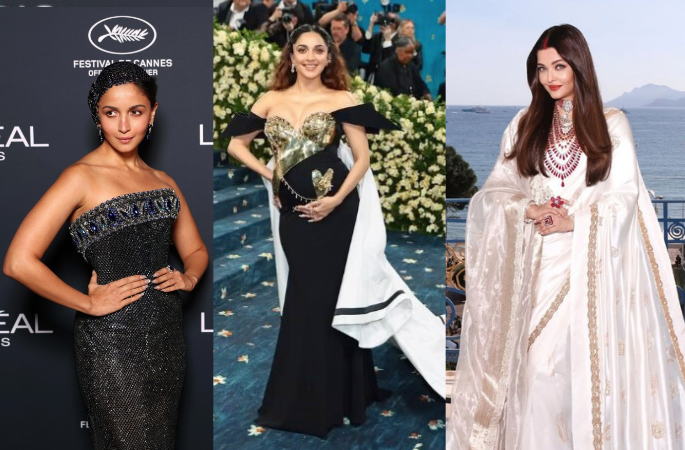
Whether it is the pregnant (Kiara Advani), popular star and recent mother (Alia Bhatt), or the (peri-)menopausal woman reclaiming public space (Aishwarya Rai), their public appearances are not just cultural texts or mediatised representations. Motherhood has long been valorised and exoticised in Indian culture, particularly through cinema, art, and popular representations that draw on imagery of the mother-as-goddess or nation-as-mother (Mother India, Bharat Mata). Bollywood has historically foregrounded motherhood as a central trope in storytelling, most often through sacrificial, traditional roles (e.g., Mother India, 1957). However, in recent decades, there has been a noticeable shift towards more progressive, complex portrayals. Films like English Vinglish (2012) explore a woman’s identity beyond motherhood, while Tumhari Sulu (2017) and Panga (2020) depict women navigating “mommy guilt” and reclaiming aspirations post-motherhood.
The portrayal of celebrity motherhood has evolved alongside neoliberal ideals of individualism, wellness, and consumption. The rise of digital media and social platforms has amplified public interest in the private lives of Bollywood stars, especially celebrity mothers. Every public appearance becomes a ‘spectacle’: from symbolic all serve as media signals. These symbolic cues are closely monitored for signs of conformity to or defiance of what is seemingly “Indian culture and tradition,” especially in a climate where trolls on social media and “cancel culture” often denigrate (only a few extol) a move away from the traditional stereotype.
This shift marks a stark contrast from earlier decades, especially the pre-2000s era, when many female actors retreated from public life post-marriage or motherhood. Today, pregnancies of actors are transformed into a media spectacle, inherently contradictory and ambiguous. The “baby bump watch” has become a genre of its own, contributing to unrealistic expectations of post-partum “body-back” ideals.
Bollywood celebrity mothers often uphold hyper-femininity while negotiating the pressures of becoming “yummy mummies”. Celebrity mothers like Aishwarya Rai, Neha Dhupia, and Swara Bhasker have publicly responded to media trolling of their post-pregnancy bodies, while others like Shilpa Shetty Kundra and Lara Dutta have embraced the wellness industry, promoting yoga, maternal fitness, and lifestyle brands during and after pregnancy.
Marshall McLuhan’s (1964) concept of “the medium is the message” offers a useful lens to analyse this phenomenon. For Bollywood celebrity mothers, the red carpet or Instagram feed becomes the “medium,” but their bodies are the message, cultural artefacts that transmit meanings about femininity, motherhood, beauty, nationalism, and desirability. These actors are not passive participants in media; their very presence is read, interpreted, and debated. A pregnant body, a post-partum body, or a(n) (ageing) menopausal body,all become symbolic sites through certain kinds of hyper-femininity being idealised.
Celebrity motherhood now lies at the intersection of femininity, health, economy, national identity and cultural politics. India being a significant consumer of globally circulating beauty products, fashion and glamour, the growing media presence of Indian celebrity (mothers) has given India a global media presence, especially with magazines like Harper’s Bazaar and Vogue India. Indian celebrities and celebrity mothers are gaining global media presence as cover stories in these magazines.
In January 2025, actress and new mother Deepika Padukone, showing visible post-partum weight, walked the ramp as the showstopper for designer Sabyasachi’s 25th anniversary show. Her confident appearance in a structured white suit drew mixed reactions: praised for not rushing to meet beauty standards and body-shamed. In contrast, Alia Bhatt, in a black Sabyasachi saree at the same show, was applauded for her “grace” — a veiled compliment to her return to thinness and youthful glamour.
The Met Gala and Cannes 2025 presented a cultural tableau of motherhood on a continuum with Kiara Advani (pregnant), Alia Bhatt (a young mother), and Aishwarya Rai (in her 50s) embodying different meanings of motherhood. Kiara’s walk at the Met Gala, the first ever by a pregnant Indian celebrity, was a performance of idealised maternal femininity. Alia’s slender post-pregnancy appearance served as evidence of productive motherhood, disciplined, attractive, and media-friendly. Rai disrupted traditional slim femininity, defying and redefining standard beauty norms with her fuller body, ageing face, and heavy couture at Cannes. This year, she was referred to as the “Mother of Cannes,” a term both celebratory and patronising, marked her symbolic transition from a glamorous commodity to a reclaimed ageing body- beautiful, fashionable and poised.
A further layer of meaning was added by her visible sindoor , reportedly, the first time she wore it to the festival. Traditionally a Hindu symbol of marriage, the sindoor in today’s political climate also evokes nationalistic resonances, especially after the government’s Operation Sindoor (a military response to the Pahalgam terror attack in Jammu & Kashmir). In applying sindoor, Aishwarya symbolically pushed back against divorce rumours, and resonated with the nationalistic imagery of the idealised mother- resilient and righteous.
Celebrity mothers bodies are no longer just a site of aesthetic scrutiny,but a complex and often contradictory battleground of (hyper)femininity, nationhood, and cultural ideology.