
 Devika Brendon
I do not know why people
romanticise the days of their youth
As if the only errors they made then
were sexual indiscretions
or emotional misapprehensions,
and therefore by definition, recoverable.
This has not been my experience!
Let me explain.
Thirty five years ago,
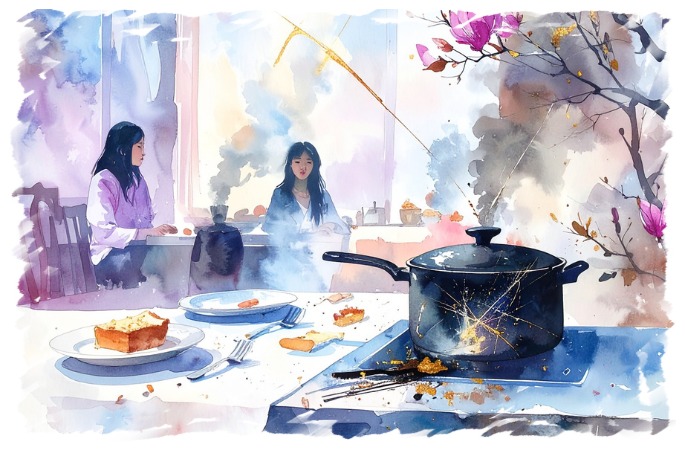
the tine of a fork
that I had used to make
breakfast for a friend
Had slightly scratched the base
of her Bessemer saucepan.
She had not said a word about it, at the time.
The food was enjoyed
Mutually, so I thought. Life rolled on.
I did not know, then, about
What was going on, subtly,
under the surface of anything:
Of how even a small amount of damage
could leak toxins into what we try
To give each other.
This came up, unlocked from the vault,
In a recent discussion. News to me.
She had forgiven me, she said,
because I had grown up entitled.
Which to her meant (apparently)
that I went around destroying
people’s cookware,
and heedlessly scraping their parquet floors,
entirely unconscious of the value
of what I was harming.
In my world, she imagined,
money grew on magnolia trees,
Broken items could be replaced with ease.
And no one got hurt by what anyone else did.
I used to cook for my friends.
But now here we are, with her
feeling short changed.
The scratch on the base of that pan
Was a fracture in what was between us
Like a tiny piece of aberrance
That amplified, over time.
And she framed it as forgiveness
That courtesy which prevented her from speaking up
But was it something less charitable?
Was it virtuosity? Camouflage?
Because she had her areas of ignorance, too.
She got us late to see the opening scene
of King Lear, at the National Theatre.
Can you believe it? The Love Test,
the pivotal scene, from which all else transpires.
Unlike Shakespeare’s other plays,
this opens fast and strong,
ushers us straight to the core
without filter, in media res.
That was my first realisation
that there was sabotage occurring.
That what I tried to give her – that play, and a concert at the Opera House – and lunches and dinners and overnight stays, all my gifts to her on that visit –
were not getting through to her.
There was interference going on,
between intention and outcome.
This was something I had to understand
Literally: stand under it, and view it
From all angles, to see it for what it was.
Human beings are spirits blundering
in an unforgiving material realm
So much gets scratched and damaged
and tarnished, in our skirmishes
I keep a drawer where I store
chipped glass and crockery
So that it can be hurled with relief
To vent frustration
Like bombs being detonated
on isolated islands
We make ourselves trivial to each other
By letting such accidents simmer
I do not mean this ironically,
It is cast iron, in fact, this realisation.
She said I was an outlier in her range of friends.
I cannot replace the high end implement
So many decades later. It is not redeemable.
An unrecoverable error.
She prefers to cherish her judgments
And pride herself on her moral exaltation.
She highlights the injury, embossed it, augments it.
It’s like Ikigai done wrong.
Where repair is not the purpose.
Underlying the sanctimony is
something primal: that uncoils itself
And stares me in the face.
Why is this clear to me?
Because I pray, for enlightenment.
I am a visionary, despite my flaws.
Because I bring these incidents to God, regularly.
I say: Please, show me what has been hidden from me
But only what I need to see.