
 Swarnavel Eswaran
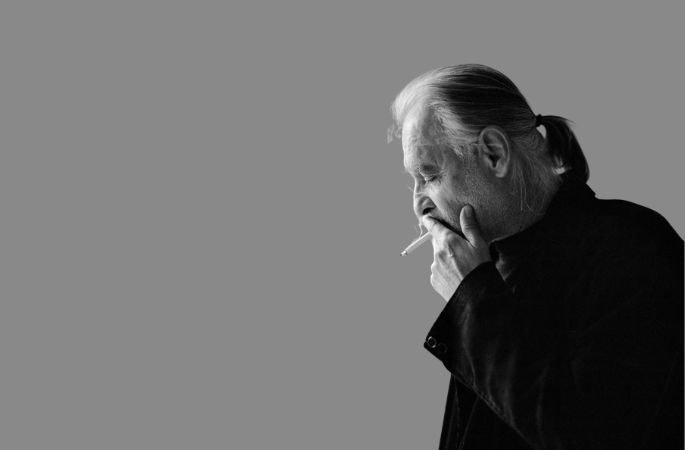
Béla Tarr (1955 – 2026): Wind, Duration, and the Poetics of Persistence
––Swarnavel Eswaran
“Tarr, however, renders this metaphysics unavoidable. Where Nádas inscribes collapse into flesh, and Krasznahorkai disperses it across language, Tarr gives it duration, weight, and weather. From Damnation (1988) through Werckmeister Harmonies (2000), he translates Krasznahorkai’s long sentences into unbroken camera movements, making time itself the primary material of cinema. His films do not interpret despair; they stage it as lived experience. The camera lingers not because revelation is imminent, but because there is nowhere else to go. Endurance is no longer metaphorical; it is demanded” (Pachkhédé, 2026).
Abstract
Béla Tarr’s cinema offers a singular vision of ethical endurance, temporal persistence, and the erosion of meaning. From his early socially-engaged works to the monumental Sátántangó, through Werckmeister Harmonies, The Man from London, and culminating in The Turin Horse, Tarr constructs a cinema defined by extreme temporal patience and moral observation. This essay situates his oeuvre within both philosophical and cinematic contexts, drawing on Nietzsche, Levinas, Heidegger, and Camus to explore ethical responsibility in a world where values have lost their authority and existence is defined by “thrownness” and absurdity. By integrating Julia Kristeva’s concept of the “abject” and Giorgio Agamben’s theory of “gesture,” the analysis demonstrates how Tarr strips away narrative illusion to reveal the raw facticity of existence. Furthermore, the essay utilizes the concept of Stimmung (mood/attunement) and the “permutation principle” to situate Tarr alongside Robert Bresson and Ritwik Ghatak, emphasizing how ethical attention and the persistence of the ordinary shape his cinematic vision. There is a specific gravity to this world, a weight that pulls both the characters and the camera into a state of relentless continuity. This is the poetics of persistence: a refusal to look away when the promise of redemption has faded, suggesting that to remain, to wait, and to endure is the final, necessary art of the apocalyptically mundane.
Introduction: The Architecture of Endurance
Béla Tarr’s cinema is often described in terms of its weight—the heaviness of the rain, the oppressive duration of the shots, and the gravitational pull that seems to fix his characters to the earth. However, to view this weight merely as an aesthetic choice is to miss the profound ethical dimension of his work. This essay argues that Tarr’s stylistic evolution—from the agitated, handheld social realism of his early career to the monolithic, glacial pace of his final works—represents a systematic “stripping away” of narrative illusions to reveal the raw, material core of existence. The trajectory of this analysis mirrors Tarr’s own reductionist path: it moves from the “social anger” of the 1980s, where characters fight against political structures, to the “ontological fatigue” of The Turin Horse, where the struggle is no longer against the state, but against the void itself.
To navigate this descent, the essay adopts a multi-layered theoretical approach. It begins by tracing the chronological shift in Tarr’s filmography, demonstrating how the specific “social hell” of Family Nest dissolves into the universal “metaphysical mud” of Sátántangó and Damnation. Here, the environment ceases to be a backdrop and becomes an active agent of Heideggerian facticity—a force that limits and defines the human subject. As the narrative structures collapse, the essay pivots to the philosophical implications of this void. By engaging with Nietzsche, we understand the “death of God” not as a dramatic event, but as the quiet exhaustion of values that Tarr stages in The Turin Horse. However, this exhaustion is not the end point. The essay argues that within this collapse, a new form of ethics emerges. Drawing on Emmanuel Levinas, we explore how the silence and proximity of Tarr’s characters constitute an “ethics of co-presence” that survives even when philosophical authority has faded. Furthermore, by utilizing Giorgio Agamben’s concept of “gesture” and Julia Kristeva’s notion of the “abject,” the analysis examines the mechanics of this survival—how the act of walking, eating, or simply “bearing” the weight of the body becomes a form of resistance against the “unreasonable silence of the world.” Ultimately, this essay posits that Tarr’s cinema is not a documentation of despair, but a rigorous “cosmic comedy” that forces the viewer to endure the passage of time, transforming the act of watching into an ethical practice of patience and solidarity.
Cinema as Ethical Duration
The initial sounds in Béla Tarr’s films seldom originate from dialogue. Instead, auditory elements such as wind whistling through walls, boots pressing into mud, or persistent rainfall establish a sense of time that moves without urgency. Tarr’s cinema does not begin with conventional narrative exposition; rather, it establishes a moral and temporal climate in which characters persist rather than progress toward resolution. This atmosphere functions as more than mere background; it constitutes a Stimmung, or “attunement,” serving as a comprehensive experiential medium that dissolves the boundary between internal psychology and the external material world (Hannan, 2018).
Central to this temporal architecture is the music of Mihály Víg, whom Tarr credits as a co-author of the films. Víg’s scores are not mere accompaniment; they are often composed before filming and played on set to dictate the rhythm of the camera’s movement and the actors’ gait (Kovács, 2013). Structured as a ritournelle or circular refrain, the music does not develop linearly but turns in rounds, resembling the narrative’s refusal of progress. Whether it is the drone of a harmonium or the repetitive chime of bells, the score acts as a “temporal container,” binding the characters to a cycle of eternal return from which they cannot break free (Hannan, 2018).
Critical analysis of Tarr’s work must prioritize duration over plot or biography. Tarr does not merely slow cinematic time; he imbues it with ethical responsibility. His extended takes serve less as stylistic flourishes and more as ethical imperatives, requiring the viewer to endure. As András Bálint Kovács (2013) observes, Tarr’s oeuvre adheres to a “permutation principle,” in which early stylistic elements are systematically recombined and decelerated to achieve a heightened density of expression. Viewing a Tarr film necessitates patience, focused attention, and moral engagement. In line with Susan Sontag’s (1966) account of challenging art, these works resist straightforward interpretation and instead demand sustained presence. Tarr’s films do not ask what they mean, but whether the viewer will remain present, participating in a “circular dance” of time that resists linear progression (Kovács, 2013).
When Tarr declared The Turin Horse (2011) as his final film, many interpreted this as rhetorical or apocalyptic. In retrospect, this decision appears as an ethical resolution. Further continuation would have risked unnecessary repetition; the formal and philosophical development of his cinema had reached its logical conclusion. At this point, even images seemed unable to justify themselves beyond the act of patient observation.
From Social Anger to Ontological Fatigue: The Early Films
Tarr’s early films were deeply engaged with social critique, emerging from a climate of political and economic tension in Hungary. Family Nest (1979), produced while he was a student, confronts housing shortages and familial tension in urban socialist environments. The handheld camera, raw framing, and cramped domestic spaces convey both literal and emotional confinement. Tarr’s focus on repetitive, often mundane conflict is already a signal of his emerging preoccupation with the ethics of attention rather than straightforward narrative causality. These films utilized a “documentary fiction” style prevalent in Hungarian cinema of the 1970s, characterized by improvised dialogue and non-professional actors, to expose the “everyday hell” of interpersonal relationships (Kovács, 2013).
The Outsider (1981) and The Prefab People (1982) continue this focus on alienation and domestic strain. While often classified as realist works, they already refuse closure: characters drift, arguments recur, and resolutions remain elusive. Tarr avoids presenting sociological problems as neat moral lessons; his subjects are enmeshed in the forces around them, trapped rather than exemplary. As Lilla Tőke (2016) notes, Tarr’s position as an “outsider within” the Hungarian film industry mirrors the marginality of his characters; his work consistently refused to serve the “constructive” role in nation-building often demanded of small-nation cinemas.
A decisive turning point comes with Almanac of Fall (1984). Unlike the social realism of his earlier works, this film is highly stylized: interior compositions, artificial lighting, and deliberate color palettes create a world of relational cruelty. This visual shift was heavily influenced by set designer Gyula Pauer, a central figure in the Hungarian avant-garde “Pseudo-art” movement (Kovács, 2013). Pauer’s concept of “Pseudo” involved creating surfaces that pretend to be real while simultaneously revealing their own falsity—an aesthetic of “false appearance.” In Almanac of Fall and later Damnation, this manifests in interiors that feel like theatrical cages; the walls and spaces are not merely backgrounds but active, “pseudo” surfaces that trap the characters in a world that is undeniably concrete yet metaphysically hollow (Kovács, 2013). Language functions as a tool of control and dominance, revealing a network of dependence and exhaustion.
Tarr later characterized this as the culmination of his ‘angry period,’ after which he transitioned to a slower, more meditative style—less concerned with protest and more with the ethical exposure of human endurance. This stylistic shift also places Tarr in dialogue with the Hungarian tradition of Miklós Jancsó, whose fluid long takes Tarr slows down to a glacial, ontological weight. Jancsó acts as the bridge between the “social realism” of Tarr’s early work and the “metaphysical” long takes of his later work.
The Architecture of Collaboration: Hranitzky, Krasznahorkai, and the Collective Gaze
While Béla Tarr’s cinema is characterized by a singular, monolithic vision, its execution relies on a tight-knit “family” of collaborators who have been instrumental in constructing his distinctive aesthetic. Tarr has explicitly stated that his work is not the product of a solitary auteur but of a collective synchronization, noting that filmmaking “is a very complex string of things” where actors, cinematographers, and the camera must breathe in unison (Tarr, as cited in Hudson, 2026). Central to this creative infrastructure are his partner and co-director, Ágnes Hranitzky, and the novelist László Krasznahorkai.
Ágnes Hranitzky: The Rhythmic Architect
Ágnes Hranitzky, Tarr’s partner and longtime collaborator, occupies a unique and decisive space in his filmography. Serving as editor since The Outsider (1981), she is the partner with whom Tarr established the rhythmic signature that defines his mature style (Hudson, 2026). Her influence extends well beyond the cutting room; Hranitzky is frequently credited as a co-director, most notably on Tarr’s final feature, The Turin Horse (2011), as well as The Man from London (2007). Hranitzky’s presence on set allowed Tarr to focus on the intricate choreography of his long takes, while she monitored the composition and continuity, ensuring the “breathing in sync” of the crew and cast. Her editorial hand is evident in the “permutation principle” of the films, where the refusal to cut becomes an editorial choice in itself, creating the suffocating yet hypnotic duration that marks the Tarr aesthetic. As Tarr describes the process, the synchronization of the dolly grip, actors, and cinematographer creates a situation where “the actors have no chance to leave the situation,” a rigorous constraint overseen by Hranitzky’s editorial eye (Hudson, 2026).
László Krasznahorkai: The Melancholy of Resistance
If Hranitzky provides the rhythmic discipline, László Krasznahorkai provides the metaphysical gravity. The partnership began in the mid-1980s when Tarr was handed a manuscript of Krasznahorkai’s debut novel, Sátántangó. The two “hit it off right away,” establishing a shared worldview rooted in cosmic absurdity and existential decay (Hudson, 2026). Although they intended to adapt Sátántangó immediately, the political climate of communist Hungary made such a bleak, monumental project impossible to fund at the time. Consequently, they channeled their “social anger” and “ontological fatigue” into a smaller scale project, Damnation (1988), which marked the true beginning of Tarr’s metaphysical noir style (Hudson, 2026).
Krasznahorkai, a winner of the Nobel Prize in Literature, is not merely a screenwriter but a foundational architect of the Tarr universe. His prose—famous for its serpentine sentences that defer meaning—finds its cinematic equivalent in Tarr’s endless tracking shots. As noted by the Harvard Film Archive (2006), this collaboration produced a “trilogy” of “melancholy resistance” comprising Damnation, Sátántangó (1994), and Werckmeister Harmonies (2000). In these works, Krasznahorkai’s literary vision of “free-floating millenarian dread” is transmuted into a cinema where rain, wind, and mud become active agents of history’s decomposition (Lim, as cited in Hudson, 2026). Together with composer Mihály Víg, who has scored every film since Almanac of Fall (1984), Hranitzky and Krasznahorkai helped Tarr secure his legacy not as a solitary “medieval stone carver,” but as the conductor of a rigorous, collective despair (Scott, as cited in Hudson, 2026).
Rain, Desire, and Moral Stasis: Damnation
With Damnation (1988), Tarr’s mature cinematic voice fully emerges. Nighttime industrial landscapes, rain-slicked streets, and extended tracking shots convey a world where desire itself has become burdensome. Here, the environment becomes a protagonist; the camera traverses the landscape independently of the characters, emphasizing the “materiality of time” and the “metacommunications” of the physical world (Hannan, 2018). Movement no longer guarantees progress; the camera traverses the environment while the world remains morally and temporally inert. Longing is presented not as a path to fulfillment, but as a corrosive force that accentuates stasis. The protagonist, Karrer, is trapped in a circular narrative where betrayal and conspiracy replace the “everyday hell” of the earlier films. Tarr’s work here demonstrates that time itself can function as an ethical instrument, imposing attention and endurance on both the character and the viewer. The “rain” in Damnation is not merely meteorological but ontological; it is a “universal vegetal and digestive ground” that dissolves the distinction between the human and the animal, reducing the characters to a state of biological persistence (Martell, 2016).
The Observer Archetype: The Spy in the Window
A recurring structural motif in Tarr’s mature cinema is the figure of the passive observer—a character who watches the world through a window or from a hidden vantage point. From Karrer staring at the cable cars in Damnation to the Doctor recording the villagers in Sátántangó, and Maloin in his watchtower in The Man from London, these figures function as “second-order observers” (Kovács, 2013). They embody a specific relationship to the world: one of alienated scrutiny rather than participation. The window frame becomes a screen within a screen, emphasizing that for these characters, life has become a spectacle to be witnessed rather than a reality to be lived (Hannan, 2018). This voyeurism is not empowering; instead, it draws attention to their entrapment. The characters are separated from the world by a pane of glass, just as the viewer is separated from the film, creating a double mediation that reinforces the themes of isolation and impotence.
Mud, Cows, and the Aftermath of History: Sátántangó
This ethical weight reaches its zenith in Sátántangó (1994), Tarr’s seven-hour collaboration with László Krasznahorkai. The film begins with cattle wandering through mud for several minutes before any human figures appear, refusing immediate narrative engagement or symbolic shorthand. This opening shot invites what James Martell (2016) calls a “bovine” sight—a heaviness of vision that dissolves the boundaries between human and animal, forcing the viewer to inhabit the “background” of the image rather than seeking immediate meaning. Instead, the viewer is placed directly inside a condition of temporal and existential persistence.
This integration of landscape and failure evokes what Walter Benjamin termed “natural history” (Naturgeschichte): the moment when historical events lose their teleological drive and decay back into the muteness of nature (Hannan, 2018). In Tarr’s universe, the “wrecks of the socialist voyage” do not stand as political monuments but merge with the rain and mud, becoming fossils of a time that has ossified (Rancière, 2013). The “cosmic” perspective here is not transcendent but strictly material; it is the gaze of history petrifying into a landscape of ruin, where human agency is swallowed by the “indifferent and unstoppable traffic between things” (Krasznahorkai, 1998).
The village itself is already in decline when the story begins: the promises of collectivism have eroded, and belief has been reduced to a routine habit. When the enigmatic Irimiás returns, offering renewal and hope, his rhetoric moves faster than the villagers’ capacity to respond. They follow not from faith but from ingrained habit. In this way, history is depicted as simultaneously active and inert, moving in a cycle rather than developing. As Kovács (2013) argues, the film operates on a “spider’s web” logic: the characters are caught in a network of relations and surveillance that is flexible yet inescapable, restoring itself immediately after any disturbance. The film’s structure—designed as a tango, moving forward and then backward—subverts linear narrative expectation. As Jonathan Rosenbaum (2007) observes, Tarr’s cinema does not dramatize despair for effect; it refuses the illusion of hope. This becomes particularly evident in the doctor’s character, who documents village events with obsessive rigor yet ultimately retreats into solitude. The act of observation itself, here, constitutes a moral and ethical engagement, a “Cosmic Wirtschaft” (cosmic economy) where the observation of minute details becomes the only defense against the “unstoppable traffic between things” (Krasznahorkai, 1998).
Harmony, the Whale, and Ethical Interruption: Werckmeister Harmonies
In Werckmeister Harmonies (2000), Tarr turns his attention from social decay to metaphysical tension, exploring collapse through symbolic and ethical lenses (Pachkhédé, 2026). The film opens with János Valuska arranging inebriated townspeople into positions resembling the sun, moon, and earth—a brief, fragile attempt at order within the upheaval. Tarr films this with tenderness, stressing the ethical and temporal patience required to witness human action. Valuska represents the “idiot” figure in Tarr’s universe—not as a derogatory term, but as one who possesses a “cosmic perspective,” capable of seeing the “constancy, quietude and peace” of the universe even within a dirty pub (Hannan, 2018).
The arrival of a dead whale, dragged into the town square by a traveling circus, introduces a silent, overwhelming presence. Tarr allows the whale to exist without overt allegory or narrative framing, emphasizing inertia and endurance. It is a disruption of the sensible, a “poietic object” that breaks the fabric of ordinary experience (Rancière, 2013). Jacques Rancière (2006) has argued that Tarr’s cinema redistributes the sensible by denying narrative hierarchy: meaning does not erupt dramatically but saturates duration and space. Later, a hospital scene illustrates ethical responsibility under duress. As a mob threatens the town, violence halts before an exposed, vulnerable figure—a naked, older man standing in a bathtub. Tarr does not comment or moralize; he allows the moment to extend, demonstrating that ethical attention can exist in endurance itself. Here, ethics is not codified or prescriptive but emerges from patient engagement with the lived world, reflecting Levinas’s notion of ethical interruption (Levinas, 1969). The sight of bare life halts the “mechanistic” violence of the mob, revealing the “conspiracy of details” that governs Tarr’s universe—where order and chaos are intimately linked (Krasznahorkai, 1998; Kovács, 2013).
Genre Without Redemption: The Man from London
The Man from London (2007), Tarr’s adaptation of Georges Simenon, represents his most direct engagement with genre cinema. Yet even here, the conventions of the crime narrative dissolve into moral ambiguity. Rather than generating suspense or teleological momentum, the film exhibits a “classicization” of the Tarr style, characterized by a radical reduction of dialogue and an increased reliance on silence and visual expressivity (Kovács, 2013). The protagonist, Maloin, stationed in his watchtower, exemplifies the “second-order observer” frequently found in Tarr’s mature work (Kovács, 2013). His vantage point converts the crime thriller’s requisite action into a spectacle of alienation; for Maloin, the events below are a reality to be witnessed from a distance rather than lived (Hannan, 2018). The fog-laden port city thus transforms from a setting of intrigue into another landscape of waiting and ethical inertia. Ultimately, genre frameworks fail to restore ethical clarity; the characters remain trapped in a circular trajectory where the hope of transformation—typical of the heist plot—proves to be the ultimate delusion.
Nietzsche, the Horse, and the Exhaustion of Thought: The Turin Horse
The Turin Horse (2011) begins with Nietzsche’s collapse in Turin, yet Tarr avoids dramatizing philosophy as spectacle. Instead, he explores its aftermath, depicting life when philosophical and moral certainties no longer operate. The father and daughter who inhabit the bleak landscape are neither allegorical nor symbolic; they are human figures navigating a world stripped of metaphysical authority. The film presents an “anti-creation” narrative, a six-day undoing of the world where light, water, and eventually life itself fade away (Kovács, 2013). Nietzsche’s collapse signals the limits of reason, emphasizing the exhaustion of the solitary thinker. Values do not fall with dramatic force; they gradually cease to function. The father and daughter persist through labor and repetitive, mundane routines—changing clothes, eating potatoes, staring out the window—enacting continuity in a world emptied of heroic affirmation. This repetition is not merely a narrative device but a “rhythm of messianic nature,” a focus on the “eternal transience” of worldly existence (Hannan, 2018). The horse, central to the narrative, remains immobile and silent. It is neither defiant nor heroic; it simply withdraws. Human effort and philosophical reasoning confront inertia itself. Thought and ethics reach their limits, dramatizing the challenge of sustaining life after conceptual and moral collapse. As the neighbor’s monologue suggests, the catastrophe is not just natural but moral—a result of “man’s own judgement over his own self,” a debasement of the noble by the parasitic.
Nietzsche and Levinas in The Turin Horse: Ethics Beyond Philosophy
Tarr positions Nietzsche’s collapse not as spectacle but as a lived condition. His characters exist in a world where philosophical authority has dissipated, yet ethical engagement remains possible. This is where the tension between Nietzschean exhaustion and Levinasian responsibility becomes central. While Nietzsche demonstrates the limits of reason, Levinas emphasizes responsibility to the Other (Levinas, 1969). In Tarr’s film, this manifests in small, pre-reflective acts: the daughter tending her father, preparing food, and sharing space. These gestures, habitual and unremarkable, constitute a Levinasian ethic of co-presence. The horse’s immobility reinforces the ethical limit: one cannot compel or fully interpret the Other, whether human or non-human. Responsibility is enacted through acknowledgment and restraint, rather than domination. Tarr’s cinema thus inhabits the space between the collapse of philosophical certainty and the persistence of ethical attention. Even as wind blows and light fades, moral vigilance persists. The film enacts a “final rising of the background,” where the distinction between figure and ground dissolves, leaving only the raw materiality of existence (Martell, 2016).
The Weight of Existence: Thrownness, Facticity, and the Absurd
If Nietzsche diagnoses the collapse of values and Levinas offers an ethical response, it is existentialism that provides the vocabulary for the lived experience of this void. To fully grasp the “poetics of persistence” in Béla Tarr’s cinema, one must situate his characters within the framework of existentialist philosophy, particularly through the lenses of Heidegger, Sartre, and Camus. Tarr’s universe is not merely a setting for narrative action but a manifestation of Heideggerian Geworfenheit (Thrownness). His characters do not choose their world; they are thrown into an environment defined by an ‘ontological’ rain and a raw materiality that threatens to swallow them. This environment represents their facticity—the crushing weight of material conditions that limit human freedom (Heidegger, 1927/1962). In films like Damnation and Sátántangó, the mud and wind are not passive backdrops but active agents of this facticity, creating a “materiality of time” where the distinction between the human subject and the indifferent object world begins to dissolve. The characters are “enmeshed in the forces around them,” trapped in a state where the “everyday hell” of existence is inescapable.
Furthermore, Tarr’s rejection of traditional narrative causality aligns with Jean-Paul Sartre’s maxim that “existence precedes essence” (Sartre, 1946/2007). Tarr systematically strips away the “story”—the constructed essence or destiny of a character—to reveal the raw, unscripted reality of their existence. His films “do not interpret despair; they stage it as lived experience,” prioritizing the “rhythmic, pre-linguistic, and corporeal aspects of existence” over the clarity of the Symbolic order. In The Turin Horse, the father and daughter are not symbolic archetypes but human figures performing the barest acts of survival—eating, sleeping, dressing—in a world “stripped of metaphysical authority”. Their actions are devoid of teleological purpose; they do not move to progress a plot but simply to persist, enacting a “mediality” where movement becomes a “pure means” rather than an end.
Finally, this persistence in the face of a silent universe evokes Albert Camus’s concept of the Absurd. Tarr’s insistence that his films are “cosmic comedies” suggests a recognition of the fundamental absurdity of the human condition. The characters often engage in a “circular dance” of deception and hope, similar to the futile struggles of Sisyphus (Camus, 1942/1991; Kovács, 2013). Yet, Tarr presents an “ethics of staying” that parallels the Sisyphean revolt: the choice to endure is a rejection of the “comedic delusion that one can outrun existence”. By refusing to look away when “the promise of redemption has faded,” Tarr’s cinema transforms the “exhausted rhythms of life” into an act of defiance. In this “Cosmic Wirtschaft” (economy), the act of observation and the refusal to succumb to the “unstoppable traffic between things” become the only dignified responses to an absurd world.
Agamben and the Cinema of Gesture
The prevalence of walking in Tarr’s films can be understood through Giorgio Agamben’s concept of “gesture.” In narrative cinema, movement is usually instrumental—a character walks to get somewhere. In Tarr, movement becomes a “pure means,” divorced from teleological goals (Hannan, 2018). The endless trudging of Irimiás and Petrina in Sátántangó or the father and daughter in The Turin Horse does not advance the plot; instead, it exhibits the “mediality” of human existence (Hannan, 2018). These bodies are caught in a state of “bearing” or “enduring,” where the physical act of walking reveals the weight of their being-in-the-world (Agamben, 2000). In this cinema, gesture does not communicate information; it communicates communicability itself, exposing the “incurable speech defect” of being-in-language (Agamben, 2002, as cited in Hannon, 2018).
Kristeva and the Abject: The Collapse of Symbolic Order
If Nietzsche provides the philosophical context for the exhaustion of meaning in Tarr’s universe, Julia Kristeva offers a psychoanalytic framework for the material conditions of that exhaustion. Tarr’s cinema is persistently fascinated by what Kristeva terms the “abject”—that which does not respect borders, positions, or rules, and disturbs the “clean and proper” body (Kristeva, 1982). In Tarr’s films, the boundaries between the human and the animal, the interior and the exterior, and the living and the decaying are constantly eroded by a “universal vegetal and digestive ground” (Martell, 2016).
This confrontation with the abject is central to Tarr’s ethical vision. As Lilla Tőke (2016) argues, Tarr’s marginal position within national cinema allows him to function as a “minor artist,” one whose work “constantly grapples with how to represent the impossible, the abject.” Tarr does not turn away from the repulsive or the decaying; instead, he suggests that we remain human only by “recognizing in each of us that which is untouchable, repulsive, the abject” (Tőke, 2016). This recognition is not a descent into nihilism but a necessary confrontation with the material reality of existence, stripped of its social masks.
We see this most vividly in Damnation and Sátántangó, where the environment itself seems to metabolize the characters. The relentless rain is not merely a weather event but an ontological condition that dissolves the foundational requirement for the Symbolic order. The characters trudge through mud that threatens to swallow them, inhabiting a world defined by “stupidity [bêtise] with peristaltic movements” (Martell, 2016). Here, the “internal process of digestion” becomes more profound than any external gesture of attack, reducing human agency to biological persistence. In Werckmeister Harmonies, the abject takes the physical form of the dead whale. It is a massive, rotting corpse dragged into the center of the town’s civic order—a “monument of… nondistinction” that collapses the separation between the human and the animal (Martell, 2016). The whale defies classification; it is a disruption of the Symbolic (the law, the town, the musical harmony) by the intrusion of the Real. It brings with it the “melancholy of resistance,” a recognition that the social order is fragile and permeable to the chaotic forces of nature.
Tarr’s rejection of traditional narrative (“story”) in favor of “rhythm” and “atmosphere” can be read as a privileging of the Kristevan Semiotic over the Symbolic. The Symbolic relies on language, linear time, and clear meaning—structures that Tarr systematically dismantles. In their place, he foregrounds the Semiotic: the rhythmic, pre-linguistic, and corporeal aspects of existence (Kristeva, 1982). This is evident in The Turin Horse, where language is reduced to bare commands (“Eat,” “Sleep”), and the film’s “metacommunication” occurs through the repetitive, rhythmic sounds of the wind, the scraping of spoons, and the horse’s heavy breathing. The scene of the father and daughter eating boiled potatoes with their hands is a stark enactment of the abject; it is the collapse of table manners (culture/Symbolic) into the raw necessity of feeding (nature/Semiotic). By stripping away the “spiritual dust and grime” of narrative convention, Tarr forces the viewer to confront the “unspeakable density” of the material world, leaving us in a zone of abjection where “meaning collapses” but “dignity endures” (Hannan, 2018).
Bresson, Ghatak, and Tarr: Ethics, Minimalism, and the Persistence of the Ordinary
Tarr’s cinema echoes both Robert Bresson’s ascetic minimalism and Ritwik Ghatak’s ethical melodrama. Bresson’s Au hasard Balthazar (1966) presents a donkey whose silent endurance exposes human cruelty, paralleling Tarr’s horse in The Turin Horse. However, where Bresson maintains a theological distance, abstracting the body into fragments (hands, feet, eyes) to suggest a spiritual whole, Tarr immerses the viewer in the “mud” of the material world, refusing transcendence. The resonance with Ghatak extends to the acoustic realm; both directors utilize sound not as accompaniment but as a disruptive force. In Ghatak’s Komal Gandhar (1961), the soundscape cries out with the trauma of post-Partition displacement, whereas in Tarr, it hums with the “ontological fatigue” of a world that has ceased to move forward. Tarr transfigures ordinary objects and gestures—potatoes, clothing, mud, and daily labor—into ethical acts, combining attentiveness, duration, and patience. Bresson isolates the gesture, Ghatak intensifies the rhythm, and Tarr saturates the temporal experience, creating a cinematic environment in which ethics emerges through observation and endurance. The Turin Horse exemplifies this synthesis: even the most ordinary acts are elevated into gestures of moral responsibility, enacted through patience and co-presence.
Tarr’s Cinema as “Comedy”
Despite their grim atmosphere, Tarr has frequently insisted that his films—with the exception of The Turin Horse—are comedies. This is not the comedy of gags, but a “cosmic comedy” of human futility, akin to the absurdism of Samuel Beckett. Recognizing this ironic dimension is crucial for understanding Tarr’s ethical vision: it prevents the films from collapsing into pure miserabilism and frames them instead as satires of a humanity that believes it can cheat fate (Kovács, 2013). The “Satan’s Tango” is a grotesque dance of deception, and the drunkards orbiting the “sun” in Werckmeister Harmonies are touching precisely because they are fundamentally ridiculous. As Tarr notes, his admiration for the tales of von Münchhausen reflects a belief that lies can illuminate truth (Hannan, 2018). In this context, the “ethics of staying” becomes the only dignified response to the absurdity of the world. If the attempt to escape or progress is merely a “circular dance” (Kovács, 2013), then the choice to endure—to remain present—is not just an act of fatigue, but a rejection of the comedic delusion that one can outrun existence.
The Ethics of Staying—and of Stopping
Tarr’s work is frequently described as pessimistic, yet it is devoid of cruelty. His characters are neither aestheticized nor ridiculed; Tarr remains attentive to them, resisting the easier path of abandonment. As Tarr has stated, “the more desperate we are, the more hope there is” (as cited in Chilcott, 2007). While his influence on slow cinema is significant, his moral and temporal rigor remains inimitable: style may be replicated, but conviction cannot. Tarr’s enduring marginality positions him as a “minor artist” in the Deleuzian sense—one who operates within the dominant language of national cinema only to disrupt its internal coherence (Deleuze & Guattari, 1975/1986). Similar to Franz Kafka, to whom he is often compared, Tarr creates a “literature of the people” by emphasizing their absence and silence. His refusal to deliver the “constructive” narratives expected by national film industries constitutes an act of political resistance; by remaining an “outsider within,” he compels the medium to bear witness to the abject, the impossible, and the voiceless (Tőke, 2016).
Tarr’s retirement embodies the ethical principles that underpin his cinema: a rejection of speed, productivity, and simplistic resolution. In an era dominated by media saturation, withdrawal itself constitutes an ethical act. Susan Sontag’s famous 1995 lament regarding the “death of cinephilia” framed the decline of cinema not merely as a loss of quality, but as the erosion of a specific kind of spiritual and ritualistic attention. Yet, within this eulogy, she identified Béla Tarr as a vital exception, championing him as one of the select few capable of preserving a “unique, transformative cinematic experience” (Harvard Film Archive, 2006). For Sontag, Tarr’s work offered a “melancholy resistance” to the acceleration of the medium; his films do not merely solicit viewership but demand a surrender to their duration and gravity. In an era of fragmented attention, Tarr’s relentless, rain-soaked worlds restore the “shudder” of the art form, proving that even if cinephilia is dying, the capacity for cinematic awe endures in those willing to bear the weight of his time.
Tarr’s films illustrate that responsibility is enacted not only through action but also through patient observation, coexistence, and attentiveness. Rather than characterizing Tarr’s work as a depiction of despair, it is more accurate to recognize his commitment to pushing cinema to its ethical and formal boundaries. In his films, dignity persists even as meaning collapses. Tarr demonstrates that, at times, the most responsible artistic act is to remain, observe, and permit life to unfold without the impulse to dominate or explain.
The wind persists.
The road remains sodden.
The light gradually fades.
And still, the shot continues.
(This essay is deeply indebted to the foundational scholarship of András Bálint Kovács, whose rigorous structural analysis of Tarr’s form provided the essential framework for this study; to the work of James Martell, whose insights into the bio-political and animal dimensions of Tarr’s universe were indispensable; and to Nick Badcoe Hannan, whose exploration of “mood” and “metacommunication” offered a vital vocabulary for articulating the atmospheric weight of these films.)
References
Agamben, G. (2000). Means without ends: Notes on politics. University of Minnesota Press.
Agamben, G. (2002). Difference and repetition: On Guy Debord’s films (B. Holme, Trans.). In T. McDonough (Ed.), Guy Debord and the Situationist International: Texts and documents (p. 317). The MIT Press.
Camus, A. (1991). The myth of Sisyphus and other essays (J. O’Brien, Trans.). Vintage Books. (Original work published 1942)
Chilcott, R. (2007). The more desperate we are, the more hope there is. Vertigo, 3(7), 10–11.
Deleuze, G., & Guattari, F. (1986). Kafka: Toward a minor literature (D. Polan, Trans.). University of Minnesota Press. (Original work published 1975)
Hannan, N. B. (2018). “A cosmic Wirtschaft”: Mood, materiality and “metacommunication” in the cinema of Béla Tarr [Doctoral dissertation, University of Sydney].
Harvard Film Archive. (2006). Melancholy resistance: The rainy worlds of László Krasznahorkai and Béla Tarr. https://harvardfilmarchive.org/programs/melancholy-resistance-the-rainy-worlds-of-laszlo-krasznahorkai-and-bela-tarr
Heidegger, M. (1962). Being and time (J. Macquarrie & E. Robinson, Trans.). Harper & Row. (Original work published 1927)
Hudson, D. (2026, January 9). Béla Tarr: Lamentation and laughter. The Criterion Collection. https://www.criterion.com/current/posts/9028-bela-tarr-lamentation-and-laughter
Kovács, A. B. (2013). The cinema of Béla Tarr: The circle closes. Wallflower Press.
Krasznahorkai, L. (1998). The melancholy of resistance (G. Szirtes, Trans.). New Directions.
Kristeva, J. (1982). Powers of horror: An essay on abjection (L. S. Roudiez, Trans.). Columbia University Press.
Levinas, E. (1969). Totality and infinity: An essay on exteriority (A. Lingis, Trans.). Duquesne University Press.
Martell, J. (2016). Becoming Béla Tarr’s bêtes, or how to stop being afraid of ceasing to be a human being. Sanglap, 3(1).
Pachkhédé, N. (2026, January 6). The ethics of staying: Béla Tarr and the cinema of endurance. Naked Punch. https://nakedpunch.com/the-ethics-of-staying-bela-tarr-and-the-cinema-of-endurance/
Rancière, J. (2006). The politics of aesthetics. Continuum.
Rancière, J. (2013). Béla Tarr, the time after (E. Beranek, Trans.). Univocal Publishing.
Rosenbaum, J. (2007). Movies as politics. University of California Press.
Sartre, J.-P. (2007). Existentialism is a humanism (C. Macomber, Trans.). Yale University Press. (Original work published 1946)
Sontag, S. (1966). Against interpretation and other essays. Farrar, Straus & Giroux.
Tőke, L. (2016). The outsider within: Béla Tarr and Hungarian national cinema. Hungarian Cultural Studies, 9, 235–246. https://doi.org/10.5195/ahea.2016.259