
 Nadi
Nadi
“My husband is travelling in business class,” she had said to the man sitting next to her. Sitting next to her means sitting very close to her, since this was Economy. What one politician had recently described as ‘cattle’ class. To drop casually into a conversation back home, that Anant had a business class ticket, could give rise to an envious look in the listener, and for Justine herself, a ‘poshness’, or so she had thought.
In an aircraft however, to say “My husband is travelling in business.”, when she herself was in economy, would bring her only the expression which showed that difficult combination of pity and ridicule. Such a statement, we realise, was the wrong thing to say only just after we have said it. She had and then, had looked at her co-passenger’s face, but that pity-ridicule expression had not come. He had been busy taking off his jacket, and had only responded with an almost too-tired-to fully- raise them, partial raise of an eyebrow. “So?” he had seemed to ask.
The ‘So’ extended much beyond a ‘so what about that?’ to a ‘so what, when you are privileged in every way’. He would be right if he thought that. He, a man of colour, speaking French while requesting the flight attendant for something, but speaking Arabic on that phone call he had made just before take-off. For looking at Justine, her blonde hair and blue eyes, he had seen only a white woman to whom the flight attendant would have definitely granted any request.
Justine the gold-digger, Justine the one who had snared Dr. Anant Bhide the scion of a renowned Doctor family, Justine the nurse who left her life in England to support her husband’s work in a small Indian town. The wives who had sniggered “gold digger”, were all travelling in business class, with their doctor husbands. For they were Doctor’s wives, whose tickets had been bought by their husbands wanting to turn this training trip into a holiday. Justine’s ticket had been sent by the project. An economy class ticket allotted to nurses. Had it not occurred to Anant to get hers upgraded? At least for what was to be their last trip together, now that she was no longer young, now that she was hypertensive, knowing that her feet swelled on sitting for long periods? But the ‘gold-digger’ did not point it out. As for ‘white’, it was now restricted to a dot between her eyebrows, the dot she had only noticed in the past one month. Now that she has stopped applying the vermillion mark which was one of the Indian customs she had adapted. The vermillion mark which signified the ‘saubhagya’, the married status. Justine had stopped applying the vermillion exactly one month ago. On the day Anant died.
Justine was not mourning, she was angry.
Her presumptuous sister on the duty phone call from London, as usual, ‘knew’ the reasons for this. “Oh Justine, I understand how you feel alone, abandoned almost. After leaving your family and country, now you find yourself alone in a strange place. You are angry that he has died, and ended your life together.”
Yes, Justine did not say this aloud, it was about their life; but not that it had ended, but about how it had been. How Anant had treated her all throughout that life.
How does one recount three decades? What would be the use of that recounting? That analysis of what went wrong at what point? Justine began craving for solitude. For all that lament about how Justine was left all alone in the world, Anant’s relatives did not seem to leave her alone even for a moment. Sometimes she thought, they were enjoying the sprawling house, the pure air. But then, the crowd slowly decreased after the cremation, and then after the tenth day ritual, suddenly, the house was free of all Bhides.
The last couple to leave was an old couple Anant’s kaka-kaku(paternal uncle and aunt). She had packed too much to eat on the train, he said. He was the one who always got hungry, she said. But from a house in mourning, he exclaimed. Of, please do not give me all your superstitious nonsense, she sighed. Shu, we are at my relative’s house, he pleaded. Of course, she said, when do we visit my relatives?
Justine remembered how she needed to pack snacks for Anant. This will give him acidity, that will increase his blood sugar, this he likes, that he doesn’t. Once he had looked disgusted, as she sprinkled some of the last crumbs of a packet of crisps that he was about to throw, and ate them. Disgusted, but not observant enough to, for the first time, raise in his mind, the question of whether she would like something to eat as well. Justine almost smiled at the way kaka-kaku had listed out the patterns of their marriage in just one conversation about packing snacks for a journey.
The recounting that she had just a while ago, found impossible, this old couple had managed to do, that too a recounting of a marriage much longer than Anant’s and Justine’s had been.
One particular travel could tell the story of an entire marriage.
A journey as microcosm for an entire life. Anant and she travelling in the same aircraft, but he in First class, and she in coach. A microcosm so exact. Justine had thought how that trip to Marseille was not just a microcosm of their marriage, but also a kind of summing up, since it was their last trip together. The last overseas trip in Justine’s life too, as any ‘foreign’ tour was only because Dr. Anant Bhide had been invited somewhere; why would Justine travel? Suddenly, a thought crossed her mind that it need not be the last one. That, in fact, she must make that trip again, this time alone. A revisiting.
A revisiting by first class, Justine smiled to herself.
The Bhides would have been shocked to know that the “poor widow going to England to grieve with her parents” was actually an angry woman who had started, strangely, after his death, hating her husband. Flouting their classic condolence advice of “Do not be sad. Just remember the good things.” Justine was setting out to avenge the insults heaped upon her. Although, who was she taking revenge upon? What return hurt could be inflicted on Anant now?
Now she stands in the queue from where he had waved to her. She has the same ticket as the others in the queue, her luggage however, she notices, stands out. What she does not notice, is that she too stands out. It is obvious to the others that she does not belong, and in many subtle ways, it is conveyed to her. Everyone here would like to be seen as sophisticated, , so of course there is no pushing or shouting in the way in which she has seen the upper caste patients behave with dalit patients, as if it is a crime to be standing in the same queue, or even suffering from the same disease! Here her oddness is indicated by a glance exchanged between two elegant women, or by looking at her sandals and socks for a moment extra. The worse is when there is a condescending offer to ‘explain’ or ‘help’. The moment she refuses the offer, almost rudely, and the women who have not heard the condescension, but have seen her refusal have to only smile to join the ‘othering’. An atmosphere is created by such a group of people. Every person except those who have been ‘othered’ will label the sensitivity to such an atmosphere as paranoid. They are not doing anything to her. Justine is the rude one. They are rightfully, almost kindly, smiling. The joke is on her.
The joke, in every situation with Anant, usually found its way on Justine, especially in the presence of friends. Now she is standing here at the port taxi counter, booking a cab to visit the church on the hill. Close by, she sees groups of chattering tourists booking the Little Train tour. She too had been part of such a group, a few months ago. The toy train , actually a road vehicle with many little carriages, had seemed too funny to Justine, undignified in some way. Her suggestion of taxis was met with chastising about the cost, about them being from a third-world country etc. etc. “I cannot even think of blowing money up like that.”, one of the ‘wives’ said. Well, Justine earned her own money, so maybe… But she was of course, not allowed to speak, was laughed at to ensure that she would not dare to speak, and the tickets were booked. In a hurry, as if it had to be accomplished urgently. Maybe childish behaviour was vital if enjoyment had to be achieved. There had been a lot of giggling, public hugging, general expressions of fondness, gestures which were difficult for Justine, so Anant sulked. A man in his fifties looking like a petulant child.
Looking away from all that was causing that knot at the base of her head which she knew would be followed by an increase in her blood pressure, she started walking alone towards the steps.
Tow extremely attractive women are talking with each other, leaning against the railing that separates the two sections of the steps. Extremely attractive to the point of being fascinating. Justine cannot take her eyes off them. A mother and daughter probably. Similar features, the same strength in their bodies, the same colour. It would have been nice to leave the noise of too-gregarious others, the sulking spouse and be able to talk alone with a daughter, Justine thought as she stared at them.
A forgotten dream – daughter was now walking towards her, smiling. The younger woman, around 25, a little plump, wearing a short skirt and a strappy blouse. Justine smiled back, but only for a moment, because in a sudden movement, the girl had held her shoulder tightly. The older woman had opened the flap of Justine’s jhola. Then, they were gone. And, so was her purse, she saw. Anant, Anant, Justine managed to call out after the initial shock-silent attempts.
Seeing him continue the conversation he was engaged in, Justine began to run down the steps, realizing quickly that she should have been running instead, in the opposite direction, towards the thieves. “My purse,” she said, “..come up.” When he did, she had a plan of action. She would look for the thieves, he should go to the security office and make a complaint. Neither could be done, for Anant started doing what he always did when she was in illness or pain or distress – blaming her. And she, in her usual response, became quiet, immobilized, just froze.
When an argument was at the stage of likely escalation, he had a way of pulling himself to his full height, raising the volume of his voice just a little, and, well, and nothing else; nothing in the present moment anyway. Simply the memory of moments of violence on his part, total helplessness on hers was enough. Enough to shut her up, even agree, smile and appease, while feeling indignation and helplessness. Not just the position of non-choice in that particular argument, but on a much larger scale, of non-choice in life itself. Looking back, she could see only the burnt bridges she had left in her path towards love, towards doing something out of the ordinary, getting out of anonymity towards the fame and recognition that was supposed to be part of the life that Anant had proposed. Part of the community of selfless doctors, friends. Said friends were now nowhere to be seen. They had thought Anant and Justine were having a fight, they would say later, and so, had chosen to stay away, chosen to pretend that they had not seen her waving to them for help.
The uniformed security guards listened politely, to her whole story, punctuated regularly by his blaming her for the flimsy bag she carried, her carelessness, her head always lost somewhere. As it ran, the story was showing her to be some kind of neurotic, of course, because of the part where she said she was staring at the thieves, felt drawn to them, but mainly because of his insults, that contained, as all insults inflicted by spouses do, the phrase, “you always…” . You are always careless, what are you always dreaming about, etc. Justine will remember the almost – slap she felt each time Anant lifted the flap of the jhola and let it fall, to emphasise the careless openness of the bag. Anyway, it turned out that there was not much action they guards could take, except give Anant the telephone number and address of the police station where they could lodge a complaint. The guards had already started interacting with Anant, rather than with her, although she was the complainant. She was used to this. If your husband treated you like a piece of garbage, it is as is other men sensed that you were not important, that he was the person in charge. Justine was used to this.
And Anant, she realizes now, had probably been used to the kind of abrupt thing she said on their way down the steps. “We are not going to the police station, Anant. I do not wish to lodge a police complaint.”
Now, as if retracing her steps, she has come back alone.
Here it is. La Basilique Notre-Dame-de-la-Garde. The blinding sun prevents her from looking up at the mother-goddess. Instead, Justine looks at the step where she had told Anant that she would not be lodging a complaint. And at another point where she had not dared to glance back while descending the steps with Anant that day.
After the whole ordeal, and the translations and repetitions of her story, they had been coming down, and she had heard a cry and looked to the place it came from. There was the younger thief, suppressing that cry with the palm of her hand. Do not press the baby’s mouth so hard. That was the soundless thought. Not raising an alarm, exclaiming at the discovery. Only, an anxiety about the baby’s safety. The anxiety felt by a nurse. Also, the extreme youth of the thief. The foolhardiness of trying to catch a glimpse of the stupid, gullible woman that she had robbed. The stupid, gullible woman was Justine herself, and yet she felt a tenderness for this thief. The anxiety felt by a nurse and the tenderness felt by, well, it was best not to go there, to that decision of never having a child.
Now that he is gone, she remembers that it was almost hers alone, the decision to remain childless. The regret over that decision had been lifelong. The regret, like the decision, was only hers. Or so it seemed. For Anant had never expressed any regret. Just as he had not opposed when she decided that they would not have any children.
That was Anant. Always.
And so too, for smaller decisions. So, on the steps of that church on the hill in Marseille, when she had said, they wouldn’t go to the police, he had not asked her why.
Now she wishes she had told him, because the reason had been entangled with a maternal feeling she wanted to acknowledge. Now, standing here alone, she wants to put her head on his chest. He would have smelt of a mixture of Old Spice and a faint smell of the operation theatre, she could have told him how she spotted the thief, what she felt, why she made the decision to let her go, and then talk of that other decision. Anant would never demand an apology, but Justine could have come close to something like it.
But now she couldn’t, for Anant was dead.
Perhaps the sun is making her giddy. Thirsty, Justine remembers she no longer carries a bottle of the cold water that Anant needed a sip of every now and then. She also has skipped breakfast, in the newfound feeling of freedom that she did not have to make sure that Anant ate enough for his insulin dose, and what he would like. For what she had, in anger, called ‘all the fuss about food’ was because Anant was a diabetic, and he used to be concerned about his mind being alert while performing surgery, and he had depended on Justine to keep his glucose levels stable, which she did diligently. In spite of all that care, the heart attack had happened anyway.
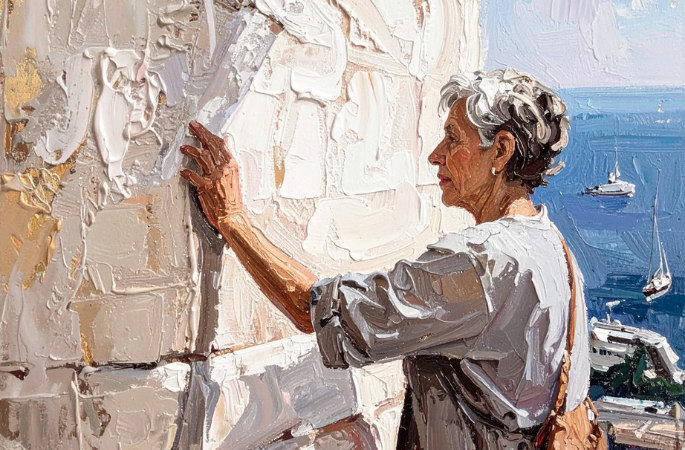
Justine sits down in the small band of shade created by the wall, and calls the taxi driver. She wants to leave. She turns away from the sun and faces the wall. Away from the glare, she can open her eyes. She rests her hand on the wall.
Justine will be leaving this important site without even climbing all the way up to the entrance. Might as well, while waiting for the driver, look at the wall at least.
The carvings on the old wall have become worn out. The grooves, for some reason, rather than the crafted design are taking the light to reveal a hidden pattern. A pattern quite different from the one so painstakingly executed by the artist. A pattern almost invisible, revealed on observation, to be more beautiful, even clearer.
Justine’s friendly wave is met with loud happy shouts from the passengers of the tourist train. From the cool car interior, it is possible to look at the sun pouring diamonds on the sea. The driver points to the Chateau d’If. Justine has actually been on the island the last time she was here. She had loved the island, the roughness of it. The stories of it. Nikolas, their guide was an assistant professor at the university that was hosting them. The young man had, knowing that she liked books, singled Justine out for describing details of the prison cell of Edmond Dantes. Sights were pointed out as if Edmond Dantes was really here. Imprisoned here. Counting there. Escaped from. There. Here.
Nowhere. Justine knew that. And yet, it was enjoyable to believe for a while, to feel the breeze from the sea that Ulysses had sailed on, the gates of which were being demonstrated now, by the clasping and unclasping hands of a young man. Now she wonders whether she was enjoying the charming flirtation of Nikolas, or thinking of Edmond, who was the only man to escape the fortress, but the story never happened. So, is the man she was thinking of, the man who wrote Edmond then? Alexandre Dumas? No Pere. Not you. Who mattered, was that voice that had almost whispered, thinking she was bored with Nikolas’ unceasing commentary, and ‘saving’ her as spouses often do, at parties, or perhaps envious of Nikolas, possessively, “Come Justine, let me take a photo of you.”. The voice she remembered now. Anant.
Even her enjoyment of the harmless charms of Nikolas had been possible because of the presence of Anant. The presence which required a lot of work from her, was even oppressive at times, but had become essential, and more importantly, beloved.
As Justine went to the airport at 2 AM to catch the flight to Paris, she knows that she had needed to confirm that presence in her life, that Anant was there, albeit at a distance. That there was a man she belonged to.
And so, she had said “My husband is travelling in business class.”
Anant, who never treated her as an equal, true, but had always respected her. Would she have liked it if he had paid to upgrade her ticket? Or did he know her so well that he knew that her self-respect and independence mattered to her very much? Hadn’t she told him how these were the two qualities that she had inherited from her mother? Maybe he had not wanted to take them away from her.
Maybe. She would never know. For that part of her life is over.
Justine stands in the immigration queue at Mumbai airport with the other passengers of the Paris – Mumbai flight. Probably for the last time, as she has decided to no longer live in India. She would go back to England, take care of her mother, take up a job at a hospital. Maybe in infectious diseases, having picked up a lot of experience here in India. She wishes she could say that she would continue Anant’s work, run the Bhide hospital, with some help from his friends – the doctor colleagues. But no, she would get her own job, buy her own ticket.
So, her ‘business class’ trip, her solo ‘foreign’ holiday has ended. Returning now, she does not recollect anything that she did in this trip. A cruise around the Calanque rocks, from the last time she went to Marseille replays in her mind.
An unexpected storm over the sea, an unfamiliar blue. The rain colder than Indian rain. The rocking boat, and Anant’s motion sickness. If they had been on a road journey, he would have been sick and she would have been standing, slightly embarrassed, on the side of the road with a napkin and a water bottle. But in this boat, probably due to the presence of some good-looking women, she smiles to herself now – so she too was possessive, was she? – he had gone to the edge of the boat and stood there. Justine had watched him for a while, giving him his space. Then suddenly, the boat had started tossing and turning. Plates, glasses, all the paraphernalia of the tourist experience flew off shelves. Justine had tried to walk, and fallen. Someone, please get a blanket to my husband, she had begged the tour guide, who had by now, given up the pretense of cheerful calm. As the gales became worse, the captain came down to talk. Let’s go back to harbour, Justine pleaded, my husband is sick. Anant could not walk to the cabin; he could not let go of the pole to turn back. Justine looked towards him, and then at the tall white rocks. She remembered the church on the rocky hill. Yes, the theft of her purse had happened on the day before. Till this morning, she had regretted going there. Now, she prayed to the Bonne Marie – the good mother – wasn’t she supposed to protect those in distress at sea? Please keep him safe, she had found herself saying. Please keep him alive, she had cried out aloud.
Now, walking out of Mumbai airport, almost a month after her husband’s death, tears finally flow down her face as Justine remembers that Mediterranean storm.
How she had looked at Anant precariously holding on to the sail.
How she had had only one thought.
“Losing you would be the worst thing to happen to me.