 Nadi
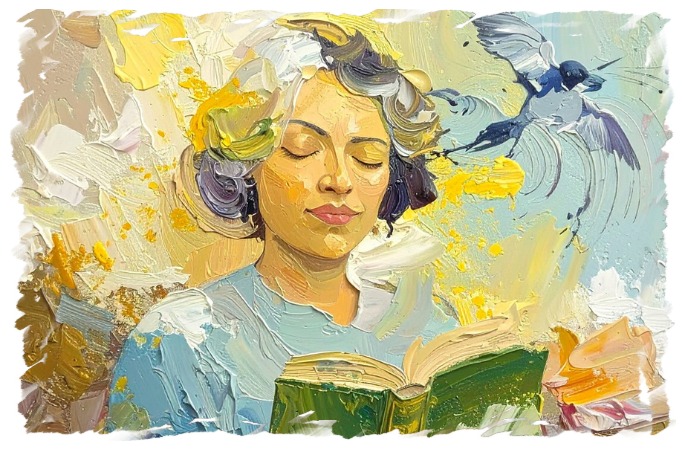
NadiI used to look down upon audiobooks. Then, one day, a swallow flew straight at my eye.
While discussing literature and women, apart from the content of stories, the circuits of their telling and receiving are also important. The audiobook is one such circuit, increasing in popularity. A lot is written about whether the effects are the same as “actual reading”, and it is generally agreed that they are, especially for people who find it difficult to read.
While learning difficulties are top of the list for the general population, for women, correctly but somewhat in an essentialising manner, it is emphasised that women can access audiobooks even while performing tasks of caregiving, cooking etc.
Spending time with a book is a part of my reading pleasure. Holding the book in my hands, feeling in communion with the author’s mind, is a refuge. I had never considered listening to audiobooks. Even the practicality, accessibility and economics of reading on Kindle overrode the feel of paper, the underlining, and the smell of books.
Especially the smell.
“Biblichor”, the word for the comforting smell of old books, is a combination of Biblos meaning book and Ichor, the blood of gods. That the word is derived from petrichor, the smell of the earth after long-awaited rain, evokes a nostalgia for the Konkan of my childhood. This emotional attachment, almost to the point of dependency, has continued for decades.
Until the 6th of March 2025, when a swallow flew straight at my eye.
Yes, that is how I described the floaters to my ophthalmologist. I will not go into details about how that happened. That is another story. Not the stars that cartoon characters see when they get slapped on the face. The flashing lights and the dark spirals came later.
As you can imagine, or even know from experience, I craved books, needed stories, needed meaning. In crisis, or in the state of absolute loneliness that illness puts us in, we want what non-readers call escapism. What we know as a connection with another soul, receiving strength and love from a story.
Unfortunately, this was a situation, this was a pain, which did not allow me to do that one thing which I depended on to help me: reading. I turned to audiobooks.
First, I asked my partner to get me the Audible app. Then, to read me the list of free audiobooks, as I had only one credit worth 139 Rupees and did not want to spend any more money till I was sure this audio thing worked for me.
Up came self-improvement, religion and inspirational books. I was almost put off by the whole idea, when I discovered the search option. I typed my most-loved name, and the Virginia Woolf collection appeared.
Free.
Appeal no. 1: Audiobooks should be freely available. Their locations should be widely shared. Some should be free of cost.
The first book I “heard” was a dear book, Mrs Dalloway. The familiarity with this book could also be attributed to films. I had taught The Hours in a Screen Adaptation class, reading David Hare’s screenplay, Michael Cunningham’s novel and Virginia Woolf’s Mrs Dalloway. Woolf’s book, in so much detail to make the connections, that I almost know it by heart.
Next, The Waves. Her most complex, and I feel, her best novel, and my favourite.
Now, we who love The Waves already have in our heads our own voices for each of the characters who are quilting the story. Distinct voices, but all our own. Would listening to other voices blemish this, I worried, as it happens sometimes with characters’ faces when a favourite book is adapted for the screen?
However, the voices that narrated The Waves were excellent, and it was a beautiful experience. I listened, holding in my hand my green cloth-bound old copy, bought for 30 Rupees many years ago from a library “withdrawn books sale”.
An encouraging experience, the Virginia Woolf collection, all 30 hours and 13 minutes of it.
Next, Wuthering Heights. I was still staying with the novels that I knew almost by heart. The narrator was the actor Shernaz Patel. Being from English theatre, her English was superior to my small-town accent, but being Indian, closer to my voice than the narrators I had heard before.
I will never forget the voices of all these narrator-actors who read to me when I could not. When I found the Woolf books, filmi me had recognised the names of Tilda Swinton, Kristin Scott Thomas. Now I know that many of the narrators are trained actors. They found audiobooks worthwhile enough to take time off their busy schedules.
Appeal no. 2: Actors, people with good voices, should record themselves reading books, and on whatever platform they can, make them available as audiobooks.
John Berger says, “The novelist’s voice functions like an inner voice.” Making this literal, listening to a novel in the writer’s voice can accumulate this happiness.
The Hunchback of Notre Dame, Middlemarch, and then, finally, 12 hours and 38 minutes of listening to the delightful Miriam Margolyes reading The Bell by Iris Murdoch marked the end of the “familiarity” phase. I was ready to listen to books that I hadn’t read before.
Still staying with loved authors, I heard the one work of Colm Tóibín’s that I hadn’t read: his poems, Vinegar Hill.
All of us search for recordings of authors reading excerpts from their work. Somehow, hearing the words which they wrote, in their voice, fills our hearts. I now know that many authors make audiobooks. This works very well, especially for memoirs.
Appeal no. 3: Authors should make an audio version for every book they write. Just as translation takes an author’s work to more readers, audio will take it to people who cannot read.
On the first of July, in the middle of listening to Thomas Hardy’s Far from the Madding Crowd, my eyes began to heal. The floaters persist, but I am reassured by my ophthalmologist as well as a retinal surgeon that they were, well, keeping an eye on my retina.
I opened a book. Felt the pages. Did not read. Simply looked at a picture.
Picasso’s Acrobat’s Family with Ape 1905.
Was the juggler family from Ingmar Bergman’s Seventh Seal inspired by this one, I wondered. A stream of connections, memories, begin to flow when you touch paper.
So yes, there is a special feeling associated with paper books, but I knew that I would continue to sometimes listen to audiobooks even when I was able to read. Because audiobooks had comforted me at a time when I was not.
Appeal no. 4: Do not look down upon anyone who is listening to a book, rather than reading it.
Maybe the person who once read to them is no longer around, maybe they are too busy to sit down with a book, maybe a swallow flew straight at their eye.
In the first week of August 2025, I began to read a book.
A Town Like Alice by Nevil Shute, 1950. Weather-beaten, fragile pages.
I inhaled.
A smell more divine than petrichor.