
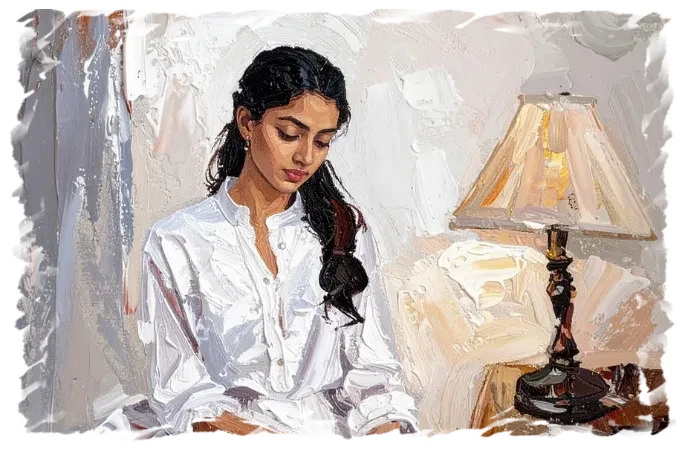
 Keshayinie Edmund
At that time, I was studying in Grade 9 at school. In our health textbook, there was a lesson about menstruation. But our health teacher did not teach us about it. I used to secretly look at the pictures in that lesson when no one was around. The reason for this secretive looking was that if any of my classmates saw me, they would tease me.
Many of my female friends had already become “big girls” even before coming to Grade 9. When the class teacher took attendance, she would loudly call out our names. During those times, if the name of a girl who had missed school because she had her period was called, the teacher would say, “She has her period.” On those days, when I got home, I would ask my grandmother about it. She would sharply say, “You still need to grow more.” Later, when my mother came back from work, I would ask her too. She would say, “I’ll tell you later, dear.” But I always noticed that my mother’s face would droop a little when she said this. At that time, I didn’t understand why.
During all this, one day, like all the other girls, I too became a “big girl.” I became a big girl while I was at school. One morning, after finishing sports practice and entering the classroom, a friend called me aside and whispered to me to turn around. When I looked, I saw something reddish like a stain on my uniform. She immediately told the class teacher. The teacher took me to the school Sick Room. They took my mother’s phone number and called her. Within fifteen minutes, my mother arrived at the school. When she came, she kissed my forehead and cried a little. I did not understand why they were behaving like this. I also felt a slight pain in my stomach.
Soon, my entire extended family came to the school. They covered me with a white cloth, placed an iron plate in my hand, and took me home in a vehicle. Before I could enter my room, many changes had already been made there. The bed sheets and the window curtains had been changed. A knife was placed at the entrance of the room. My mother took me into the washroom and told me to wear a pad. Later in the day, neighbors and close relatives had all gathered at home. A square enclosure was made using cloth, with a lamp in the middle and some waste placed on top of it. They made me sit on top of that. Nearby, in a water vessel, jasmine flowers had been placed. All the female relatives took water from that vessel and poured it over me. Then they covered me again with a white cloth and took me back to my room. From the conversation I overheard, I understood this ritual was called the “First Water Ceremony.”
My father’s sister, whom we called “Murai Mami” (auntie), gave me a green egg and neem leaves to grind. I was upset and cried at that moment. After everyone left, my grandmother came and said, “You must not go outside from now on. If there is an emergency, you must come with this knife,” and handed me a knife. There was a strict order that my elder brother and younger brother were not allowed to enter my room. I noticed a kind of warning expression on my elder brother’s face and an unreadable smile on my younger brother’s face. After that, my elder brother never came to my room. Sometimes, the younger brother would stand at the door of my room when no one was around, looking inside. From that day onward, many people came to see me. But only women were allowed into my room. They would bring something from the list of sesame seeds, neem leaves, horse gram, clarified butter (ghee), or country hen eggs.
Every morning and evening, my “Murai Mami” would come and give me green eggs and neem leaf oil. At mealtime, fried eggs with ghee and brinjal would be served. Every day, my grandmother would mix horse gram flour with ghee, wrap it in a cloth, warm it, and place it on my lower abdomen as a hot compress. Later, she would unwrap it and feed me. They often forced me to eat white horse gram porridge and sesame seed balls. I was bathed daily, with turmeric rubbed into my body. For three days, my days passed like this. After that, my menstruation days were handed over to the astrologer, and a day was set for a ceremony. As told, a saree of a specific colour was bought for me. On the day of the ceremony, the “First Water” ritual was performed just like before. But this time, after the bath, they took me to the temple, lit lamps, dressed me in the saree, decorated my head and face, and seated me on a stool in the hall under alamp.
The whole house was filled with guests. The food was lavish. My mother’s elder and younger brothers both wore veshtis and headgear, and theyadorned me with jewellery. This ceremony is called the “Thaai Maaman Sadangu” (Mother’s Brother Ceremony). My “Murai Mami” performed the aarti (prayer ritual). After many such ceremonies, a holy brother blessed me and chanted prayers. Later, guests ate lunch, and then each family came, gave gifts, stood beside me, and took photographs. Many took photos of me alone, in various decorations and poses.
After all this was over, my mother told me I could now go outside. Somehow, her words gave me a feeling of freedom in my heart. After two days, I was sent back to school. They even gave chocolates to share with my classmates before sending me off. When the teachers saw me in class, they said my appearance had changed, and I looked more grown-up. That night, lying on my bed, I thought, “Being a ‘big girl’ is no longer for me.” With that thought, after about five days, I suddenly had stomach pain. After coming home from school and changing clothes, I saw blood stains on the back of my shirt. Along with the physical pain, an indescribable mental anguish started to grow inside me. My mother ran and told me, laughing, that this happens every month. From then on, I began to expect every month. During those three days, I felt a kind of discomfort and stomach pain spreading inside me. I also began to dislike light-colored clothes on those days. No one explained to me why the blood was coming or from where…
Today, as a university student, I know many things about menstruation and the “First Water” ceremony. When I become a mother, I am determined to give my daughter this knowledge beforehand and prepare her for “those three days.” I am very clear that the mental anguish I experienced should never happen to her. She should not misunderstand, like I did, that “the ceremonies” mean “becoming a big girl.” She should understand the physical and mental changes she will undergo and prepare herself for those three days.
You can read the My Adolescence Diary – Page 1 here.