
 Mohamed Riyas
“Do good and make it to a boat and throw it into the river. one day it will meet you as a camel in the desert.”
Sufi Quote
“We have wandered all over Dunlop Street…but there is none with flowers, the big flower They don’t look like the ones you search for. What do we do?” Bharathi asked.
“Let’s search. It should be somewhere, Come, let’s see if it’s there at Bismi’s shop,” said Ismail.
Ismail had only been in Singapore for a month, and this was his first venture onto Dunlop Street. The Tekka market, overflowing with everything from home, left him wide-eyed with wonder.
From small roadside stalls to large shops, goods were packed tightly, filling every inch. Coir mats, Chennimalai bedspreads, red-and-black striped turkey towels resembling coconut scrapes, seaweed, Indian shoes, ropes, carton wrappers. The shops were so full they seemed unable to hold any more. Standing at their entrances, shop assistants called out in Tamil, “Come inside, buy!”
A wave of nostalgia swept over Ismail, as if he were back at the Thursday market in Tuvankurichi. He remembered the anxious wait while goats were untied, loaded onto the ‘small elephant’ truck, and taken to market, a nervous fire always burning in his belly. Without sisters, his world revolved around Umma. Whenever there was a little profit after selling the goats, he would buy her sweet jackfruit, her favourite, and head home with a sense of purpose.
“We’ve reached the shop,” Bharathi said.
After weaving in and out of countless shops, exhaustion tugged at their feet. But as they slipped into the narrow lanes of Dunlop Street, a charanam from an Ilaiyaraaja song floated out to greet them, lifting their spirits.
Then, in the shops, they entered one after another, Imman, Anirudh, and A. R. Rahman took turns, sharing the Sunday holiday with the workers.
Standing at the entrance to Dunlop Street, Ismail looked at the entire stretch of road with awe. Migrant workers were tasting the temporary happiness of their Sunday break. Some opened beer bottles secretly, others openly, sitting on the grass field and pouring drinks. Illegal Indian tobacco was crushed in palms and pressed between teeth and tongue, accompanied by whistled “nus… nus…” sounds. Some men were grinning broadly as they bargained with sex workers who had smeared themselves with talcum powder, laughing and chatting as they shook their bangles.
On that street, every remedy for numbing life’s ache was on offer, each stall promising a brief escape from sorrow.
The market street seemed to absorb the helplessness of Indian workers who had crossed oceans, now wandering its length burdened by sorrow, separation, and longing.
At Tiruchirappalli airport, Umma and his younger brother had come to send Ismail off.
Squatting on a line of bolted iron chairs, Umma cried. Though Ismail told her again and again, “Umma, don’t cry,” she could not hold back her tears. It was not just him she was crying for, but his father as well.
A white cat, appearing from nowhere, stood beneath Umma’s chair, gently brushing itself against her. While his brother went to look for a trolley to load the luggage, Umma began speaking against her own will, pleading in a way that objected to Ismail’s foreign journey.
“Ismail, look here. This cooking fire, you see, it is like a void to us. It feels like this fire is not good for our family. Your father, it was this same fire that dragged that man all the way to Malaysia. Now that fire’s heat is pulling you towards Singapore. You are going after it too, like a chicken under the spell. If this goes on, I will be left all alone,” she said, breaking down.
Ismail’s father had travelled to Malaysia many times. But after his last journey, there had been no news until today. The white aerogramme letters sealed with flight stamps had stopped coming long ago. During his school days, Ismail used to peel off the foreign stamps from his father’s letters and stick them on the wall of his house. Just to look at those stamps, his friends would eagerly come running to Ismail’s house. On those stamps were birds in different colours, durian fruits, the giant rafflesia flower, and hibiscus blossoms.
When the letters stopped arriving, one side of the wall waited empty, without new stamps. The colours on the old stamps slowly began to fade. During his dad’s last journey, Ismail’s younger brother was a child. Now he had grown into a young man. After the letters stopped coming, Ismail’s umma too became like a broken clock, standing still in waiting.
Time and again, letters written by Ismail’s schoolteacher to the return address printed on the father’s letters were sent to Malaysia. Not a single response. Every day, Umma would wait anxiously, wondering whether the postman who came into the village at four in the afternoon would bring any good news.
On sacred Friday nights, on Eid nights when the crescent was sighted, she would sit in the courtyard of the house, place both Ismail and his younger brother in her lap , and cry out towards the sky, “Yaa Rabb, Why did you make my children fatherless?”
Her desire was that Ismail and his younger brother should study well. But in Ismail’s family, the chickens that laid eggs to earn daily food, and the goats bleating restlessly in the shed, could give them meals but not anything beyond that.
“If I go abroad like my father and earn some money, only then can we stand on our feet properly,” Ismail said for the first time.
There was no happiness on Umma’s face. “Don’t go. Stay here,” she said again and again. Ismail refused.
When the chance to go to Singapore finally arrived, the family sold nine goats huddled near the leaky roof to pay the agent. The weight of that money pressed on Ismail’s shoulders like a sack of stones. Family burdens pulled him one way, his father’s disappearance another. His mind turned these worries over and over, like prayer beads slipping through restless fingers.
As Ismail pushed his luggage trolley and entered the airport terminal, the image of his father boarding a plane for the last time merged in Umma’s mind with the sight of him leaving now, like two doors of the same opening.
Through the glass, she watched the trolley wheels squeak as they rolled towards the departure gate. “How many Ismails there are in this world. How many children like Ismail,” she thought.
“Oh my Creator, protect all the children who travel,” she prayed, spreading her Duppatti wide and lifting her hands.
Once, when Ismail was asleep in his village, his dad appeared in his dream. Holding his hand, he pulled him into a room. He followed him without understanding where he was being led. Inside, large vessels bubbled with boiling meat. Rice pots overflowed, frothing like milk. He showed him everything carefully.
In another room, his grandfather Basheer was cooking. When Basheer saw Ismail, he hugged him tightly and kissed him.
“Grandson, what are you staring at? Do you think your father and I are doing nothing here?” he asked, laughing.
He took Ismail by the hand and showed him the stove, where the fire burned fiercely with a thak-thak sound. At first, Ismail was afraid to go near it. Slowly, he moved closer.
“Don’t be afraid, Ismail,” Basheer said. “This fire won’t destroy like your umma fears. This is the fire that lets others live. It is the fire that feeds the hungry.”
Then they opened another room. From a wedding feast laid on a large sahan platter, four people were eating together. Meat curry and ghee rice were being served. Pointing to the people rising from the meal with full stomachs, Basheer said quietly, “Look at their faces after hunger is gone. Look at the peace there. This is what your father and I earned. This is what you too will earn.”
A wedding feast eaten together dissolves many small resentments and everyday irritations. At the event, everyone prays in unison for the newly married couple. The collective prayer, “May you live for many years,” drifts through the air like pigeons flying out of a mosque courtyard.
That prayer, says Nenna Basheer’s culinary wisdom, requires a pure heart, and that purity is prepared through the food we cook for such occasions. This thought seeps into Ismail’s mind, flowing in like fat melting and running from a piece of meat roasting over a low flame.
“What connection is there between prayer and cooking, Nanna? I don’t understand,” Ismail asked.
His dad, who had finished cooking, wiped his face with a red cloth and said, “Food cooked in a halal way carries people’s prayers straight to God. Haven’t you heard that?”
Holding Ismail’s hands, both of them said together, “Purity begins in the intention. Only then comes cleanliness of the vessel. Whatever you do, the heart must be clean.”
When the dream ended, Ismail would wake up calling for his dad. On nights when the two of them appeared in his dreams, the smell of onions frying, garlic, and curry leaves felt like welcoming him to cooking. A desire grew in him to earn the name “Coconut Rice Basheer,” like his grandfather.
Working as a cook at weddings and kandoori feasts around the Karisalpatti–Tuvankurichi region, Ismail found his calling. That light now pointed him towards Singapore.
Once, a big shop owner who had come to Tuvankurichi for a special occasion tasted Ismail’s coconut rice and meat curry. He was delighted. He arranged all the travel formalities and offered him work in Singapore.
Ismail chased away the cat that kept rubbing itself against Umma’s legs and asked his brother to comfort her.
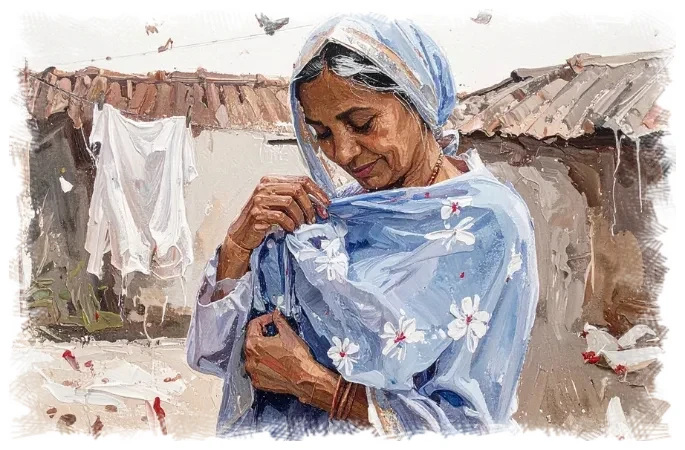
He gazed at Umma’s Duppatti once more. It was faded and worn, its fabric now steeped in Ujala blue. The dark blue background had browned at the edges, and the flowers had surrendered their colour and brightness to time.
It was the Duppatti his father had brought, full of love, from Masjid India on his first return from abroad. In his suitcase, among a few perfume bottles and axe oil, this Duppatti had been carefully kept folded. Once, when his brother secretly broke open the suitcase to steal sweets, syrup accidentally spilt onto it. Umma washed that stained Duppatti and continued to wear it.
The new foreign Duppatti his father had brought had replaced the free white cotton cloth from the ration shop that Umma had used earlier. Now, if she went to a relative’s wedding, she no longer needed to borrow a Duppatti from their neighbour Zainambu.
But her happiness ran deeper than newness. The edges of the Duppatti seemed to hold his father’s scent, his touch, his nearness, coming alive each time Umma draped it over her shoulders. Butterflies fluttering to its faded flowers felt like messengers from Malaysia, as if the father stirring rice pots far away had sent them home.
Whenever Ismail thought of his father, a parade of foreign scents filled his mind: the sharp bite of Gudang Garam cigarettes, the tang of gold medal axe oil, the secret perfume of Lux soap for his aunt, the leathery aroma of new walker sandals, and the mingled sweetness of jawwu mittai and jelly bottles, each memory arriving one after another.
Spotting these familiar goods along Dunlop Street, Ismail felt his father’s memory come rushing back, vivid and bittersweet.
“Show me a white Duppatti with big flowers,” Ismail told the salesman.
Among the Duppattis spread out, one stood apart. It was different. It resembled Umma’s old Duppatti. White hibiscus flowers bloomed across it. As Ismail bent down and smelled the Duppatti, the salesman said,
“Brother, it’s an item for sale… don’t do that.”
The salesman unfolded and refolded many Duppattis. Still, Ismail chose the hibiscus Duppatti. He packed it carefully and wrote on it in bold letters.
“Give to Fathima, Karisalpatti goat shed.”
Send it with a friend who’s going back home.
By sending Umma that Duppatti, Ismail felt that he had, in some small way, become a grown man. Certain that this Duppatti would bring her a new kind of happiness, he turned back towards the shop. He also believed that it would offer her a fresh comfort, easing the ache of remembering his father.
On a Friday morning, Ismail woke from a dream. In a dried-up pond, the Duppatti he had sent lay spread between two sticks, drying in the sun. A strong breeze lifted it, carried it through the air, and wrapped it around Umma. She held it in her hands with joy.
The Duppatti he had sent without asking her would have reached Umma by now. Thinking it would come as a pleasant surprise to her, Ismail called Umma early in the morning.
“Umma… did the Duppatti arrive safely?” he asked.
But Umma did not speak about it. Instead, she began sharing the joy of Rabiath’s wedding proposal, the girl next door. Hearing the news of Rabiath’s wedding, Ismail too felt happy.
Rabiath’s father, who ran a tea stall in the Karisalpatti bazaar, had five daughters in a row. Bitter and worn down by the disappointment of not having a son, he had named the last daughter “Podhum Pen”, meaning “Enough daughters.”
“Somehow, everything has come together for Rabiath. The expenses aren’t very much. If we just serve tea on the wedding day, that will be enough. The groom’s family has said they don’t need a feast. They say the groom works in a vest factory in Tiruppur. He struggles a lot. But he is decent.
By getting a note from the mosque leader, going door to door among the better-off houses in the surrounding area, and collecting from our own neighbours as well, we have to do this wedding, Ismail. I even thought of taking the two goats lying in the shed and selling them. Something little from us.”
Ismail listened quietly, then asked again, “Umma… the Duppatti I sent…”
“Yes, dear. It was very beautiful. I spread it out and showed it to the neighbours. Rabiyath came to see it. She touched it again and again. I saw how her fingers trembled when I noticed that. Her eyes filled with tears.”
“And then…?” Ismail asked.
“If she had a younger brother like you,” Umma said softly, “she might have had the courage to tell the dreams in her heart. That man had only daughters. So I gave her the hibiscus Duppatti you sent.”
Shock and bitterness rose inside Ismail. All his wandering through Dunlop Street, all the effort, he felt like telling the story behind it.
Holding back the anger that rose in him, Ismail clenched his teeth and said,
“Umma! Do you have any sense? Do you know that was the Duppatti I bought specially for you?”
“Let it be, Ismail,” she replied. “I’ve already lived my life. She’s the one who has her whole future ahead of her. If you give one thing, it comes back tenfold.”
“Even then, why give away something new as Sadaqa ?”
“What does new or old matter, Ismail? What we give must be new to the one who receives it.”
Ismail was silent.
“It’s all right. If we give a thousand rupees, we can buy a Duppatti from Thondi Bai’s cloth shop in the Madurai lamp post. Once you buy it for her, you take it back the Duppatti from her again.”
What kind of twisted logic is that? Taking back what you’ve given is like picking up vomit and eating it again.”
Ismail remained still.
“Listen, Ismail. The thought that your father is still with us lives in my Duppatti.”
“What? That old Duppatti? Is that even a Duppatti? Just throw it away, toss it somewhere in the jungle. It’s become limp, as if it has absorbed decay. Throw that away and use this one instead, isn’t that what should be done?
As Ismail began to shout in anger, a sob came from the other end. Wanting to calm her again, Ismail said, “Umm, listen….”
She began to cry loudly. When he called out once more, “Umm…”, the phone connection had been cut.
She stepped into the courtyard to scatter grain for the chickens and glanced up at the sky, heavy with rain-laden clouds. As memories welled up, she wandered to the back, where her old Duppatti hung on the line. She folded it with care, pressed it to her nose, and breathed in a happiness beyond words.
As a fine drizzle began to fall, she hugged the Duppatti to her chest and hurried indoors. Overhead, two butterflies danced above the roof, undeterred by the rain.
………………………….
This story is originally written in Tamil by Mohammed Riyas and translated into English by Shameela Yoosuf Ali. A journalist, writer, and researcher, Shameela works across storytelling and scholarship. As Editor-in-Chief of FemAsia, she is committed to bringing voices across languages to wider audiences, translating with care to preserve tone, memory, and emotion.