 Mudassar Javed
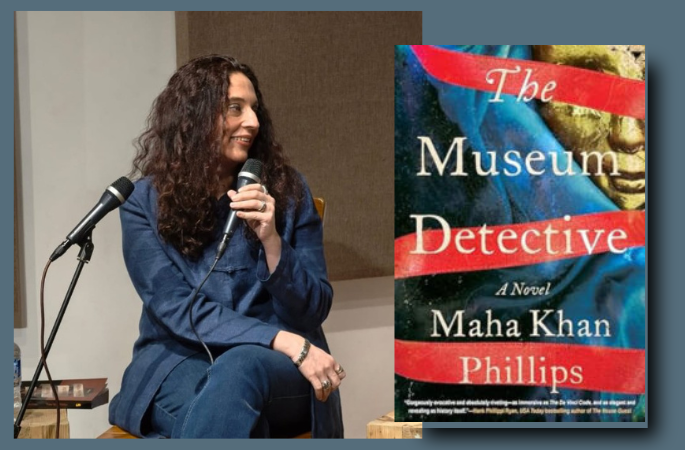
A thriller doesn’t normally start in a museum storeroom, with fluorescent lights having trouble keeping the lights up and a curator thinking in layers the way archaeologists do. But The Museum Detective by Maha Khan Phillips insists that the most dangerous crimes are not necessarily committed in back alleys of cities. Sometimes they are sitting in plain sight, catalogued, wrapped in red tape, and protected by a “police escort” that may not be protection at all.
Maha Khan Phillips brings Pakistani crime fiction to an unusual, exhilarating space: Karachi’s museum world, where antiquities, ambition and institutional vanity collide. The premise is immediately cinematic. Dr Gul Delani, a Karachi-based curator and Egyptology-trained archaeologist, is called out to advise the police after a drug bust in western Pakistan. What They Have Found in a Cavern Does Not Fit the Script of an Ordinary Raid. It is a sarcophagus that is dense with inscriptions and a mummy that looks almost too perfect to be real, “an honest to Gods, heart-stopping, breathtaking, bone-chilling mummy”.
From there, the novel provides what crime readers seek: urgency, increasing risk, and a conspiracy that continually changes shape. Yet Phillips is not satisfied with just one hook. The mummy investigation keeps tangling with Gul’s private wound, the disappearance of her teenage niece Mahnaz three years earlier. Gul’s grief is not a soft background music, it is the engine that makes her go and stirs up her moral impatience. At one point, she attempts to resist thinking about Mahnaz, and fails, reminding us that obsession, like trauma, has no professional boundaries.
Phillips’s most powerful instinct, though, perhaps honed as a journalist, is the way she links crime to systems rather than a single moustache-twirling bad guy. Smuggling, narcotics, museum politics, police turf wars, provincial rivalries, international posturing: the novel understands that “illegality” is often a network, not a person. That is why the setting of the museum is important. Museums are supposed to be guardians of public memory, but they are also institutions in which budgets can be strangled, reputations can be manufactured, and the past can be made to serve whichever narrative is loudest at the moment. In Phillips’s Karachi, archaeology is more than just a scholarly calling, it is a language of power.
The procedural texture of the plot, particularly in the early part of the novel, may try the patience of impatient readers. Phillips takes time to establish Gul’s institutional landscape, the museum’s internal tensions and the protocols around handling a fragile body that has suddenly become politically explosive. This slow burn, however, is not wasted. It is similar to the logic of excavation, where speed destroys evidence. When the novel finally tightens, it does so with authority, and Phillips proves she knows how to stage suspense in the unlikeliest of places. Consider the instance when Gul is given permission to transport the mummy. The passage is brisk, physical, almost logistical and this is precisely why it is unsettling. The body is strapped into an ambulance, the sarcophagus tied down and the convoy moves through the city under watch. Gul’s dry observation, “Bloody hell”, lands as a mix of wit and warning.
This is where Phillips’s style works best: controlled, factual, quietly atmospheric. She constructs her world through professional detail rather than lyrical flourish, trusting the inherent drama of the situation. Even a small scene, like Gul teaching children at a museum club “how to mummify a basket of oranges” does double work. It is funny, local, revealing: Gul is the type of educator who makes the past touchy and a bit scandalous, and the community backlash is a hint of the cultural anxieties that will shadow her work.
Gul Delani herself is an arresting creation, even when she is hard. She is not written to be charming. She is whip-smart, blunt, impatient of incompetence, and frequently domineering in a way that will divide readers. Yet that abrasiveness also has the reading of a refusal to perform softness for the comfort of others. In a society and a professional culture that often punishes women for being direct, Gul’s personality becomes part of the novel’s argument. The question is not whether or not she is “likeable”, but whether or not she is believable as someone who has had to fight to become an expert and refuses to be reduced to decoration.
The supporting cast brings energy, especially the warmth and steel of Mrs Fernandes, Gul’s secretary and confidante. Their relationship provides the most humane interludes of the novel, moments when the danger recedes for a moment and the story remembers that courage is rarely solitary. At the same time, the novel introduces a huge number of secondary figures, officials, colleagues, interns, smugglers, power brokers. This is partly the nature of a series opener setting the groundwork, but the proliferation can sometimes blur the narrative edges, especially when institutional factions start to multiply.
Phillips’s most effective thematic move is the one she makes with the mummy itself. The body becomes an object of struggle, coveted, claimed, exploited, defended, endangered. In this sense, The Museum Detective is not only a whodunit, but also a meditation on value and disposal, on how the world looks at women’s bodies through radically different lenses: sacred, scientific, erotic, criminal, marketable. The novel’s underlying horror is not just that a woman may have been killed, but that her “worth” can increase and decrease depending on whether or not she can be commodified. That idea gives the thriller its bite and it’s what prevents the book from being a mere page-turner.
Still, the novel is far from without its weaknesses. At points, the violence verges on graphic intensity that some readers will find excessive, and a little trimming would have enhanced the book’s more intellectual suspense. Likewise Karachi, despite being mapped convincingly as a city of contradictions and pressures, is not always evoked with the sensory fullness that Pakistani Anglophone fiction at its best can achieve. Phillips is writing in a genre form in which pace and plot are often more important than the long, lush accumulation of place. Whether one sees this as restraint or missed opportunity will be dependent on what one comes to crime fiction wanting.
Yet the ambition is clear. The Museum Detective dares to put archaeology at the centre of a modern Pakistani thriller, and it dares to make a Pakistani woman scholar the type of protagonist who does not apologise for her intelligence or her anger. It is also a novel with a keen eye for the way institutional realities affect individual fates. When Gul is informed that her police protection is being withdrawn, and that her safety is “no longer a priority”, the line rings in as much as political commentary as it does plot complication. The state can mobilise power rapidly when the optics require it, and move away just as fast when truth becomes inconvenient.
The most persuasive argument for picking up Phillips’s novel is that it opens a door that Pakistani English fiction has too rarely crossed with confidence: genre writing that is locally grounded, ethically alert, and unashamedly entertaining. This is Karachi noir with an archaeological spine, a mystery that knows well the glamour as well as the brutality of what it means to “discover” a body, ancient or modern. If later instalments deepen the texture of character and place while maintaining the precision of the plotting, Phillips may well cut out a distinctive space for herself in Pakistani crime fiction.
In the meantime, The Museum Detective is a fast, smart invitation to read differently. It asks you to look at the museum not as a quiet building of dead objects, but as a live battleground, where history, politics and greed negotiate with the fragile remains of human lives. And once you enter that battleground with Gul Delani it is unlikely you will put the book down before she turns the past over and makes it speak.