 Savia Viegas
The train sped past the platform of Mahalaxmi station. Efa’s anxiety to alight from the moving train and breathe in the fresh open air was still making her push forward through the warm, breathing mass of torsos, arms and thighs. She kept her palms on shoulders of sari-clad women clutching their palus as she propelled herself forward.
‘Pagal! Fast train hai,’ someone yelled impatiently.
‘Want to die, try someplace else’ another retorted as she shoved her.
Landing back, she got elbowed in the ribs without mercy as the women glared angrily though kajol-lined evening eyes.
The train was still speeding past Lower Parel, past Elphinstone Road, as Efa struggled and got caught in a heave of bodies, barricaded by their warm gravity. She breathed deeply trying to release the knotted rumpus in her chest. The train was pulling into Dadar station and the women readied themselves to alight holding their sari pleats with their left hand while the right clutched their handbags. Propelled by the enormity of the exodus, Efa found herself landing on the platform with its sticky black worn-out flagstones.
She exited quickly walking hurriedly past the flower and vegetable sellers, into the gully of the sari shops and kitchen utensils, past kabuttar-khana to the Plaza cinema bus stop. Once she boarded the double-decker and got a ticket for Century Bazaar, Worli she breathed more freely and felt better. On the upper deck, the warm air filled her chest as with deep breaths she expelled it filling her lungs afresh.
That night Efa dreamt of mackerel cutlets, water-melon chunks and lentil barfi repast spread on a chequered bed-sheet on the sands of Zalor, her village in Goa. Her aunts and cousins were all there watching the dolphins frolicking in mid ocean. They were calling out to her ‘Efa, Efa, Efa.’ The fresh salted breeze came in gusts, the sun shone in the clear sky making the sand shine white and the jade-coloured foam laced waves crashed on the shore amid the din of the ocean roar. Efa had spotted her panties in the morning and had to be rushed to the gynaecologist. She was pregnant. It was still her first month in the city and she had begun to get panic attacks in crowded situations. The doctor banned all travel by crowded trains and advised total bed-rest.
Theirs had been a love marriage. Immediately afterward her husband of two months, an air force pilot, had been sent to Siachin where a new air base was being built. That was the time she discovered she was pregnant. So instead of settling down wherever Suraj was posted, she found herself having to shift in with his parents in Bombay. She did not take kindly to the incessant chaos of the bustling city. Moreover, her in-laws were a working couple, from a different culture and she had to do the adjusting without Suraj.
Gyan, her younger brother-in-law, had taken up a job in Bangalore. With the bed-rest there were further limitations to her movement. Sometime an odd relative dropped in or a college-mate passing by through Bombay remembered to say hello. The most difficult chunk of time to pass was the day; sleep took care of the night. To make time fly, she read a lot, stitched a lot, cooked a little and spent the days pretty much on her own in a tiny flat with little windows.
One day Efa had a visitor: ‘I am Hashu,’ he announced hands on hips. ‘And who are you? Have the Guglanis sold their flat or something? Where is Gyan?’
‘Nobody’s at home,’ she said and shut the door on his face, a little taken aback by his rough appearance.
Few days ago she had opened the door to a pair of hijras (transgender) who began to dance on seeing her and demanding money.
‘Eh baby, mummy khiddar hai?’ they asked in loud neutral voices.
Hearing the commotion the neighbours had luckily opened the door and redirected them to another Guglani household three blocks away, where a male child had been born. Their presence and dancing would be treated as an auspicious harbinger of good luck for the new born.
Efa informed her in-laws about the strange visitor on their return in the evening.
‘Oh! Hashu,’ exclaimed Mama, ‘He is alive then. He was a regular here, dropping in once every month and then he just vanished for last six to eight months.’
‘This is a standing rule beta,’ said Papa very haltingly. ‘Whenever he comes do not send him away empty-handed. Make him a cup of tea and give him pao, a banana and ten rupees’.
A month later, at the dot of 12, the same man who called himself Hashu, rang the bell. Efa saw him through the peep-hole. He had a shock of silver white hair and stood with his hands folded against his midriff.
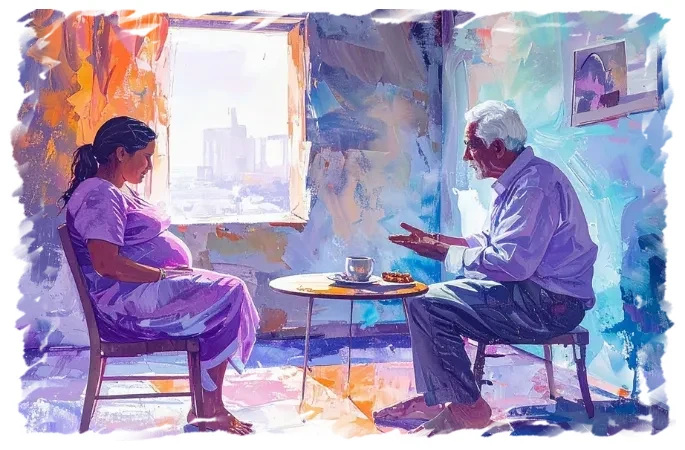
‘Nobody is at home,’ Efa said opening the door with her embroidery ring in hand, and added as she was told to do, ’but I can make you a cup of tea.’
‘Please do, thank you,’ replied the man in accented English. He didn’t come in but sat outside on the door-step of the ground floor flat.
Efa put the tea leaves and water, added sugar and waited for them to boil before adding milk. She let it simmer on the slow flame for some time, arranged the tea-cup, pao and a long green banana on a steel plate and folded the ten rupee note in the palm of her right hand.
He asked for a glass of water and drank it up in gulps. She gave him the tea-cup in the steel plate and sat down on the opposite side of the step. Hashu broke the bread into two equal parts and dipping them into the tea, began blowing on them before he ate the bloated pieces hastily. She watched him closely. He was a slender man of above average height, and wore a grey and green chequered brown shirt over pyjamas that were stained and had discoloured with time.
Aware that she was watching him with her face cupped in her hand, he spoke to her directly.
‘I’m Hashu K.. you are…?,’ he said his lips breaking into a faint smile.
‘Suraj’s wife, Efa, ’she said.
‘Oh, Aha, the Fauji is married is he?’
‘Oh, oh, congratulation,’ he said awkwardly running his fingers through his thick hair. ‘I have come after many months. I have just come back from Larkhana!’
‘Larkhana in Sind, Pakistan?’ Efa asked incredulously.
‘Yes, Larkhana in Sind, Pakistan,’ he replied promptly.
‘How did you?’ she questioned still disbelieving.
‘I walked with the Rabari — the shepherd communities of the Kutch!’
He looked at the beautiful girl sitting in front of him and smiled a wide smile that revealed uneven yellow teeth. Efa gave him the ten rupee note and shut the door after he had left.
Mama checked with her when she returned from office whether Hashu had come. When Efa replied in the affirmative her father-in-law who was sipping his evening cup of tea intervened.
‘Do you know that Hashu was the President of the student Union at Oxford University at the same time when Indira Gandhi and Krishna Menon were mere students. He was a Rhodes scholar a brilliant mind!’
‘Then how did he get to this state papa?’ Efa asked.
‘He was in my school in Larkhana, school topper, athlete and head boy, all the boys looked up to him in awe.’
‘Then?’
‘He came back to India and worked in Delhi for The Quest as that weekly’s chief reporter.’
‘Then something went wrong,’ he sighed.
He gave up his job, his family, and took to the road
Efa cleared away the tea things conjuring up a magical picture of exotically attired Rabaris guiding their enormous herds via the mountainous passes.
A month later she was waiting for the hands of the clock to move to 12 pm, a time when Hashu would arrive. It was still half an hour away. Finally, someone knocked. Efa opened the door. She invited him in while she made the tea. He declined to come in but took his habitual position on the door step while the tea brewed. She took the steel plate with the regular offerings.
‘How can you travel to Pakistan without a passport?’ She questioned naively as Hashu was peeling the banana. He stopped midway and crossed his legs.
‘Of course, the Rabaris do so I did too. In the Kutch region, it was not possible for the Rabari Dhebaria sheep and goat rearers to stay all year round near their villages.’
‘What/ who are they? Toba Tek Singhs–not realising the Partition of India and Pakistan?’ Efa retorted.
‘So you have read Sadat Hasan Manto… Brilliant writer…moved to Pakistan from Bombay.
The Kutch is semi- arid desert frequently hit by drought. The forage is not sufficient to feed the animals. So after the monsoon the Rabari move towards Sindh! ‘
‘Why not forest land?’ Efa was tempted to ask.
‘Access to forests or common pastures is limited, given their low position in the local political hierarchy. Long-distance movements of the Rabari herds allow them to be more productive.’
Efa gave Hashu the ten rupee note when he rose asking for a mug of water to rinse his mouth.
That night Suraj called from Siachan. The phone-line crackled all the while that they spoke.
She told him about Hashu and his Rabari tale.
‘He is a mast maulah of stories,’ Suraj said before the line got cut.
In 20 weeks, the baby began to kick. Efa told this to Suraj when he called. When she went for a routine check-up, her gynaecologist allowed her to hear the baby’s heartbeat. She could hear the distinct thud, thud … thud like a breaker on the shore. It was indeed a thrilling moment. A little after the taxi dropped her home, the door bell rang. It was Hashu.
‘My visits have become more erratic now, I travel to different parts of India. How are you and the baby doing?’ he asked gesticulating a bump on her midriff.
‘All is well with me and the baby,’ said Efa smiling. ‘Let me make you some tea.’
She brought him the tea with some banana and walnut loaf she had baked yesterday.
‘Where have you been this time now?’ she asked sceptically.
‘I am returning from Kutch. I have been to the ancient city of Dholavira. I go wherever my travels take me,’ he said gesticulating wildly with his hands.
‘Dholavira haan!’
‘Yes. The old city of the Indus Civilization in the Kutch!’
‘Oh!’
This city was built on a geometrical plan consisting of three divisions – the citadel, the middle town, and the lower town.’
‘Is it also built of burnt brick like Harappa and Mohenjo-daro?’, Efa asked. The neighbour came out just then to feed the crows. A flock of crows flew in from somewhere and began to swarm around cawing incessantly.
‘Aare what are you sitting here for?’ asked the elderly lady feeding the crows. Hashu began to sip his tea in silence. After she had gone in, he continued…
‘No. The most striking feature of the city is that all of its buildings, are built of stone.’
‘Is it?’
The baby had begun to kick and she followed its movements, listening Hashu’s story.
‘How did you get there?’ she asked him distracted by the baby’s kicks.
‘Look!’ he exclaimed pulling out an old plastic packet from his pyjama pocket. ’ let me show you something.’ He unfolded the white plastic bag and took out something from it. He placed it on the palm of his hand for her to see. She gasped in delight as she looked at the items. One was an exquisite seal with a bull figurine on it and the other was a huge oblong carnelian bead with zig-zag etchings.
Where oh where did you find these,’ she exclaimed taking them on the palm of her hand and touching the delicate seal turning it over and touching the boss and running her finger over the highly polished bead.
‘Dholavira is flanked by two storm water channels; the Mansar in the north, and the Manhar in the south. I found the seal in the Manhar and the bead I purchased from the Khambhatt bead makers.’
‘The city within the general fortifications runs for more than a hundred acres. The acropolis and the middle town have gateways, built-up areas, street system, wells, and large open spaces. The lower town had a bead-making factory’.
‘What else did you see?’
Lothal and Dholavira had dockyards where boats would have been sailed upstream from the Gulf of Cambay during high tide. He gave Efa the seal and the carnelian bead when leaving.
Efa served Hashu lunch instead of the habitual tea. He was still reticent to enter the flat and ate the food balancing the plate on his thighs.
‘Where did your magic carpet take you this time?’ she asked massaging her swollen feet. She was already seven months pregnant. She took a little walk on the footpath outside to ease her swollen feet. She saw him enjoying the vegetable pulao and fried mackerel as she walked back and sat down again.
‘Ajmer Sharif Dargah.’
‘And what is that?’
‘It is a sufi shrine of saint, Moinuddin Chishti. The shrine has the grave of the revered saint, Moinuddin Chishti.’
‘Where, where is that?’
‘Ajmer Sharif Dargah is situated at the foot of the Taragarh hill, in Ajmer, Rajasthan. You have to enter through a narrow crowded doorway. It consists of several white marble buildings arranged around two courtyards. A massive gate donated by the Nizam of Hyderabad and the Akbari Mosque, built by the Mughal emperor Shah Jahan himself.’
‘Oh ‘
‘People throng here – Hindus, Muslims, tourists, royalty. Akbar and his queen used to come here by foot on pilgrimage from Agra every year in observance of a vow when he prayed for a son. The large pillars called “Kose Minar”, erected at intervals of two miles along the entire way between Agra and Ajmer mark the places where the royal pilgrims halted every day’.
‘The main gate to the shrine is the Nizam Gate, followed by the Shahjahani Gate, erected by the Mughal emperor Shah Jahan. In turn, it is followed by the Buland Darwaza, built by Sultan Mahmood Khilji.’
‘Bamiyan now,’ she said smiling and handing the tea things. She was now heavy with child and moved slowly. He took the steel plate from her and kept it beside himself before he sat down on the step.
‘Where is Bamiyan?’
‘It is on the Silk Road, which runs through the Hindu Kush mountain region, in the Bamiyan Valley in Afghanistan. The Silk Road is an antique caravan route linking the markets of China with those of the Western world.’
‘You went to Afghanistan?’ said Efa, disbelieving again.
‘Yes. I travelled with a caravan of Roma gypsies’.
‘I rode to Bamiyan which had once had several Buddhist monasteries, and was a thriving center for religion, philosophy, and art. Monks at the monasteries lived as hermits in small caves carved into the side of the Bamiyan cliffs like at Ajanta.’
‘The Buddhas of Bamiyan were monumental statues of standing buddha carved into the side of a cliff in the Bamyan valley. The statues represented a style of Gandhara art. They were 115 ft and 174 ft tall, respectively’.
Efa was feeding the one-year-old Kabir his dinner when the door bell rang. He wore a beard and had on a white shirt and black trousers and introduced himself as Hashu’s son, Raj. He gave Efa a bunch of yellow roses and said: ’My father asked me to give you these when I meet you.’
‘I lost touch with Hashu after…hmm …the tragedy,’ she said.
‘I kept writing to my father for five years at the ashram where he lived for a short while and where we knew someone. But he never replied my letters. Then in between he met you’.
‘He said you gave him love and care. It meant the world to him’.
‘After you migrated to Goa, he gave up visiting the place. That was the time I got a reply for my letters’.
‘I came down immediately and traced him in this ashram in Kandla where he spent some time whenever he rested from his wanderings.
Efa sat on the old rocking chair with Kabir fast asleep in her arms.
‘He had a fantastic mind to imagine all that he talked about.’ She said on reflection.
‘I got father admitted to an old age home where his care, food and medical needs will be attended to. I also arranged consultation with a psychiatrist. That is the least I could do’, Raj said softly aware that the baby was asleep.