
 Hina Ahmed
Inside a Persian Rug
by Hina Ahmed
Naani was the only person allowed into our wedding hall before the ceremony began, the VIP, the Queen Bee. She was the first one to see the decorated hall, the first one to be seated, and the only one to see the first dance. My husband and I stood on the center of the dance floor gazing at each other with the same thoughts in our head: But we haven’t rehearsed anything! The song started: Florence and the Machine, “The Dog Days are Over.” The words blared: Happiness hit her, like a train on a track, coming toward her, stuck still, no turning back. Our bodies loosened as the music flowed through us, an unbreakable force. We surrendered to its will; danced like two fools in love. I glanced at Naani in the audience, her frail body covered in a velvet shawl. She clapped her hands and bopped her head like the young girl she once was. My husband and I swung our hips, waved our arms and twirled each other around, until the room spun, until our feet hurt, finally collapsing onto each other in a fit of laughter. I gazed back at Naani from over my husband’s shoulder. Her face sparkled beneath the dim lights; a look of quiet satisfaction; the kind that comes from the acceptance of a long-awaited prayer.
***
“I was protecting them, my children, from the enemy, the enemy is after them, but I did it, I scared them away,” Naani said, the last time I spoke to her over Facetime. Her white hair hung around her face, her skin glistened in a dewy glow, her eyes shined bright and piercing, the gaze of a warrior.
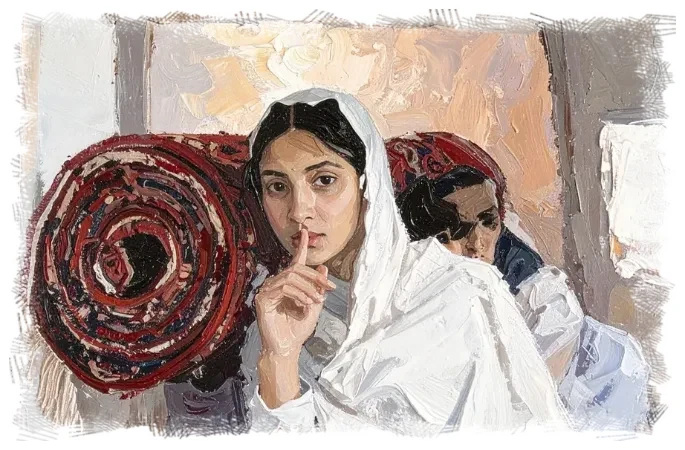
Naani would do anything to protect her family. Her love was fierce and unstoppable, like her love for Pakistan’s independence during the 1947 war. During the War of Partition, a family friend told her father his family was in danger and needed to evacuate their home in Ambala, India immediately. Her father was a prominent lawyer and pioneer of Pakistan’s independence movements, working closely with the All-Indian Muslim League and its founding members, Muhammed Ali Jinnah and Allama Iqbal. When the evacuation orders were given, Naani helped move her siblings out of the house and onto a truck transporting Persian rugs. She did exactly as her father asked: didn’t talk, acted quickly, left everything behind.
On the back of the dark vehicle, Naani rolled her siblings into the rugs to hide from border patrol officers. Along the bumpy road, the truck stopped and the driver’s window rolled down. Where are you going? Why? Who else is with you? A flash of light struck the driver’s face. Naani held her breath, her stomach in knots. The flashlight moved to the back of the truck, shining on the rolls of rugs Naani, her sister, her brother, her mother, and her father all hid between, still as statues, every fiber in their bodies stiff with terror, their hearts filled with duaas: Ya Allah, we beg you to save our lives, to make us survivors of our new nation, Ameen.
They arrived in a refugee camp where they lived in overcrowded makeshift tents, foraged for roots and leaves to eat, and were surrounded by infectious diseases like cholera, TB, measles, and smallpox. Hours turned into days, turned into weeks, turned into months. Eventually they were taken from the camp to their new home in Rawalpindi where Naani’s new life as a Pakistani girl began.
Over a decade later, Naani married my Nana Abu, a man in the Pakistani military.
When she first laid eyes on him, she was struck by his tall, sturdy build, his black mustache, his British accent and his favorite phrase, “Bloody hell!” He was a man who could command an army, an entire room, the kind of man her family thought could lead a family.
Nana Abu knew Naani was the one for him when he first saw her in a simple shalwar kameez, her long black hair in a braid, a subtle smile on her face.
He said, “She was nothing like the fashionable women in my family. The last thing I wanted was another high-maintenance woman.” It was this trait of an outward simplicity and inward complexity I proudly inherited from Naani.
Nana Abu often left the family for long stretches of time for military posts in Dubai and Saudi Arabia. At first, Naani and her children joined him, but as the children grew, she told him to go alone, that the children needed the stability of their Pakistani home. Their marriage became one of long distance, making Naani the sole leader of her own home.
I remember a photograph of my Nana Abu’s apartment in Dubai. On the side of the living room was a cardboard statue of a white woman with a bob haircut and a perfect toothpaste-advertisement smile.
“Who is she?” My eight-year-old self-asked.
Nana Abu held the photograph in his hand. “She’s my faithful companion, Ms. Louise.”
I narrowed my eyes on the image. “But… Ms. Louise is made out of cardboard…”
“Yes…”
“So, she’s not real…”
“Beta, you must understand the great power of the imagination. It’s the imagination you use to play ‘house’ with, to create elaborate stories with your Barbies with, to daydream with. Trust me when I say, it’s the same imagination that will carry you through the hardest times in your life.”
I nodded my head like I understood what was to come.
***
As Pakistan continued to develop as a nation, Naani envisioned a new, better life for herself; one in which she wasn’t controlled by the patriarchy of a father, or a husband, one in which her own desire for freedom was born. At the time, it was the Western world which seemed to offer this freedom.
Naani’s exposure to the West first occurred through her husband’s military travels to London and the U.S. When he returned, he brought back suitcases full of chocolatey treasures: Cadbury, KitKat, Maltesers, and Rococo, wrapped in silver and gold foil, devoured within seconds by his children and grandchildren. For my Naani, he brought Pond’s cream, which she slathered on her face until her last breath. After receiving these treasures from her husband she said, “Amreeka ki baat hi aur hai, Pakistan mai kuch nahin rakha.”
Naani’s desire to move to the West was also influenced by her older sister, Jameela Zaidi’s experience studying at the Slade School of Fine Art in London. Unlike my Naani, my great-aunt had ambitious career aspirations. She dreamed of becoming a renowned artist and Art Professor. Unlike many other fathers at the time, my great-grandfather supported his daughter’s vision for herself and wanted her to strive for greatness as a Pakistani woman.
Naani didn’t share this desire for a vocation which could have granted her access to the Western world. Instead, what she wanted most was to be a mother. It was through her children that the opportunity to leave for the West became possible.
When my father’s proposal from America came for my mother in 1984, Naani saw it as an opportunity to give her children a better life than the one they had in the politically unstable nation of Pakistan. Unlike Naani, Nana Abu had no desire to leave Pakistan. “This is my country. This is where I will live and die,” he said. Naani lacked this devotion to her nation; all of it residing in the nation of her children.
***
In America, Naani consumed her first Burger King whopper, her first McDonald’s French fries, her first all-you-can-eat buffet at her favorite establishment Old Country Buffet, at which she was a regular customer.
“If you come for breakfast, you can get lunch for half off!” She’d say.
She could easily spend her afternoons perusing department stores like Philadelphia Sales, Ames, Kmart, Walmart, and her all-time favorite: The Dollar Store. “There is simply no place like Amreeka,” she’d brag to her friends in Pakistan, proud of being the one who got away.
But, all this changed as she grew old.
In her work, The Happiness of Blonde People, Elif Shafak writes that the West is where you go when you’re young and want independence and freedom, but the East is where you return when you grow old and need the companionship of family and community. For my Naani, the East was curated within the walls of my Khala’suburban home, where she spent most of her life. As she aged, her world centered around her reclining leather couch in the living room and her favorite news channel: Geo T.V. Her sentiments had now changed to, “Amreeka mai koi zindagi nahin hai,” there is no life in America.
Through the television, Naani escaped American tedium and isolation. “When I’m surrounded by my language, I feel like I’m home,” she’d say, blasting the volume of the T.V. This was followed by my uncle jolting out of his seat to grab the remote control and scream, “it’s too loud Ummi!”
Afterwards, Naani looked at him bewildered. He clearly wasn’t hearing what she was hearing. She wanted to be devoured by the sound of her language; its abundance filled her, washed over her, soothed her, like she was lying in a bathtub, rubbing up against the water’s edges, her head tilted back, floating in a familiar world sound.
***
It was through Naani that I first learned to speak Urdu, through Naani that I learned the word: ghar, through Naani that I learned what makes a home, a home. When I practiced my American-Born-Confused-Desi-Urdu with her she always treated me like a native speaker, never made fun of my American accent, or incorrect use of gender pronouns and grammar. Instead, she spoke to me like I was just as Pakistani as her, like my identity had never been compromised.
***
It was in the safety of Naani’s home where I celebrated my Pakistaniness. I spoke my fragmented Urdu, ate mouthfuls of puri-halwa, watched Pakistani soap operas and Dance India Dance. In her home, I was brought back to stories of lives before mine existed, lives which reminded me of the smallness of my own existence. While she sat in her recliner with her feet perched in the air, we all gathered around her, eating bowls of seviyan and plates full of biryani and kabob, the house filled with laughter.
***
In the spring of 2025, I told Naani I’d be moving across the country to get my PhD. She said, “Bari fakhr ki baat hai, another doctor in the family.” She pulled me toward her, where I rested my head on her stomach, like it was her womb I came from. She handed me a white envelope with her shaky handwriting on it: My dearest Hina, Love Naani. Inside: a hundred-dollar bill, which she handed out like candy at every birthday, every Eid, every milestone, big or small. I always pushed it away; told her it wasn’t necessary. She looked at me with a playfulness in her eyes. “What am I going to do–take it to my grave?”
***
It was the end of my first semester, the first day of winter break. My husband and I switched on Netflix to begin the holiday movie season, when I received a text from Ummi.
“Naani is not doing well. Book a flight home.”
“For real this time?” She had so many death scares and survived, this wouldn’t be different, I told myself.
It was my father’s text which shook me. “She will most likely pass in a day or two.” I placed my coffee mug down, turned off the television. He was never one for melodrama.
The soonest flight we could find out of Kansas was not until the next morning. “She’s a fighter, we won’t lose her until we’re there.” I said, reassuring myself.
Later that afternoon, on December 11, 2025, in the midst of packing, I received a text from my father.
“Inna lillahi wa inna ilayhi raji’un.Naani has passed away.”
The walls of the room closed in on me.
The back of my throat clamped shut.
I dropped my head into my knees and wept.
***
Ummi recalled how it had happened: her brother, her sister, and my two cousins all gathered around Naani’s bed. She lay with her head against the pillow struggling to breathe. They were told there was nothing left for the doctors to do. Her lungs had drowned in fluid; her oxygen had dropped rapidly in a matter of hours. All they had to do was wait. They recited versus of the Quran in the hopes of easing Naani’s transition into the next world. Her hands grew cold, her breathing slowed, her eyes closed. Ummi screamed: Lailahaillallah Muhammadur Rasulullah into her ears over and over again until everyone’s ears hurt. Naani moved her index finger rapidly like a flickering light. The room froze. Naani’s eyes popped open, two bright moons staring at the ceiling, wide and unblinking. My uncle pressed his fingers against the pulse in her neck; my aunt dropped her head against her chest. “In the name of Allah,” Ummi screamed.
The flickering of the finger stopped. Her eyes closed. The room went black.
***
On the plane, thousands of feet above the sky, a sea of clouds, soft and white like the baby powder my grandmother wore around her neck, like the blanket of snow her body would be buried beneath, like the pillow she sunk her head into when she took her last breath.
We arrived in Binghamton. The air: suffocating and cold, a rope around my throat, the life of the world swallowed by the frost. I was never one to make demands, but this time was different.
“Please drive faster,” I told the Uber driver. I prayed. I begged. Please Allah, make me get there in time. It turned out the driver was a Muslim man, who knew where the mosque was, who knew about Naani’s passing, who offered us words of consolation which failed to soothe me. We had ten minutes to make it to the Janazah. I missed the washing of Naani’s body which my sisters and cousins would have already completed. I would never again see her face, never touch her flesh. What kind of granddaughter was I? You shouldn’t have moved so far away, you should have tried harder to find a flight in time, this is all your fault, my inner critic roared.
“Faster, please go faster,” I said again.
The driver scowled back at me. “I’m going as fast as I can Ms.”
By the time we arrived, groups of people gathered outside the mosque, attacking me like a swarm of gnats.
“We’re so sorry for your loss,” they said, their arms open, ready to embrace me.
I pulled back, no longer wanting to please. “I need to go see my Naani,” I said.
My eyes scanned the crowd to find my family. They were hidden away in the corner, by the funeral car, past a row of weeping aunties. My cousins’ faces were covered in a kind of grief I’d never seen: crumbled walls, dissolved and formless, the Earth after it rains. The loss of their deepest love shuddered through their eyes. I wrapped my arms around them, wanting to shield them from the world, like the world was never designed to carry the weight of their pain. Behind them, Naani’s body was zipped up in a maroon body bag, placed in the back of the funeral car like some kind of object. I wanted to run to it, unzip it, tell her I loved her that I wanted her back, to please, please come back.
With the cold biting my nose, I wept. “I didn’t even get to see her face. I didn’t even get to say good-bye.”
My Khala pulled me toward her. “It’s ok baita. All that matters is that you’re here now.”
The sun sprawled over us, as we held each other closer than we ever had.
***
Friday, December 12, 2025. I stood in front of Naani’s grave, the world steeped in snow, the temperature below freezing. I watched my uncle, my brother and a couple other members of the community lower Naani’s white cotton covered body into the ground, reciting, Bismillah ir Rahman ir Raheem.
Today, it was my Naani, tomorrow it would be my own parents, my aunts, my uncles, my siblings, my husband. Someday, it would be me.
Up on the hill, the wind whipped against my face. The tips of my toes went numb; my body quivered beneath my down winter coat. It was a cold Naani would never feel again.
I squeezed my nephew’s hand.
“But where is she going?” He asked.
I pointed toward the sky. “Up to Allah Ta’ala.”
“Why is she going there?”
“Allah Ta’ala is calling her, like your mom calls you. When your mom calls you, you have to go, right?”
He paused for a moment, watched Naani’s body being lowered into the ground, then looked back at his mom. Instead of giving an answer, he rested his head on her shoulder and closed his eyes.
The men placed wooden planks around Naani’s body, one by one, creating a fortress around her, like the fortress she once was for all of us. Once she was securely inside, we were asked to throw dirt into the grave. I removed my winter glove and picked up the rocky, granular particles in my hand. I bent down beside Naani’s grave and slowly dropped clumps of Earth around her body, careful with my aim, not wanting to hurt her, as if her body could still feel pain, as if her body was still alive.
One by one, we buried her into the frigid, dark ground. One by one, we walked away. It wasn’t the dark that scared her, but being alone in the dark that did. Weeks before she died, while she was in the hospital, she demanded her children spend the night with her. “You don’t understand. I can’t be alone,” she’d scream to the nurse.
“How will she survive in the dark alone,” a family friend asked after her burial.
Before I answered, I remembered Nana Abu’s words. Never underestimate the power of your imagination.
I closed my eyes. There was Naani, surrounded by a warm light, with hundreds of angels dressed in translucent white, holding her up toward the heavens, the divine trumpet playing in her ears, welcoming her home.
“She’s not alone. She’ll have the warmest of homecomings,” I said, with a conviction I hadn’t known.
***
We watched the tractor pack the remainder of the dirt over her grave until it became a tall mound. It was the same tractors I watched three-year-olds play with during recess at my job as a preschool teacher, the same tractor which now took on a different meaning; no longer merely a toy to play with, but a machine to bury the dead.
I squeezed my sister and cousin’s hand, asked Allah to bless her grave, to have her pass the test of the grave, to grant her the highest place in Jannah.
For Naani, I wanted to believe.
***
My parents’ home was enveloped in layers of fluffy clouds dropped from the sky, as if to remind me that what was above me was also right there in front of me. I grabbed a shovel and pushed the snow from one end of the driveway to the other in single, straight lines. I didn’t swerve around in a zigzag like I normally do. Then, I lifted the heap with the strength of a warrior, the strength of Naani’s will, before placing it on the sleeping blanket of snow. Specks of light dazzled and danced like jewels beneath the morning sun, the sky: lucid blue, ribbons of white running through. The only sound in the early morning was the smooth edge of my shovel against the driveway. Back and forth I moved with a trance like focus, like Naani when she prayed, back and forth, back and forth, the steady thrum of the world dissolving to nothing but the silence.
***
Aap bohat hunhaar hain
Beautiful tribute to your Nanni.