
 Sutanuka Roy
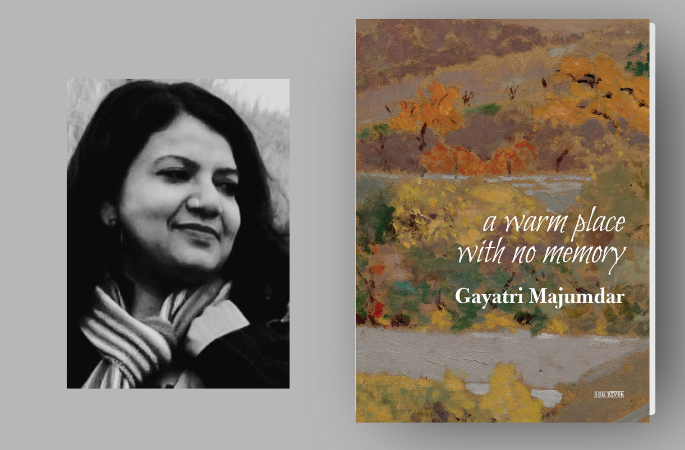
Gayatri Majumdar a Warm Place with No Memory(2024) Published by Red River
Gayatri Majumdar is a poet editor, publisher, and founder of the critically acclaimed Indian literary journal, The Brown Critique. A Warm Place With No Memory is her latest collection of poetry. As one opens the slim volume slowly and steadily, the collection emerges as an innovative space where the poet and readers interact meaningfully. One fondly remembers Stephen King’s observation in “The Shawshank Redemption”: “They say The Pacific has no memory. That’s where I want to live the rest of my life. A warm place with no memory”. The opening poem ‘My Little Magpie Robin’ is the key to seeking a warm place with no memories, “The little magpie robin will take with her light patterns/ to your end of days—her sweet cries will pierce your pain/ and remember you would’ve flowered again”. The ‘mind’ is featured in the volume as a container that holds pieces, and fractions of events, acknowledging the age-old dichotomy of metaphysical ramifications between the memory of habit and pure spontaneous memory. Memory is the natural and profound link that exists between living and remembering—“And your little magpie robin remains/ nonchalant, ripping apart precious things–/ battle cries, starry-eyes welling, cast always,/ with her relentless whistling;/ then I thought I heard,/ nothing here is left behind; nothing taken”. The poet yokes the two heterogeneous worlds into one, a warm place without memories.
Majumdar constantly plays with places, spaces, love, loss, pain, and hope, culling music from the ordinary hum-drum life and varying the drapes of memory to make it less dramatic and more contemporary, she stuns with the beauty and the range of her art, “steer my kheya tori toward the land of forgetfulness..forgiveness–/ of unending, unsoiled melody/ Where nothing more need be uttered,/ nothing is../ Remain—silently/ never leave.” She conjures her poetry from the abstraction of pure movement between forgetfulness and remembrance. ‘Surrender’ is a tightly detailed piece revolving around the power that controls human destiny, all things that are political and non-political. The intricately textured metaphor of the ‘red staircase’ that is ‘damaged’ and ‘broken’ is an epic piece with powerful stories in motion. Sarabjeet Garcha writes, “She melds dream, desire, myth, and memory into an experience that transcends the merely vicarious”. In ‘You Tree’ stark in her expression of desire love pulsates through a woman’s body. Although no good comes of her love, this woman does not allow circumstances to get the better of her. She listens to the voice inside her that urges her to be herself. “You are the tree in me/ struggling, uncertain amidst the trouble of unfear—/ that definitive light falling in your Neptunian eye…/ this hypothermia/ preserves me.”
The tension between our desire to hold on to events and experiences creates the poetical environment of exteriorization Majumdar writes, “In the timelessness of half-remembrance/ and total dissolution,/ the tiny room sloughed to cosmic talas–/ lost, not intent on ever finding its way back”. “Aware” is universal in its insights into the human condition. The readers are reassured about her consummate poetic abilities as her ‘rare eye’ sees ‘a neighbour’ pouring ‘ghee into’ a ‘fairy tale’s dying hour’ to communicate with the readers and carry the narrative of the ‘warm place’ forward. Speaking of the language, she makes sure that it makes sense to her multi-lingual, multi-ethnic, and predominantly urban readers. She uses Bengali words, Hindi words, and Russian words but never at the cost of the authenticity the words generate.
These 38 poems are profound, rooted in the pure and absurd beauty of living. They touch on different signposts of life and, in the process, transcend their own boundaries,” writes Sekhar Banerjee. Majumdar chooses to mount fragmented stories in an intimate, warm place/space. The poems carry no emotional baggage but undying faith in humanity, “Slay me, if you must, / for I am yours, / but spare me the brutalities/ of certain birthing, happy endings.” Here, poetry transports the readers to a realm beyond poetry.
Red River is a micro-independent publishing outfit based in New Delhi, India, dedicated to publishing poetry in English and English translation. Established in 2017, Red River is known for its discerning selection of titles and experimental design. Red River is managed solely by poet, writer and translator Dibyajyoti Sarma, the founder-publisher of Red River, with the help of his friends and colleagues, because for everyone involved, Red River is not just a business, but a passion and an abiding love for poetry. (The name, among other things, refers to the river Brahmaputra in Assam.)