
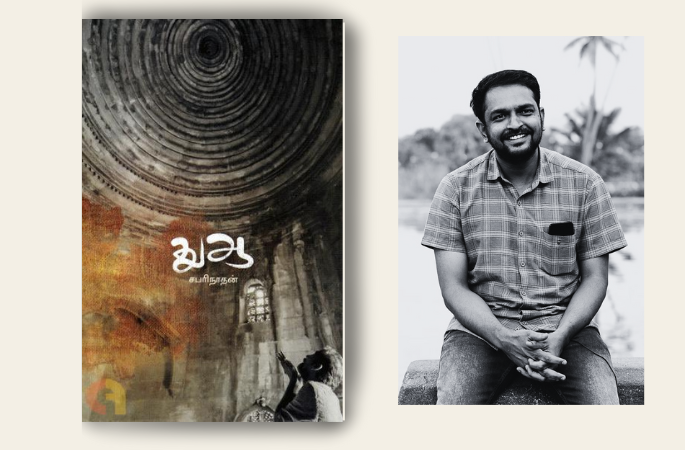
 Swarnavel Eswaran
Sabarinathan. (2024). Dua. Thannaram.
Review by: Swarnavel Eswaran
From the rich soil of contemporary Tamil letters, a voice of profound resonance emerges. It is Sabarinathan, a poet who weds a worldly literary soul to a spirit deeply rooted in native ground, yet forever restless in its questioning. His collection, Dua (துஆ) an echo of the Arabic word for supplication stands as a luminous testament to this union. This is no mere gathering of verses; Dua unfurls as a single, cohesive odyssey, a map charting the existential pilgrimage of a modern soul. It can be read as a profoundly modernist canticle, one that summons a mythic architecture to navigate the splintering of the self in a world unmoored from tradition. The voice that speaks through these pages is that of a modern-day pilgrim on a voyage both physical and metaphysical, and the poems themselves become the sacred, often tormented, artifacts of his prayer for meaning.
The Modernist Pilgrim in a World of Fragments
The heart of Dua beats with a quintessentially modern consciousness: an alienated, introspective soul questing for the authentic amidst a bewildering theatre of contradictions. The verses are threaded with the imagery of transit of trains that cry on steel tracks, of airplanes that scar the sky, of buses and roads that stretch into an endless unknown—all of which sing not of travel, but of a profound spiritual displacement. In “A Good Deed” (ஒரு நல்ல காரியம்), the poet discovers his kinship not in the thrum of the crowd, but with a lone donkey abandoned to the city’s hum, a creature mirroring his state of being exquisitely “out of place.” This shadow of alienation deepens in poems like “Lights” (லைட்ஸ்), where the gray drudgery of an office and a denied request for leave ignite a desperate, primal yearning for “a long holiday… more light, and more, more open space.”
This fractured self is laid bare in the haunting prophecy of “The boy who is going to be a poet” (கவிஞனாகப்போகிற சிறுவனுக்கு). The poem reads like a beautiful, terrible curse, charting the cartography of the poet’s fate. “Humans will unnerve you / Trees will console you,” it declares, carving a fundamental chasm between the poet and the world of men. He is a being destined for a cloven existence, condemned to “live life as a detective by night, / and a clerk by day”—a perfect, chilling vessel for the modernist’s divided soul. This inner schism is set against the backdrop of a deep, almost aching, awareness of a drowned, mythic past. In “Bank of Forgetting” (மறதி வங்கி), the poet dreams of a submerged railway station in Dhanushkodi, a place from which one might still purchase a ticket to the legendary city of Kapatapuram. This is not mere nostalgia; it is the lament of a modern heart for a world of coherent spirit and story that now breathes only as ruin and rumor. The poet is suspended between the “nine-to-five” rhythm of our century and the spectral shimmer of lost worlds, a classic modernist soul, born too late and spiritually unhinged.
The Mythic Method: The Journey as Metaphor
To give form to this fragmented experience, Sabarinathan wields what T.S. Eliot named the “mythic method.” The collection is built around a constellation of archetypal journeys, each a metaphor for the soul’s interior quest. The pilgrimage is not a straight line, but a spiral; its geography spans the spiritual and physical expanse of a subcontinent, from the sun-scorched tip of Tamil Nadu to the breathless altitudes of the Himalayas.
The second section, “Mountain Pouring” (மலைப்பொழிவு), is a masterclass in this method. Here, the journey to Ladakh is rendered not as a tourist’s passage but as a soul’s profound collision with a primal landscape. The opening poem, “Departure” (புறப்பாடு), immediately sets the tone. The airplane pilot’s voice comes over the ether, announcing the Himalayas not as a geological fact, but as a mythic truth: “beyond it lies the Kailash range… hidden in the mist beyond those mountains is Nanda Devi peak. You can’t see it, can you… No, you can’t… but it is there.” The journey is instantly consecrated as a search for the unseen but ever-present divine.
And this quest is fraught with peril. In “Sūr” (சூர்), the hunt for the snow leopard becomes a breathtaking metaphor for the pursuit of absolute truth, a dangerous, self-annihilating sublime. “To have seen it,” the poem whispers, “you must allow it to leap towards you. / You must consent to it tearing your chest and drinking your blood. / But after that, you will not be, only the snow leopard will be.”
This mythic weave extends to historical figures, who become fellow pilgrims on this timeless road. In “Four Notebooks 1920,” the mathematician Srinivasa Ramanujan, exiled in Cambridge, is transfigured from a man of genius into a mystic, a “poet forced to prove his metaphor,” his equations whispered to him by the goddess Namagiri. Similarly, the Danish missionary in “From Tranquebar” (ட்ரங்குபாரில் இருந்து…) becomes a voice of colonial and spiritual longing, his yearning for a distant home striking a perfect harmony with the poet’s search for a place of true belonging. By braiding these lives into his own, Sabarinathan suggests that the quest for meaning is not a solitary act, but a universal rite, repeated in the quiet chambers of countless hearts across history.
The Angel of History: Witness to the Wreckage
The historical gaze of the collection finds a profound echo in Walter Benjamin’s reading of Paul Klee’s Angelus Novus. Benjamin saw in Klee’s painting the “Angel of History,” his face turned toward the past, his eyes fixed upon a single, unfolding catastrophe. “Where we perceive a chain of events,” Benjamin wrote, “he sees one single catastrophe which keeps piling wreckage and hurls it in front of his feet… A storm is blowing from Paradise… This storm is what we call progress.”
The poetic soul of Dua often assumes the posture of this very angel. It does not see history as a triumphant march, but as a landscape of sacred ruins. The poem “It was in my time that madness began” (எம் காலத்தில்தான் கோட்டி பிடிக்கத்தொடங்கியது) is a direct, shattering testament to Benjamin’s vision, a litany cataloguing the slow decay of an age: “It was in my time that the pit was dug,” “It was in my time that the river began to taste bitter.” This recitation of loss mirrors the angel’s sorrowful gaze upon the accumulating debris of history. Likewise, in “Nakedness” (திகம்பரம்), a burnt tree stands as “the storm’s signature,” “the poet’s testimony,” and “a righteous one’s question.” Like Benjamin’s angel, the tree is a static, mute witness to a violence long past, unable to intervene, yet forever scarred by its memory. The relentless forward momentum of the collection, the ceaseless travel, the gnawing alienation is the very storm of “Progress” that hurls the poet into a future to which his back is turned, his gaze forever fixed on the wreckage of what has been lost, be it the phantom city of Kapatapuram or the fading ethical light of his own time.
The Sacred and the Profane: Re-enchanting the Mundane
A central, sacred tension pulses within Dua: the dance between the holy and the common. The poet’s “supplication” is often a prayer for the vision to perceive moments of transcendence, what Joyce might have called “epiphanies”, woven into the very fabric of the everyday. This is articulated with breathtaking force in “Mother” (அன்னை), where the divine feminine, the goddess Matangi herself, is discovered in the humble form of a scavenger. The poem makes a radical, divine declaration: “I scoop feces, I gather waste. I am the messenger of water, purity is my character, holiness is the boon I grant.” By finding the sacred in the most reviled and abject of figures, the poem shatters our easy binaries, offering a vision of divinity that is at once more immanent and subversive.
This re-enchantment of the mundane is a recurring song. In “The Cleaner” (துப்புரவாளர்), the sanitation worker who rises before the dawn is crowned with a “halo of light” behind his graying head, his labor elevated to a sacred rite: “He argues for humanity / for the sake of obtaining one more day.” In “The Carpenter” (தச்சர்), a simple craftsman’s moment of repose, as he “drinks something invisible, lost in himself,” becomes a holy communion. And the poem “Salt” (உப்பு) offers a spare, powerful sermon against modern glut, concluding that all one truly needs is the most elemental of gifts: “On the top-left corner of a water-sprinkled banana leaf, salt / The essence of the earth, the finest pearl, that is enough.” Here lies the heart of the collection’s prayer: a plea for the eyes to see and the soul to feel the sacred pulse that beats within the ordinary.
The Unresolved Quest and the Nature of Dua
In the end, Dua does not offer the comfort of a journey completed. Its profound power resides in its unflinching, luminous honesty about the unresolved nature of the spiritual pilgrimage. The collection does not close with answers, but with a deepening of the questions. The final, epic poem, “Stone Raft” (கல் புணை), is a testament to this, a dense, shimmering tapestry woven from history, myth, and consciousness that refuses the stillness of a final meaning.
This state of perpetual, sacred searching is the collection’s true north. In “Wrong Number” (தவறான எண்), the poet receives a call from Death, only to hear the anticlimax: “Oh… Sabari? Sorry, wrong number.” This moment of absurd, existential humour perfectly captures the poet’s condition: suspended in a state of waiting. The collection, then, is a prayer not for a destination, but for the grace to continue the journey. In “Galileo’s Night” (கலீலியோவின் இரவு), the poet looks into the darkness of his historical moment, “the stench of medieval iron: tomorrow is getting ready”, and knows the only response is to bear witness: “Stay awake, there is no other way / Be alone in the light of a single candle / with a rare truth / that you believe in / that believes in you.”
This is the essence of Dua. It is a supplication for grace within the process, for the strength to endure the silence and the uncertainty. The very act of this poetry, of shaping experience into language, of asking the unanswerable, of bearing witness, becomes the ultimate, and most holy, form of prayer.
In its final turning, Sabarinathan’s Dua reveals itself as a formidable and artistically mature work. It stands as a powerful testament to the ways contemporary Tamil poetry is breathing new life into the great modernist and existential questions, forging a unique spiritual language drawn from a rich and resonant tapestry of cultural sources. The poet as pilgrim journeys through the broken, beautiful landscapes of modernity, armed with the shimmering fragments of myth and memory, not in the hope of arriving at a final, sunlit shore, but in the profound belief that the journey itself, in all its pain and glory, is the most sacred rite of all.
Works Cited
Benjamin, W. (1968). Theses on the philosophy of history (H. Zohn, Trans.). In H. Arendt (Ed.), Illuminations: Essays and reflections (pp. 253–264). Harcourt, Brace & World.
Eliot, T. S. (1975). Ulysses, order, and myth. In F. Kermode (Ed.), Selected prose of T. S. Eliot (pp. 175–178). Faber and Faber.
Klee, P. (1920). Angelus Novus [Oil transfer on paper]. The Israel Museum, Jerusalem, Israel.
Sabarinathan. (2024). Dua. Thannaram.