
 Swarnavel Eswaran
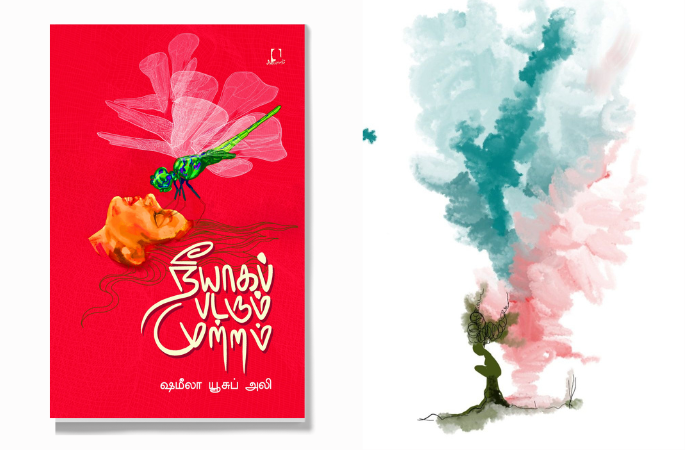
Shameela Yoosuf Ali. (2020). Neeyaakap patarum mutram [The courtyard that spreads as you]. Chennai: Adaiyaalam.
Before the analysis unfolds, let us hold a single pebble, warmed by a distant sun. It is a courtyard contained; a history held in the palm. Within its silent gray, a universe of color, touch, and longing waits to be read. This is the threshold to Shameela Yoosuf Ali’s poetry, a space that spreads not across land, but within the soul.
Central to her poetic method is the persona of the keen observer. Yoosuf Ali possesses a photographic and painterly eye, capturing moments from her immediate surroundings with a clarity that transforms the mundane into the magical. This quality is exemplified in the anthology’s title poem, “நீயாகப் படரும் முற்றம்.” The poem is a series of meticulously observed vignettes from her courtyard: “A squirrel with a back striped like two railway tracks,” “Dragonflies that escaped from my drawing,” and “a gray cat.” These are not grand landscapes, but intimate, closely framed snapshots. The act of observation is itself an act of creation and connection. The courtyard, a defined physical space, becomes an infinite extension of the poet’s self as she populates it with her attention. By observing the world with such care, she dissolves the boundary between her inner self and her outer environment, embodying the very title of her collection.
One of the most striking features of the collection is its pervasive and masterful use of nature imagery. The natural world in Yoosuf Ali’s poetry is not a mere backdrop but a living, breathing entity that mirrors the poet’s innermost feelings. In “கால் விரல்களுக்குள் ஒரு நதி” (A River Between the Toes), the poet’s consciousness, escaping the cacophony of the everyday, drifts into a “dream’s fish tank.” The poem is a cascade of beautiful images: an orchid blooming on a kitchen windowsill, the “scorched hands of summer,” and the evening sky “spilled with orange and red.” This culminates in the extraordinary final lines where a river “bursts forth” between her toes, symbolizing an overwhelming surge of emotion and sensation. Similarly, in what Professor Nuhman calls one of her finest poems, “ஏதிலி மரமும் அவள் முத்தங்களும்” (The Refugee Tree and Her Kisses), a barren, lonely tree is brought back to life by a woman’s tender words and kisses. The tree begins to “sweat flowers,” its “hairs stand on end and tingle,” and its body softens like a “monsoon mushroom.” This powerful allegory speaks to the life-giving, restorative power of feminine affection and connection.
This theme of restorative connection finds its most powerful and tender expression in “ஏதிலி மரமும் அவள் முத்தங்களும்” (The Refugee Tree and Her Kisses). Here, Yoosuf Ali presents a profound allegory of healing through a distinctly feminine, almost motherly, nurturing touch. The “refugee tree,” desolate and in “primordial loneliness,” is brought back to life not by a grand force, but by the intimate and patient care of a woman. She speaks to it with “honey words” (தேன் சொற்கள்) until the tree sprouts ears to listen. The turning point is an act of profound tenderness: “On its diamond-hard fissures / she kissed very slowly.” This gentle, nurturing act is transformative. The tree, once barren, begins to “sweat flowers,” its body softening like a “monsoon mushroom” as her touch becomes a revitalizing rain. The poem is a beautiful testament to a motherly power of resurrection, where empathy and physical affection become the catalysts that can awaken life in what was once abandoned and forgotten.
This mastery of natural imagery is deeply intertwined with the poet’s sensibility as a painter. As her biography notes, Yoosuf Ali is also a visual artist who designed the book’s cover, and her painter’s eye is evident throughout the collection. Her verses are not just descriptive; they are palettes of carefully chosen colors that evoke specific moods and atmospheres. She writes of a “devil yellow” (பிசாச மஞ்சள்) sky, a “purple elephant” (ஊதா யானை) of childhood imagination, and the “heavenly green, dark blue” (சுவர்க்கத்துப் பச்சை அடர்நீலம்) of a bird’s neck. This use of color is precise and evocative, transforming her poems into vivid visual compositions. The world she renders is rich with hues—from the “orange and red” of a sunset to the “crimson-purple lips” (செவ்வூதா உதடுகள்) that revive a dying tree—demonstrating a profound and seamless connection between her visual and literary art forms.
Beyond the visual, Yoosuf Ali’s poetry is profoundly haptic, engaging the reader’s sense of touch, texture, and warmth. She does not merely describe scenes; she invites us to feel them physically. In “ஏதிலி மரமும் அவள் முத்தங்களும்,” the reader can almost feel the tree’s “hairs stand on end and tingle” (மயிர்கள் குத்திட்டுச் சிலிர்த்தது) and its body becoming “soft like a monsoon mushroom” (மழைக்காளான் போன்று மென்மையாகிவிட்டது). The experience is visceral. This sensorial quality is central to her exploration of memory and place. The displaced pebble in “இடப்பெயர்வு அல்லது பாடும் கூழாங்கல்” is defined by its “smooth surface” (வழுவழுப்பு மேற்பரப்பு) and the memory of “the shy tickle of sand particles” (மணல் துகள்களின் வெட்கக் குறுகுறுப்பு) on bare feet. In “பெயராத வீடு,” the poet feels the “gentle warmth brimming with life” (உயிர் ததும்பும் இளஞ்சூட்டினை) in the walls of a cherished home. By grounding abstract emotions like love, nostalgia, and connection in tangible, physical sensations, Yoosuf Ali makes them deeply immediate and resonant, allowing the reader to inhabit the emotional landscape of her poems.
The collection is also a powerful testament to a burgeoning feminine and feminist consciousness. Yoosuf Ali gives voice to the constrained and silenced experiences of women, while simultaneously celebrating their resilience and inner freedom. The poem “உம்மும்மாவின் செம்புப் பானை” (Grandmother’s Copper Pot) uses the potent symbol of a copper pot to represent the confinement of female life. A leg from a “spinning top childhood” is placed inside, followed by a “torn tongue,” and eventually, her whole body is “rolled up and pressed into the pot.” It is a stark and haunting depiction of patriarchal containment, passed down through generations. Yet, this is contrasted with poems of liberation like “அவளுடைய இறக்கைகள்” (Her Wings). Here, a woman discovers her wings, long hidden away in a dusty attic, and despite warnings of danger, she dusts them off and begins to fly, finding the sky “much, much vaster than she had imagined.” This assertion of agency and the pursuit of self-realization are recurring and vital themes.
A poignant undercurrent of displacement and nostalgia flows through the collection, foregrounding “space” as a crucial element in navigating memory and identity. As a poet displaced from Sri Lanka to the UK, Yoosuf Ali explores the ache of longing for a lost home while simultaneously trying to create a new one. In “பெயராத வீடு” (The House That Doesn’t Move), a house is not merely a physical structure, but a living entity infused with the “warmth of life,” where memories of parents and siblings are embedded in the very walls. The pain of leaving such a space is palpable, as the poet acknowledges the “impossibility of digging up” the roots of memory. This theme is powerfully condensed and deepened in the metaphor of “இடப்பெயர்வு அல்லது பாடும் கூழாங்கல்” (Displacement or the Singing Pebble). Here, the pebble is more than a stone; it is a fossil of life and history. The poet describes it as having been “birthed after rolling and turning for a hundred thousand months,” its “mellowed gray” surface holding the entire history of the sea. Within its “thread-like layers” are “mermaid tales,” “dark purple sea songs,” and the “ticklish shame of sand on bare feet.” It is a concentrated archive of myth, sound, and sensation—a tangible piece of the homeland’s soul. The tragedy lies in its current state: this “singing pebble” that once resonated with the ocean’s life now “lies under a closed window,” its vast history contained and silenced, “staring at an empty sky.” It is a striking and profound image of the displaced self, carrying an entire world of memory within a confined new reality.
Beneath the surface of her lyrical verses lies a deep spiritual and existential quest, framed by a distinct Sufi inwardness. This is not the poetry of dogma, but of intimate, personal communion with the Divine. In her preface, Yoosuf Ali describes poetry as “சொற்களின் தொழுகை” (the prayer of words), framing the creative act itself as a sacred ritual. This perspective informs the entire collection, where words and letters engage in a spiritual dance, attempting to articulate the ineffable. This dance is evident in “பயணம்” (Journey), where the soul, released from the body, experiences death not as an end, but as a liberating reunion. This turn inward, to the Batin (the inner, esoteric reality), is central to her work.
Furthermore, this spiritual journey is guided by the core Sufi principle of Tawhid (Oneness), which manifests as a profound sense of inclusivity. This is beautifully captured in the title poem, “நீயாகப் படரும் முற்றம்” (The Courtyard that Spreads as You). The poet’s courtyard—her very self—expands to embrace everything: the squirrel, the dragonfly, the weeds, and the cat. The boundaries between the observer and the observed dissolve. This is not just an appreciation of nature, but a realization of the interconnectedness of all existence, a central tenet of Sufi thought that sees the Divine in every particle of creation. This sense of oneness provides a spiritual anchor, especially poignant for a poet who has experienced displacement. By seeing the self in all things, and all things in the self, a sense of belonging can be cultivated anywhere.
While Professor Nuhman rightly observes that the collection is not dominated by overt political commentary, it is not without its moments of powerful social critique. “ஓர் அங்குலமும் அசையேன்” (I Won’t Budge an Inch), written in 2009 during the final, brutal phase of the Sri Lankan civil war, is a defiant cry against tyranny. The poem’s voice challenges an oppressor to break her pen, smash her laptop, and crush her throat; yet she remains resolute, declaring that she will not move an inch in her protest against injustice. Furthermore, a series of poems centered on goats—”பாத்திமாவின் ஆடு” (Fatima’s Goat), “அறப்படித்த ஆடுகள்” (Well-Read Goats), and “ஆடு மேய்த்தல்” (Goat Herding)—function as clever allegories, subtly critiquing social hierarchies, intellectual arrogance, and exploitation. Beyond this critique, the recurring figure of the goat also embodies a quiet patience and resilience. Its quotidian presence in the poems grounds the work in everyday life, while also epitomizing the Sufi qualities of interdependence, modest subsistence, and yearning for the dissolution of boundaries.
This series of poems on goats gains a deeper intertextual resonance with “பாத்திமாவின் ஆடு” (Fatima’s Goat), a title that almost certainly nods to the iconic Malayalam writer Vaikom Muhammad Basheer and his celebrated novel, Pathummayude Aadu (Pathumma’s Goat). In Basheer’s work, the goat is a famous character that represents a chaotic, untamable, yet beloved force of nature that famously eats the pages of the narrator’s manuscript. Shameela Yoosuf Ali cleverly mirrors this by having the goat enter her dream and begin “casually… chewing on my sleep.” For readers familiar with Basheer, this reference immediately evokes the theme of life’s beautiful and absurd interruptions, where the raw, untamable energy of the everyday world intrudes upon and consumes the artist’s inner, creative space.
In conclusion, Shameela Yoosuf Ali’s நீயாகப் படரும் முற்றம் is a work of quiet power and profound beauty. Her poetic voice is distinguished by its simplicity, which belies a rich complexity of thought and emotion. She masterfully transforms personal memories, feelings, and observations into art that is both intimate and expansive. The collection is a courtyard that begins with the self but, through its empathy and wisdom, spreads outwards to encompass the universal human experience. It firmly establishes Yoosuf Ali as a vital and compelling voice in the contemporary Tamil poetry landscape.
And so we leave the courtyard, the scent of rain-softened earth still with us. The poems, like the singing pebble, are now placed within our inner landscapes. They do not shout, but whisper—of wings unfurling in secret, of oceans held in a single tear, of a home that is not a place, but a way of seeing. The gate is open; the courtyard continues to spread.
Works Cited
Basheer, V. M. (1959). Pathummayude aadu [Pathumma’s goat]. National Book Stall.
Basheer, V. M. (1980). Pathummah’s goat (R. E. Asher, Trans.). Edinburgh University Press. (Original work published 1959).
Nuhman, M. A. (2020). Shameelavin kavitai manam [Shameela’s poetic mind]. In S. Yoosuf Ali, Neeyaakap patarum mutram [The courtyard that spreads as you] (pp. ix-xiv). Adaiyaalam.
Yoosuf Ali, S. (2020). Neeyaakap patarum mutram [The courtyard that spreads as you]. Adaiyaalam.