
 Bakhtawar Khan
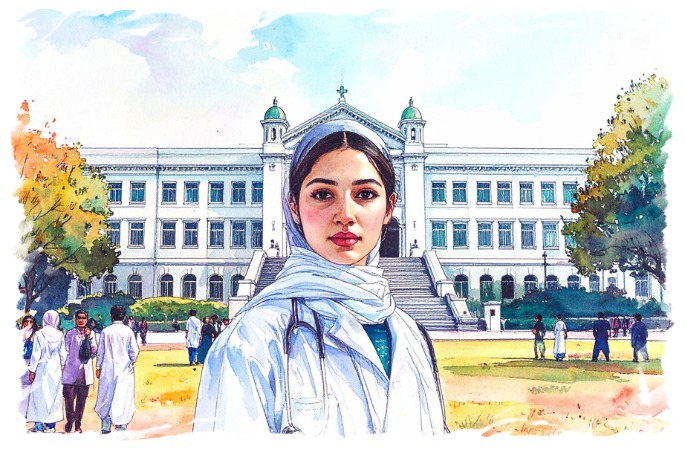
Located in the heart of Lahore, Sir Ganga Ram Hospital boasts the largest mother and child care unit in the government sector in Punjab. Hundreds of women hear their baby’s first cry within its shiny eight-storey building. Hundreds of women also have many of their “firsts” in the building across the road from the hospital: Fatima Jinnah Medical University, the only medical university in Punjab with an all-female student body.
While there is no denying the importance of a co-educational institute, studying at Fatima Jinnah Medical University was a strangely and chaotically feminist experience because, as history has taught us over and over again, there is no resistance without oppression.
In the hot and humid summer of 2022, the air conditioners in our lecture theatres were broken, and even after days of asking the administration to fix them, no action was taken. The girls in my class finally took matters into our own hands and held a protest outside the Vice Chancellor’s office with placards and demands for justice.
The funny twist of the story, though, lies in the fact that the VC’s main concern afterwards was how it was “inappropriate” for women to create a spectacle like that. One would assume it is completely “appropriate” for women to suffer in the heat silently? But then again, our respected former VC can hardly be blamed, for that is all he saw women of his own generation doing. In the same vein, perhaps the reason our current respected Vice Chancellor deems the most innocent events, for example a qawwali night, as vulgar, vile and anti-Islamic is the fact that seeing women have fun goes against his very basic belief system. On the topic of Vice Chancellors, it is also an interesting fact that even though FJMU has been producing female doctors since 1948, not a single one of them has, until the present time, been considered good enough to hold the seat of Vice Chancellor for a full term. As for the generations of FJites who once soaked up the sun, sitting for hours on the front lawn as students, and later graduated as doctors from this esteemed institute, many of them remain as demonstrators and professors at the college.
The comedy moments of the early days of college often involved those very old graduates who had spent the majority of their lives as demonstrators of basic sciences. A whole row of first-year girls fixing the dupattas on their heads outside the dissection hall because a certain demonstrator was supposed to take their substage will always be a core memory for me. I am not sure to this day who started the rumour that the demonstrator in question failed you if your head was not covered, or whether there was any truth in the rumour, but you can rest assured that the author did not take any risks and wore a dupatta especially on the day of the substage, much to the amusement of her friends.
I think my class was the last of our kind when it came to being bullied and controlled by our seniors to an almost toxic extent. There were days when a histology demonstrator tore up the diagram a student had made because the cells were too round, too big, or not big enough. There were days when blood was collected from students for pathology experiments even when the students were hesitant or unwilling.
There was always the threat of cancelled attendance and unsigned certificates, and even the threat of results, looming over our heads. Fatima Jinnah Medical College became a university in 2015, hence allowing the institute to hold its independent professional examinations. Anyone remotely involved in the online Pakistani medical students’ community would be familiar with the never-ending discourse of students from independent medical universities like FJMU, KEMU and NMU claiming that they get more difficult exams and stricter marking than their counterparts in medical colleges affiliated with the University of Health Sciences.
While the authenticity of these claims is up for debate, threatening students with failure in exams when they are found involved in a social protest against a harassment case sounds too outrageous to be true. But as our colleagues in other colleges often comment, FJMU’s administration finds it easy to control its student body with threats because it is an all-women institute, and supposedly they would never dare to make these threats if rowdy young men were also part of the student body.
The fact of the matter once again leads the author back to her claim that her class is the last of its kind when it comes to being controlled easily by seniors because, as reality would have it, during the anti-harassment protests, the student body did not back down even when threatened with failure in exams, even when the respected VC somehow got himself added to the WhatsApp group to see exactly who was involved, and even when professors tried to force the students back indoors during the protest.
Queens indeed of Queens Road, and daughters indeed of the Mother of the Nation, Mohtarma Fatima Jinnah.
While there is no denying the role departments of basic sciences played in setting us off on the right foot for our careers in medicine, it is also true that the real fun begins when one steps into the ward for the first time during third year, or at least that is how the system worked for Batch 2024. Asking a woman with kids if she is married is a mistake which I’m sure most of us made during history-taking in third year, but I wonder how long it will be until no student in the medical colleges of Punjab remembers the time when all our third-year clinical dreams were shattered by COVID-19. The worst of times indeed. But being a medical student during the infamous quarantine was a strange experience. Your family members often expected you to have all the answers, while the inability to actually do much, at least clinically, kept you up at night.
The author often felt sorrow that she missed being taught in the wards during third year because of COVID-19, but subsequent years in the wards as a fourth-year student, final-year student and House Officer taught her the hard-earned lesson that government hospitals are so overcrowded and understaffed that teaching medical students, especially third-year medical students, is the least of a doctor’s concerns when he is caring for a ward full of patients with next to no sleep and very poor nutrition.
The same doctor, however, will often find time in his schedule for fetishising the students of FJMU even when he has a wife and children of his own. I remember during my first rotation as a House Officer in Sir Ganga Ram Hospital, a doctor said, in a room with four other FJites as well as the author, that his biggest mistake was getting married before being appointed at FJMU.
The horrors of creepy old men are endless when it comes to SGRH: the one who has sent a DM to almost every student even when his own wife was pregnant; the one who was supposedly looking for his third wife among the new batch of House Officers; the one who was encouraging an innocent House Officer’s affections, eating her food and making her do his tasks; the one who tried to humble the author when she called him out by reminding her that she is, in fact, a woman.
Harassment cases are no news at the hospital during the late hours when House Officers on call are all alone and, very often, there is not even a security guard present. Workplace harassment is not unique to SGRH, it is true, but it is the author’s opinion that men working in SGRH tend to fetishise FJites because they think they are “innocent” and “modest” as they studied without any male colleagues.
It is also important to mention that sometimes our only saviours are the girls we found along the way, because there are so many examples of “girlhood” and true female friendships among FJites that it would seem there is indeed no bonding experience greater than that of shared trauma. Because when the cute group photo shoots are done with, who is there to lend a shoulder when you are crying over a failed test, or to give you a wake-up call when the random surgery PGR seems like your match made in heaven, or tell you where to get the best jhumkay from? The answer is always Anarkali, by the way.
The author’s camera roll is filled with a lifetime’s worth of videos made on the front and back lawns of the university as she and her friends spent hours upon hours sitting there: bunking lectures, eating some salmonella-heavy food, discussing everything from novels read to TV shows binged, to our love lives or lack thereof, to our shared dreams of shared apartments in far-off cities. Those moments were, in fact, a heaven of our own making.
The author is also deeply nostalgic for the fun events that were few and far between for FJites, but the days of preparation that went into perfecting every dance step or every dialogue of a comedy performance, or rehearsing the stanzas for hosting, were days filled with an insurmountable amount of joy.
It was not, however, always sunshine and roses, even among the closest of friends, because sometimes jealousy and misunderstanding crept through, and we sometimes found ourselves crying over a broken friendship while sitting on one of the many staircases in random corners of the university. Growing up together is a sentiment common among college friends, but the ways in which FJites grew up together are more lore-worthy still. Perhaps that is a story for another time?
So maybe there is some good to the all-women medical university in the year of our Lord 2025? Because, as every parent and teacher will keep telling you, life is not a bed of roses. So maybe it is good that we were nurtured into thorns ourselves?


Hi Bakhtawar! So proud of you for venting it all out in such a beautiful way. Cheers
Absolutely brilliant piece. This truly captured the essence of growing into a physician as women in a society that constantly tries to make you grow into a manageable homemaker. So excited to read what comes next.
BEST DESCRIPTION OF SGRH AND FJMU WRITTEN BEAUTIFULLY 🌟
Lived through this, and felt each and ever word of yours, go through my bones. Honestly, FJITES had the pleasure to see women, in their best and worst possible forms. The deep nostalgia I felt while reading this compelled me to go scroll through my gallery and watch the times when we signed each other’s white coats. I would say explicitly that those basic sciences years weren’t my best, but if I had a time machine that would take me back, I would put in those years, just because of “my girls” who are now scattered. Lahore and FJ still remains our heart.