
 Urmi Chakravorty
Peace Villa – their home.
A misnomer, if ever there was one.
A sprawling grey mansion, its bleak greyness punctuated by cheerful red tiles on the roof. A verdant carpet of moss breathed colour and soul into the austere brick walls.
Colour and soul – both missing from the core of their lives, the famed Svensons.
As for peace, it was the kind of peace that lies hidden among the folds of a long-forgotten silk scarf, languishing in a corner of the closet. Crumpled, frayed, jaded, yet hopeful. Waiting to be rediscovered, used, and cherished.
This was the house Aaron was born into.
Aaron Svenson – the eldest of the three children of Morris and Hannah Svenson.
Aaron had arrived earlier than expected – tiny, scrawny, with the hazel eyes and auburn hair of his mother. Nothing about him even remotely resembled his father. But Morris was ecstatic. He had established his machismo to the world, resemblance be damned!
Four years later, Aaron was joined by his siblings – Jena and Jordon – the formidable twins.
The townspeople were enamoured by the Svensons. What started as a modest diner in the neighbourhood, soon catapulted its way to the top rung of eateries in the city. Brewhouses and bistros were added to the chain, all bearing Morris’ impeccable stamp and style. When Morris promised quality, he delivered!
Friends and acquaintances envied them. Peace Villa, with its baroque architecture, its grandiose paintings, manicured lawns and marble fountains, was the cynosure of all eyes. Only, the villa remained just that – an opulent house that never quite felt like home. All five of the family had their own separate rooms. With a litany of staff to pander to all their needs, and whims.
At Peace Villa, the distance between the rooms seemed yawning. Here, silence spoke louder than thunder. Was that the reason why Aaron spoke so less? And so infrequently? Somewhere along the way, the villa had ceased to be his cozy nest, his port of calm that would shield him from all storms.
The second Sunday of every month was reserved for the grand family dinner of the Svensons. Crab cakes, devilled eggs, turkey roast, cheese lobster, pecan pie and chocolate brownie were some of the regulars on the menu. It was always the food that stole the spotlight – conversation came a poor second. In any case, it was mostly Morris who spoke while the others listened, more out of habit and courtesy than any genuine interest.
****
Aaron grew up as a sweet little boy with curious sparkling eyes who preferred calm to chaos. He often sat by the bay window in the living room, reading a book and watching the garden glisten in the rains, while his younger twins rolled in the muck on the rugby field. Hannah Svenson never had to fix bruises or change bandages for Aaron. He grew up among books with unbroken spines and glass cabinets full of fragile things that were not to be touched. Once, as a five-year-old, when he broke a porcelain unicorn while trying to climb a shelf, his father did not yell. But Aaron never forgot the glance he gave – it was like a serrated blade slicing through his soul.
“The boy needs to mend his ways, I tell you hon,” Morris cautioned his wife in a cold, sarcastic voice. “He needs to go out and toughen up, like his siblings. This pottering about inside the house like a sissy, it won’t get him nowhere!”
Morris did not speak to Aaron for a week. That silence lasted years, in different forms.
By the time he hit his teens, Aaron had turned a complete introvert. And a dreamer. Every time he tried his hand at baking, Morris smirked. When he won a painting competition in high school, Morris barely glanced at his trophy.
If Hannah was worried, she did not show it. Instead, she always tried to cover up for him.
“What’s the big deal?! He’s just a young fellow trying out different hobbies.”
Hannah’s pounding heart found it difficult to believe the words her mouth spoke. Her eyes silently followed her son, trying to decode his silence.
Things came to a pass the day Aaron stepped out for his prom night with painted nail, shimmering lip colour and a faux fur stole thrown carelessly around his shoulders. His mom’s glassy stilettossat pretty on his dainty feet.
Morris hollered like a man possessed. He kept repeating bloody twink! as he beat Aaron black and blue with his leather belt – a birthday gift from his three kids the previous year. The young boy never resisted, flinched, nor cried. But something within him snapped that day. His eyes lost their shine. His freckled face grew dark. He stopped dreaming.
Aaron began recoiling in a way even his mother could not fathom. An uneasy calm descended on Peace Villa. The twins went about their routine as if nothing had happened. Morris immersed himself in work. Hannah was frightened. Each time she looked at Aaron, she felt like his skin were peeling from inside.
Academics had always been Aaron’s forte. Hence no one was surprised when he secured a seat in the Microbiology programme at a premier university. Life in college was like a whiff of fresh air for him. Studies, new cohort, co-curricular activities, hands-on work experiences and internships stimulated him intellectually. Besides, he got to spend a large chunk of his waking hours outside the constricting confines of Peace Villa. In short, Aaron was stoked!
As a freshman, he showed great promise and passion. His mentors lauded his diligence – his peers first admired, and then envied him.
His second year at university saw him missing classes and assignments. His enthusiasm dipped, and so did his grades.
The following year, he quit.
“I don’t think I’m ready to be a biologist,” Aaron announced at the dinner table, one summer evening. “I realised my interest lies in Physics. I’ve already applied to a couple of places. If all goes well, I plan to join the Fall batch.”
Morris Svenson had long stopped getting surprised (or shocked) by Aaron’s choices. This was no exception. He discharged his fatherly duties by sponsoring the Physics programme. Aaron felt grateful. By the time his third semester began, he had dropped out one more time.
His father saw red and called him a quitter. An inept, worthless loafer! In a moment of blind rage, Morris excluded Aaron from his will. A young man with no direction or purpose in life did not deserve any share in the vast Svenson inheritance. His mother called him grossly misunderstood. Jena and Jordon stopped asking why. Between themselves, they concluded that Aaron was probably bullied in college for his dubious sexual identity.
“So, Aaron, what’s next?” Jordon asked him once, trying hard to keep the disdain out of his voice. “Maybe you should join a ‘charm school’ and dabble in cooking and painting, eh?”
Aaron remained quiet. He had long mastered the art of practising Zen, especially when people questioned his life choices. His deadpan expression took the sting out of Jordon’s barbs while Jena looked positively disappointed!
When Aaron finally left home unannounced — vanished, literally — no one was surprised. Just quietly relieved. Free of embarrassment, stemming from his actions. Free of guilt, for their inability to pre-empt and thwart those actions.
Only Hannah saw him leave. Her heart urged her to run out and stop him. But prudence shackled her feet – wasn’t she, too, tired of the daily bickering? Didn’t she yearn to return to the ‘normal’ — of boisterous conversations, smelly laundry and muddy shoes reeking of heavy workouts, ravenous appetites, and raging hormones?
Hannah went about her chores with moist eyes. To her, Aaron was her most precious first-born who, even at twenty-two, needed to be protected and preserved. She felt she had failed him as a mother. To his family and friends, Aaron had successfully sealed his image of the enfant terrible!
Twenty years passed. With niche professional degrees under their belt, Jena and Jordan joined the Svenson businesses. Morris was happy to hand over the reins to his children and act as mentor. The diner was revamped and expanded.
Hannah had long stopped feeling happy or excited about any event in life. Her intense self-deprecation after Aaron’s disappearance had mellowed into a stoic acceptance of all the curveballs that life threw her way.
****
An unexpected email threw life out of gear for the Svensons – a stylish invite to the city’s classiest dining address. It was simply signed as Aaron A Movers Inc.
A maelstrom of doubts and emotions held the family hostage. Was someone playing a prank? Or was it their own Aaron, back in the race, the one whose absence never really mattered to them? But what was that extra ‘A’ about?
As they were ushered to their designated table, the family looked around for a familiar face. There was none.
A smart click-clack of heels made them look up from the full-bodied welcome champagne they were savouring.
Another stranger!
But this time, it was the eyes that spoke — the same eager, expressive hazel eyes of Aaron, now framed within the freckled face of the smartly dressed woman who greeted them. The loose auburn curls falling over her face and shoulders seemed to offset the gravitas of her well-cut business suit.
Hannah was the first one to find her voice.
“Aaron? Is it you, my dear?”
Almost immediately, she bit her tongue.
“It is officially Alicia now, Ma,” the lady replied in a patient tone as she warmly hugged her mother. “That’s the second A in my company’s name – Aaron Alicia. But for you all, it’ll always be Aaron.”
Once the initial shock was over, they settled down for a long unhurried conversation. Catching up on the events of twenty years was no cakewalk. There were smiles and sniffles, curiosity and confusion, admiration and acceptance.
“So, are you happy in your new avatar, Aaron? Erm…Alicia? What is the work that you actually do?” Morris finally blurted what he had been itching to ask for a while.
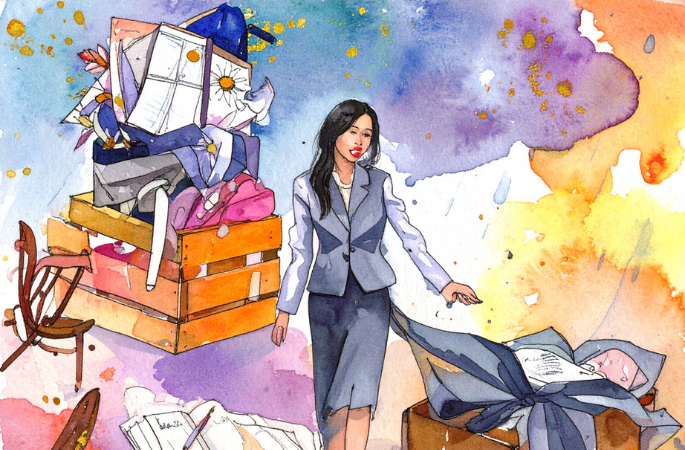
Aaron explained that she ran fleets of vans across the city, delivering things people didn’t want to carry themselves. She specialized in burdens. And was rather proud of it. Refrigerated units for pharmaceuticals. Reinforced vans for high-value electronics. Coded crates for unnamed clients. She operated like a ghost with a clipboard.
In fact, even the logistics of her parents’ diner — the one that always fascinated her as a young boy — was now managed by her firm.
Without any fanfare, she had optimized supply chains, ensured deliveries, rerouted and managed waste. Sustainable commerce was her mantra. She never overtly said she cared. Her taut face was inscrutable. Her chic business suits made her look every inch a dynamic hustler. But the grease traps stopped overflowing and the kitchen staff got health insurance. To her own office staff, she was an awe-inspiring combination of enigma and empathy.
Aaron featured on almost all the widely read trade journals of the country. Morris once called after reading one such article that eulogised her journey.
“You’ve done well for yourself,” he said stiffly. “Must say, you’ve made me proud. I think it’s time we put you back in the will.”
“No need,” Aaron replied curtly. “Let it go to the twins. I don’t have too many expenses.”
Morris never called her again.
****
Once a month, Aaron would bring her mother home for dinner. Only her mother. It was like a ritual where she always cooked herself. The old family recipes were remembered and revived – buttery crab, fresh oyster, roast turkey with a rich au jus, green beans in a creamy mushroom sauce with a staple of cornbread and a side of grilled asparagus. Dessert was almost always a pie – apple or pecan – often served with decadent chocolate pastry. Hannah loved their local craft beer, and Aaron never forgot to bring that to the table.
They never talked about the past. Between the clink of their designer steins and the crunch of oyster shells, Hannah tried asking her about what transpired during those missing years…those two decades of complete disconnect.
Aaron simply replied, “I learned to carry things.”
“What kind of things?”
“Weight. Load. Burden. After all, someone needs to carry it…and move it from one place to the other.”
“But why only you, Aaron?” The tears gently slid down Hannah’s lined, weary face. “Not all the world’s weight is for you to bear!”
Aaron immediately recoiled. Her mask of detachment was back in place. The rest of the dinner was done in silence.
Hannah realised how little she understood her child, her beloved Aaron. Even then, she waited for these evenings. They formed the only dash of colour in her monochrome life.
****
Postmodernism, they say, is about fragmentation, and deconstruction.
Aaron actually lived it.
She was a collage of selves—an uber sensitive child, a college dropout, a ghost son, a business savant, a closet empath, a mystery even to those who bore him.
She never married. She had no partner. Never kept pets. Neither travelled nor took vacations. Her apartment was minimalistic. No photos. No clocks. No décor. Only the basic furniture and essentials. Her wardrobe, however, could well be a fashionista’s envy. Her only indulgence was books, annotated with lines like “Truth is not symmetrical” or “Logistics is a metaphor for grief.”
When Jena got married, Aaron feigned illness. She sent her sister a washing machine with a crisp, handwritten note: “Come clean, always. Stains hurt.”
She did not visit Jordon when he was hospitalized with a fractured ankle. Instead, sent a courier with an elbow crutch and painkillers. The accompanying note read: “Avoid breakage. Not all cracks heal.”
The twins called Aaron ‘the myth.’ They loved her in theory. In practice, they were intimidated by her. Her quiet confidence and self-made success gnawed at their ego and inherited glory.
****
A few years later, a night watchman of Aaron A Movers Inc died on the job. Burnt critically while trying to douse a minor fire in their warehouse. Aaron shut down operations for three days. Attended the funeral. Paid the entire school fees for the dead man’s daughter. Arranged a decent job for the wife.
She came home exhausted, penitent, and stared at the wall for four hours. Then she cooked mushroom and tenderloin the way her mother liked, and called her over.
When Hannah arrived, she touched Aaron’s hand tenderly and said, “It’s okay. You don’t need to carry everything.”
Aaron smiled faintly. “I don’t carry. I move.”
****
In her final year, Aaron began to forget things. It was gradual, subtle — a missed pick-up here, an unprocessed invoice there. Daily vitamin supplements left untouched on the tea table. Nothing easily noticeable. Her long-term assistant, Rumi, noticed first. “You okay, Alicia?”
“Just tired,” she said. “Brain fog. Need to go for a run.”
But it grew worse. She walked into the wrong building once. Forgot her own name at a delivery checkpoint. Couldn’t remember her credit card details after dining alone at an upmarket eatery.
The neurologist called it early-onset cognitive decline. Possibly genetic. Certainly irreversible.
Rumi silently witnessed the decline. If it shattered her loving heart, she didn’t show it. Who in the whole world understood Alicia better than her, she smiled wryly to herself. But for Rumi, it was always dignity first. Love could wait. And in any case, when did love ever matter to Alicia?
On her part, Aaron didn’t tell her family. The anxiety, the uncertainty, the wait – they didn’t deserve to go through an encore.
Instead, she started writing. Not memoirs, not letters, but lists. With quirky headings and off-the-wall content.
- Things I Meant to Say
- Things I Chose Not to Feel
- Things That Felt Like Love but Weren’t
She emailed Rumi detailed instructions. What to do if she stopped showing up. Who all to pay. Which charities to support. How to dissolve their organisation.
“Make it clean,” she wrote. “Make it vanish. Like it never existed.”
****
It had rained heavily that evening, the first showers of April. Hannah had stayed back with Aaron for the night, an unusual departure from routine for both. The lawns smelt of petrichor. Aaron died alone in her garden chair, a DIY book in hand. It had barely been a week after her 48th birthday.
No note. Just a kettle still warm and a notebook on the mantlepiece open to a page that read:
“I carried all your weights. None of you asked me to. That’s what made it heavier.”
Aaron’s mother found her. She didn’t cry. She folded her shirts, packed the books and files. Sent them to Peace Villa in an Aaron A van. The rest, she left for Rumi to decide.
At the funeral, Jordon read from Ecclesiastes. Jena read Pablo Neruda. Hannah sat quietly and listened intently. Morris looked bored. Rumi wore thick dark glasses and said nothing. She just followed what was mentioned in a typed list titled Instructions for Dispersal.
Each guest received one item: a photo of their pick-up truck, a laminated business card, a quote from Kafka, a blank delivery invoice, an old get-well-soon card, and so on.
No one understood the pattern. But somehow, it felt like Aaron Alicia. The same mystery, and that bizarre sense of humour. Unmistakably her.
The staff appeared genuinely crestfallen. They spoke about Alicia’s unfinished life, the words she never said, her empty office couch, the small birthday celebrations she organised at work.
It felt weird to Rumi, talking about Alicia in the past tense. She was grateful for her dark glasses.
The company folded. The Svenson diner got sold. The flat remained untouched for months. Dust settled like punctuation.
There was no final message. No hidden revelation. No stranger came by to stake a claim.
It wasn’t Aaron’s death that hurt so bad. It was only her absence. And the trespassing memories, the loss of hope, the goodbye written before long anybody was ready.
A kind of emptiness that didn’t ask to be filled. Only insisted on being acknowledged.
Aaron A.
A for Anonymous.
A for Absent.
****
Years later, Jena wrote a personal essay called ‘Brother Unboxed.’ It won awards. In it, she said,
“I still think of Aaron as a brother. The brother who believed in fluid movement more than static presence. His absence spoke louder than his presence. He didn’t aspire to be known — he lived to lighten, redistribute, disappear. He was antithetical to legacy. And yet, in every box we now unpack, in every system we take for granted, I see his fingerprints. Not like a signature, but like weight removed. In fact, when the weight of living as Aaron became too heavy, he stripped himself of it and became Alicia. Another deadweight erased!”
Meanwhile, in some forgotten corner of the Internet, a logistics start-up carried his model forward. They called themselves Aaron Beta. An elusive woman in dark glasses ran it from home.
Their tagline: We carry. So you don’t have to.
***

Wow that’s a brilliant story. Loved it.
Congratulations Urmi Chakravorty.